
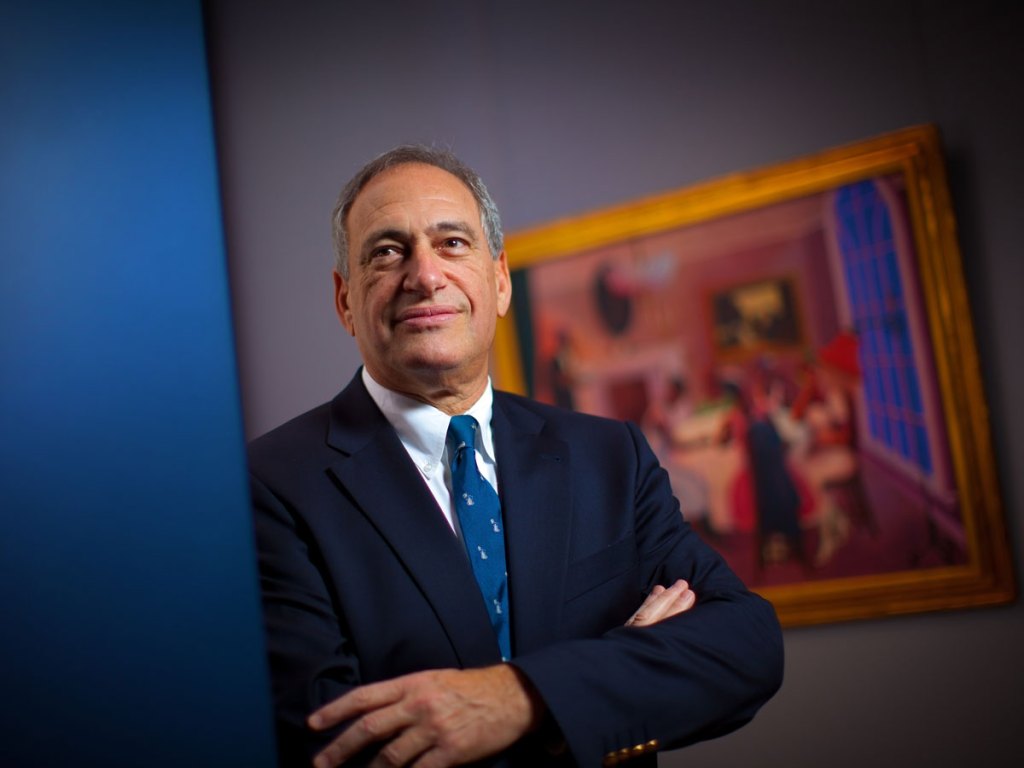

John P. Axelrod, a prominent collector and retired lawyer, died on Saturday, January 3. He was killed in a hit-and-run incident in the Boston neighborhood of Back Bay, where he had a townhouse. He was 79.
According to a report by Boston.com, prosecutors allege that the suspect “intentionally” hit Axelrod, who was walking his dog on the Commonwealth Avenue Mall. Around 8am on Saturday, the suspect, later identified as William Haney, 42, drove onto the pedestrian mall and struck Axelrod before fleeing the scene, according to police. Axelrod was taken to a hospital where he later died. His dog, Tale, was killed in the crash.
Related Articles

Haney has been charged with one count of murder and one count of animal cruelty. He turned himself into police after charges against him were announced on Sunday after police located his vehicle in the Boston-area town of Brookline, according to the Boston Globe.
Axelrod, who collected American painting, African American and Latin American art, and the decorative arts, was listed on the ARTnews Top 200 Collectors list from 1997 to 2000. His first purchase was a seascape of Glouster, Massachusetts, when he was still a teenager from the artist, who was painting on the wharf. Axelrod later became interested in collecting seriously when he was a law student at Harvard in the late 1960s, purchasing an art deco tea set by Gene Theobald for $45.
At the height of his collecting, the works in his collection ranged from multiple paintings by Paul Cadmus, Jared French, and George Tooker to a 1938 plaster sculpture by Cesare Stea that was commissioned by the WPA to a group of works by Latin American Surrealist group El Grupo Orion, according to a 2002 article in Antiques & Fine Art magazine. While his collection mostly hewed toward figurative work, Axelrod also owned a black-and-white abstraction by Norman Lewis, entitled Every Atom Glows (1951).
“There is not a collection to compare with John Axelrod’s,” Jonathan L. Fairbanks, a curator emeritus at the MFA Boston. “In a few words, it is the best of its type. What is more, John is a well-read student of his material. He researches what he collects—he knows a great deal about the modern era and the artists whose work he owns. Is John a compulsive collector? Well, yes, in the best sense of the word, for he has a passion to own and to know.”
Axelrod was a major patron of the Museum of Fine Arts, Boston, having donated more than 700 works from his holdings to the institution over the course of several decades, beginning in 1985. Those donations included his holdings of work by African American artists and 20th-century European and American decorative arts. A gallery in the MFA’s Art of the Americas Wing was named for him in 2009 and he was an honorary adviser to the museum.
“A generous supporter and passionate advocate for underrepresented artists, John had been a part of the MFA family since the 1980s,” the MFA Boston said in a statement to Bostom.com. “His legacy will live on at the Museum through the John Axelrod Collection—a transformative acquisition of nearly 70 works by Black artists.”
Axelrod first began collecting the work of African American artists after seeing the 1993–94 exhibition “African-American Art: 20th-Century Masterwork” at Michael Rosenfeld Gallery in New York. In an interview with Maine Antique Digest, he described the gallery’s founder, Michael Rosenfeld, as “a very important mentor.” In that article, Rosenfeld recalled that Axelrod became “very emotional” upon seeing the exhibition and not recognizing the names of any of the artists. He soon bought five works from the exhibition and would continue to deepen his holdings in this area for the next two decades.
“He had an incredible eye and instinct that we don’t see often,” Rosenfeld told ARTnews in a phone interview Monday. “He didn’t care what anyone thought about the art he collected. He just followed his heart. He was the very rare individual who had taste and integrity, which is very unusual, especially when you look at the art world now. He was from different era.”
In 2011, the MFA Boston acquired 67 works—39 paintings, 10 drawings, and 18 sculptures—from Axelrod’s collection of work by African American artists, reportedly selling them to the museum for between $5 million to $10 million. Among the works were the Lewis abstract painting, Hale Woodruff’s Big Wind in Georgia (ca. 1933), John Biggers’s Shotguns (1983–86), Beauford Delaney’s Greene Street (1940), Archibald J. Motley’s Cocktails (ca. 1926), and Sargent Claude Johnson’s Mask (1934), the latter two of which featured in the Metropolitan Museum of Art’s 2024 exhibition “The Harlem Renaissance and Transatlantic Modernism.”
“The museum wants the collection because you can’t have a great collection of American art without some of these artists. Period. End of story. You can’t have a great Abstract Expressionist collection without Norman Lewis,” Axelrod told Maine Antique Digest at the time.
In addition to his patronage of the MFA Boston, Axelrod was also a supporter of the Yale University Art Gallery (YUAG) and the Addison Gallery of American Art at Phillips Academy, both of which are affiliated with his alma maters. Throughout the 1980s, he donated more than 300 American prints to Yale, which mounted an exhibition tied to a 1980 donation in 1983. Beginning in the 1990s, he would also shore up the YUAG’s collection of American decorative arts, donating around 50 objects to that department, including “textiles by avant-garde designer Ruth Reeves, examples of modernist housewares and furniture, Funk ceramics, and contemporary glass,” according to the museum.
“John Axelrod was an extraordinary and visionary collector, often celebrating areas of art history long before they were fashionable,” John Stuart Gordon, a curator of American decorative arts at YUAG, told ARTnews in statement. “The diversity of his collections mirrored his insatiable curiosity. He relished the hunt for objects, as well as getting to know the makers and their families. Every gift to the museum was accompanied by stories of how he acquired each piece, the people he met in the process, and whatever colorful hijinks ensued. He loved creativity of all stripes and encouraged others to love it as well through supporting museums and educational institutions.”
To the Addison, Axelrod gave photographs by PaJaMa and Peter Hujar, paintings by George Tooker and Ralston Crawford, works on paper by José Bedia and Paul Cadmus, and an assemblage by Betye Saar. While his patronage of the Addison dates back to the 1990s, several of his donations to the museum where made in 2024 and 2025. He collaborated with the institution on exhibitions and installations focused on Art Deco silver, 1980s New York City street art, magic realism, and Precisionism, and he recently gave funds to establish the John P. Axelrod (PA 1964) Acquisition Fund there.
“The Addison Gallery was fortunate to enjoy a close and enduring relationship with Phillips Academy graduate and vanguard collector, John Axelrod (PA 1964) as a benefactor, mentor, and most importantly, friend,” the Addison Gallery said in a statement to ARTnews. “Over the course of many years, the museum’s exhibitions and collections were significantly enhanced by John’s notoriously keen and prescient eye and deep knowledge and connoisseurship. Guided by his motto ‘Buy only what you love,’ his passion for art knew no bounds, encompassing an astonishingly wide range of media and time periods.”
By the time of the 2011 MFA sale, Axelrod had turned his attention to collecting work from New York’s East Village scene, dating from 1980 to 1984, with a particular focus on graffiti art. In December 2022, Christie’s offered 26 works from Axelrod’s collection as part of an online auction, titled “Loisaida: 1980’s Graffiti and Street Art from the John P. Axelrod Collection.” The sale included works by David Wojnarowicz, Martin Wong, Peter Hujar, Rammellzee, Daze, Lee Quiñones, and Luis Frangella.
“The Axelrod collection is important not just for the artists who are in there but for the quality of the work,” critic Carlo McCormick said in a video produced for the sale. “It was bought at a time when, I suppose, it was undervalued. A lot of this is really early work from these artists who are now what we can call legends.”
Axelrod’s approach to acquiring new work was rooted in doing deep research into the various areas he collected. “I first ask myself questions: Is the work good and is the artist respected in his field? (I get books on the subject and read them, so I know all about the subject.),” he told the Observer in 2015. “I want to know, is the price a good price, and there are sources of sales price information that I check. I ask myself, ‘Is there anything else I’d prefer to spend that amount of money on?’ And, most importantly … I ask myself: ‘Do I love it?’ It’s a kind of gut check, and if the answer is no, well that’s the end of the discussion. You move on.”
Updated, January 5, 2026, at 2:30pm: This article has been updated to include an interview with dealer Michael Rosenfeld and a statement from the Addison Gallery.
Updated, January 5, 2026, at 3:25pm: This article has been updated to include a statement from Yale University Art Gallery curator John Stuart Gordon.