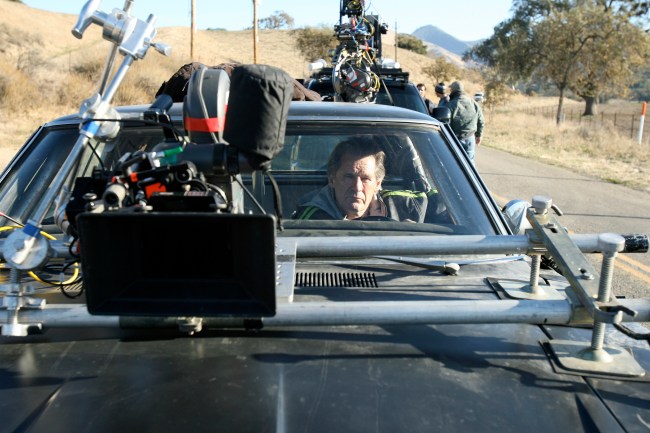

As the man who served as Kurt Russell’s stunt driving double on Quentin Tarantino’s “Death Proof,” Buddy Joe Hooker deserves Hollywood canonization. There are few modern films featuring car stunts as impressive as those he choreographed and performed in Tarantino’s imaginative, high-octane exploitation tribute.
Yet Hooker’s work on the film was less a benchmark in his career than a culmination, capping more than 50 years of extraordinary efforts as a stunt performer behind the wheel, on top of a horse, from the crow’s nest of an oil derrick — you name it, he’s done it. That pedigree is what made him the perfect co-curator for the Criterion Channel’s capsule collection, “Stunts!” Featuring “Death Proof” plus Hooker’s other standout work, such as “The Hunted,” “To Live and Die in L.A.,” and “Hooper,” the collection spans a century of films showcasing one of the medium’s most enduring traditions: making stunt performers risk life and limb for the audience’s entertainment.


To commemorate the release of “Stunts!,” Hooker spoke to Indiewire about the films featured in the collection, which also includes Buster Keaton’s “The General,” William Wyler’s “Ben-Hur,” Peter Yates’ “Bullitt,” and Jackie Chan’s “Police Story.” Reflecting on the work he’s done himself and inspired from others (including Hal Needham’s “Hooper,” a fictionalized account of his stuntman heyday), Hooker talked about his origins as an actor, the psychology of stunt men and women willing to defy death, and the collaborations that led him to break records or otherwise do some of his most memorable work.
This interview has been edited for clarity and length.
IndieWire: Looking at the “Stunts!” collection on Criterion, do those films offer specific benchmarks, or are there ones in there, notwithstanding “Hooper,” at least partially inspired by your life, that were very influential or inspirational for you or the industry at large?
Buddy Joe Hooker: There’s definitely some. To start off with, you’ve got “Bullitt.” Looking back on it, it’s like “Mary Poppins” doing these little two or three-foot jumps [over the hills in San Francisco], but it was the first one, and it was very innovative. The next notable one was “The French Connection,” with Billy Friedkin. Now, it was more of a genius of editing because there wasn’t a lot of car stunts in there, but again, it was the first of its kind. Then we did “To Live and Die in L.A.,” which I coordinated with Friedkin again. We did some very innovative things on that that had never been done before that everyone started using, [with] cars going against cars. Then you had [John Frankenheimer’s] “Ronin,” all those films. And I think the European stuntmen took a lot of what we were doing and adapted it very well to their cinematic ventures. So yeah, there were some huge milestones.
I understand your father was a stuntman, but you started as an actor. When did you discover that you preferred stunts to on-camera acting?
Actually, it was just the opposite. I started to do stunts. I did my first stunt when I was 13, so that was 70 years ago. I was working on a TV series called “Rin-Tin-Tin,” and I worked on that for two or three seasons. My father had been a Western stuntman for years, had a great career, and went into stunt coordinating. And he didn’t want me to follow in his footsteps, because at the time, the only thing that was happening was Western stunts — and they were brutal. It was like the caveman era of the stunt world before it evolved. So my father wanted me to be an actor, so I did that up until I was probably in my early 20s. And then I decided that I wanted to follow my real passion, which was stunt work.

They say that you get courage from doing the things that you’re afraid of. Do you remember having nerves about a stunt early in your career and then figuring out a way to get over it so you could take on these incredible challenges?
When I first started, I was young, so fear wasn’t anything that I realized, basically.
You were young and dumb.
I was having a lot of fun, jumping off rocks, knocking Indians off horses, all that kind of stuff. Later on in my career, when I started trying to transition from actor to stuntman — back in those days when there was no social media, none of that kind of stuff — the way you got a reputation was by word of mouth. So there was a group of us that were coming along, and all of us had the same mindset about searching out the craziest kind of stunts that were available, that nobody else wanted to do, and we would look for those. Some of those things [were] the first time I ever felt any fear whatsoever. And looking back on it, I think the fear was generated by the fact that I wasn’t really secure about what I was doing as far as my skill set.
Can you remember a specific example?
I’m up there diving off of an oil derrick, 95 feet tall, into an 18-by-20-foot airbag, which looked like a postage stamp. Just climbing up there, the fear took hold. I think it’s a normal thing. Anybody that doesn’t get afraid of those kind of things is crazy. But what I learned to do quickly was to understand, “OK, this thing could kill me.” So I’d say, “Thank you, fear. You’ve taught me a very valuable lesson here.” Because when you’re doing very high-profile, life-and-death kind of things, you really need all the concentration you can get to accomplish what you need. So if you’re standing on the side of that oil derrick and 50 percent of your mind is consumed with fear, you only have 50 percent to work with. So I learned that in smaller ways way before I got on the oil derrick, but fear is always something that’s going to be there. You just have to know how to deal with it.
In the featurette about you on the Criterion Channel, you said that you particularly love the barrel roll. I remember when “Casino Royale” came out, the filmmakers claimed they broke a world record for the number of barrel rolls.
We don’t call them barrel rolls; we call them cannon rolls. The way that these stunts are initiated is that you actually have what amounts to a cannon sitting in your backseat — in the old days, a black powder charge on it — and a button that you have in your hand. And when you get the car wherever you want it to be, you hit the button, there’s an explosion, and this cannon throws you through the air. That’s why I like to refer to it as a cannon roll. And it was not “Casino Royale.” It was a John Wayne film [“McQ”]. It was the first time that there was ever a cannon used in a car.
Whether or not they’re right, when you learn about some record set, do you ever feel jealous that you weren’t the one to get to do it yourself, or does that news just set the bar higher for you in the future?
It makes you jealous in a very constructive way. Still, I’ve never heard that. I’ve been told, with trying to keep my humility intact, that I’ve done more cannon rolls in the film industry than any other stuntman. I think that I would be aware of “Casino Royale,” and when we’re finished, I will look that up. But they just did a film called “The Fall Guy.” And one of the main stunts in that was a recreation of the stunt that [“McQ”] did. It was on a beach and all of that, and they were trying to break the world’s record, which was supposedly, at the time, nine rolls, and they did 10. I was a little upset about that — not jealous, but pissed off. I’m sure I have done rolls that are on film that I have yet to go back and look at because the stuntman that did that film, Logan Holiday, is a very good friend of mine, and I don’t want to blow his whole thing about thinking that he holds the world’s record.

The first movie that I rewatched in Criterion’s “Stunts!” collection was “Hooper,” and it’s not just a great film about stunts, but a great film. Was that film conceived out of stunts that you’d already done, or was it a way to create a wish list for stunts that you wanted to find a way to do on screen?
“The Fall Guy,” to me, was not a movie about stuntmen. It was kind of a love story, and it had some stunts in it, but it told nothing about who a stuntman was or why he did what he did. “Hooper,” I’ve been told, was about Hal Needham, who was [originally] Burt Reynolds’ stuntman, and myself, and our development through our careers. As a stunt coordinator, Hal gave me one of the first good stunts I ever had in a movie way back in the ’60s, on a remake [by director Douglas Heyes] of “Beau Geste.” The only reason that I got the job was not only did I pester Hal to death, but he was a very good friend of my father’s. So I asked my father to ask Hal about giving me a job as a stuntman on the film. That became a thing in the film, when the director insists that Ski [played by Jan-Michael Vincent] does the stunt. That’s the worst thing you could do to a stunt coordinator, to insist to somebody that they don’t even know or know about their qualifications, is going to do a stunt in their movie. All of those correlations through Hal and my relationship is how [the story in “Hooper”] developed.
I love how you think Burt’s character is going to be an enemy to Jan-Michael Vincent’s, but even though there’s clearly a rivalry, they become friends. How accurate have you found that in the stunt community, especially between stuntmen of different generations?
I found that to be exactly true, except that my relationship with Hal Needham took a while. The final straw was where director [Douglas Heyes] told him I had to do a good stunt on the movie. So Hal Needham, kind of pissed off, probably, gave me the biggest stunt in the film, where I’d fall off the top of this fort in “Beau Geste” through a burning rooftop. But after I was done with that and it came out perfect, our relationship was pretty solid. Had I not pulled it off, then it would’ve been a different story. But Hal Needham was one of those kind of stuntmen, that when you were working for him, you better go all the way — you better hit the ground as hard as you can hit it, or that gas pedal better be to the metal. Hal bragged a lot always about how many bones he broke in his body and how many times he broke his back, and all this kind of stuff, and I would tell him, “Hal, listen, you’ve got to quit saying that shit, because when you tell people that you’ve broken all these things, it sounds like you’re not really good at what you do, that you’re making a lot of mistakes.” And I know that’s not true, because over my career, I worked with Hal on pretty much every Burt Reynolds film that he did before we did “Hooper.”
I imagine you two had other differences.
I was from a weed-smoking culture, and he was from the stuntman drinking culture. He was a horse guy, I was a surf guy. But we developed a great relationship over the years, and it was great. When we were doing “Hooper,” before we got to shooting, I had read the script. Hal gave it to me because he knew I was going to be working on that, so I saw all the stuff [he intended] for this young character, Ski, which I kind of surmised was me. So I went, OK… I’ve been doubling this actor, Jan-Michael Vincent, for four years now at Disney, doing all his stuff, like “The World’s Greatest Athlete.” So I went, “If I can get Hal to cast Jan in the part, I’ll get to do all of those stunts.” So I set up a meeting with Hal and Jan. Hal loved him, thought he was perfect for the role, and voila, I got to have the most fun I ever had on a film. It’s the only film that has ever been made that really told about who we are as stuntmen and what we do. They didn’t have a lot of time to tell everything, but it was right on. You had the director in there that everybody hated, and I’ve been through that many times. But working on it was great.

Are there pivotal moments you remember in the industry changing how you do what you do — where the movie industry implemented a new standard or a new technology came along that fundamentally altered what you did?
Looking at the evolution of stuntmen and women, there’s a lot changed but very little change as far as their mindset went. I mean, what our goal was back then was to always be looking for innovative ideas, to search out stunts that had never been done before, and to take risks — ones that we thought we could get away with, anyway. All of that kind of thinking is fully ingrained in stunt people now.
What were some of those changes?
The big transition, I think, was when Western films stopped being popular and the transition to high-impact car stunt movies. So one of the main evolutions, as I saw it in the stunt world, was that we had to learn new skillsets. Motorcycles were becoming a big deal. The motorcross world had just invaded the United States. The Europeans were coming over here, and they had all of these lightweight two-stroke bikes that would do everything. So there was a whole new technological invasion. Everybody wanted to learn everything we could about cars and how to make them do what we wanted them to do. If they wanted a 90-degree slide, how do you do that? Well, we went and rented Hertz cars, and we would go off and to find a parking lot and do slides all day long until we wore the tires off so bad they quit renting cars to us.
I can understand why.
And Hal Needham was very innovative as far as that goes, because he had Burt and they were doing “White Lightning” and “Gator” and a lot of car work, “Smokey and the Bandit.” So with Hal’s help, our little group started learning more than everybody else knew. We started implementing ramps and all of these kind of things that started adding huge, huge new assets to car chases. Speaking of car roll records, my friend and I had just done a film called “Hell’s Angels ‘69” with the real Hell’s Angels, and the producer on that was doing another film [with directors Lane Slate and Tom Stern] called “Clay Pigeon.” We had heard through the grapevine that they were going to roll this pickup truck down a huge, long sand dune, so we’re going, “Maybe we can talk them into the two of us doing this thing,” because we were wanting to break some records. I think the world’s record at that time was 10 rolls on assist without ramps. So we go talk to them and say, “Hey, we’d love to do that pickup truck stuff.” But they go, “No, we’re going to just push it over with dummies in it because we don’t have the money to pay your stunt adjustments or have something in there [like] a proper roll cage.” So we said, “How about we be the dummies, and we will drive that thing.”
Again, young and dumb.
They go, “Well, we don’t have any money.” And we go, “How about $500 apiece?” And he goes, “Great, done deal.” As it turns out, the truck did 22 rolls. [Fact check: Footage actually indicates the number was 17.] That is a world record, never been beat. Back in those days, we should have done the world’s record and had it recorded and all that kind of stuff, but we didn’t really give a shit about that. We just were very stoked that we got to put our names on everybody’s lips for about a month.
The “Stunts!” collection is now streaming on the Criterion Channel.