
inside symbols and social ritual in ga-adangme funerary culture
In her book Buried in Style, Swiss anthropologist and photographer Regula Tschumi documents Ghana’s funerary traditions, exploring how ritual objects, figurative coffins, and commemorative practices translate grief into form, color, and collective memory. For more than twenty years, Tschumi has been returning to southern Ghana, following Ga-Adangme funerary culture as a living system of images, symbols, and social rules. What initially appeared as a striking visual phenomenon unfolded slowly, almost reluctantly, into a much broader cultural language. ‘It went step by step,’ she recalls during our interview. ‘When I started, there was still the idea that these coffins were ”invented,” and I didn’t question it. I believed it.’ Only through time, proximity, and trust did that narrative begin to unravel.
Discussing with designboom, Tschumi reflects on long-term fieldwork, ethical representation, and how death rituals function as social and visual continuities.
Early encounters with coffin makers such as Paa Joe and later Ataa Oko shifted her understanding decisively. Ataa Oko, who was already too old to build coffins, showed her drawings and photographs of works made decades earlier, quietly undoing the idea of singular authorship. ‘That’s when I started to doubt the stories I’d heard,’ Tschumi tells designboom. ‘Slowly, mainly through Ataa Oko, through his drawings, I started to connect with this society, the religion, the use of the coffins, and their story.’ The coffins revealed themselves as expressions embedded in belief systems, lineage, and social hierarchy.
all images by Regula Tschumi
figurative coffins and funeral rites in southern ghana
In Tschumi’s account, figurative coffins follow two distinct yet overlapping trajectories. Traditional families often choose restrained forms tied to totems or protective animals linked to family identity and spiritual power. ‘It’s more than a symbol,’ she explains. ‘It’s a totem, something that protects the family.’ Christian families, by contrast, developed a parallel language shaped by church restrictions and social boundaries, adopting playful or surprising forms instead. ‘They were not allowed to use the symbols reserved for the upper class, the chiefs, and the priests,’ the Swiss anthropologist shares with us. ‘So instead, they began to use playful motifs. They can even have fun with it.’ What appears whimsical from the outside is, in fact, regulated and deeply coded.
Buried in Style, brings these layers together through both photography and text by Regula Tschumi, treating funerals more like negotiated public events rather than spectacles. ‘Each funeral is different,’ Tschumi insists. ‘It depends on the family, the place, the budget.’ Dance, music, decoration, and even silence all have their place, but none are universal. The texts it the book situate the images within this shifting social terrain, tracing how coffins, performances, and roles evolve across generations. Read on for our full discussion with Regula Tschumi.
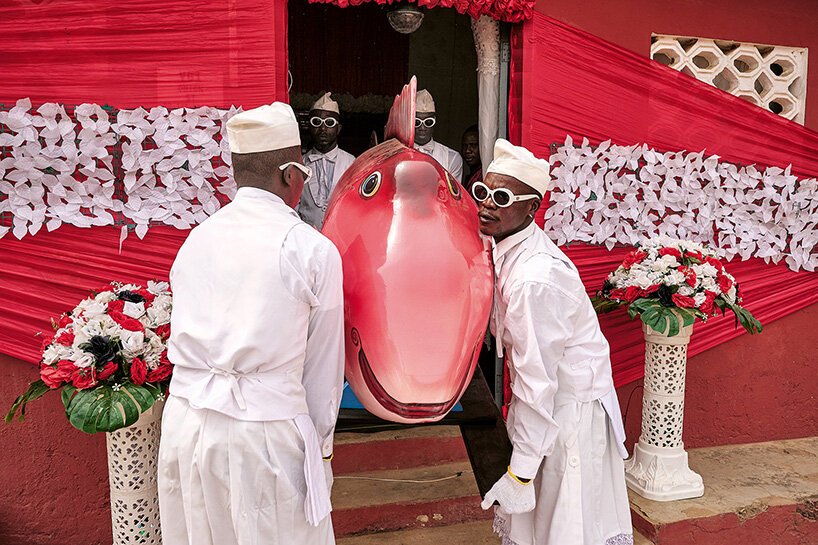
exploring how ritual objects, figurative coffins, and commemorative practices translate grief into form
in conversation with Regula Tschumi
designboom (DB): You’ve been researching and photographing Ga-Adangme funerary culture for over twenty years. What was the very first moment in Ghana that made you realize that this is a whole visual language that you need to follow
Regula Tschumi (RT): Well, you know, it went step by step. When I started, there was still the idea that these coffins were ‘invented,’ and I didn’t question it, I believed it.
The first time I was there, I was with Paa Joe, who was already famous in 2002. Then I discovered another artist, Ataa Oko. He told me he had been doing these coffins for a very long time, and he could even show me photographs of his old coffins.
That’s when I started to doubt the stories I’d heard, the idea that the coffins were the invention of a single artist.
Slowly, slowly, mainly through Ataa Oko, through his drawings, because he was too old to do coffins, I started to connect with this society, the religion, the use of the coffins, and their story. It came gradually. From one thing to the next, I discovered that everything I had believed was different.
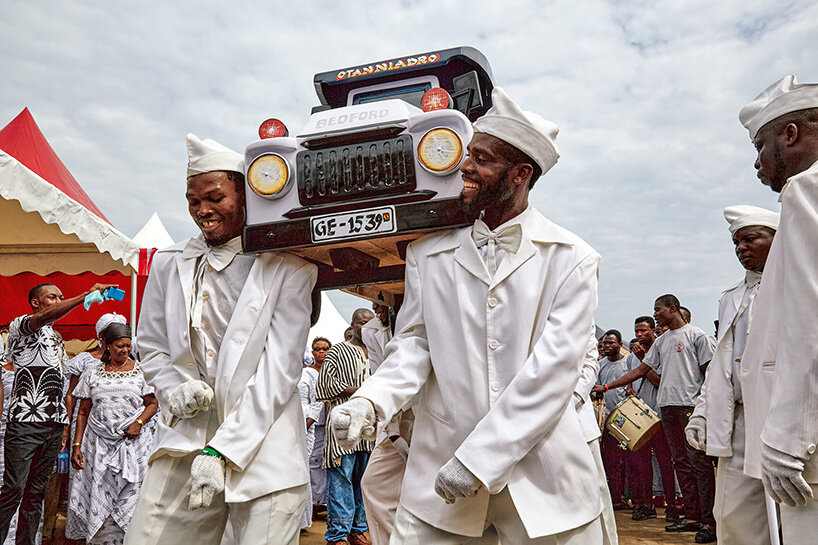
following Ga-Adangme funerary culture as a living system of images, symbols, and social rules
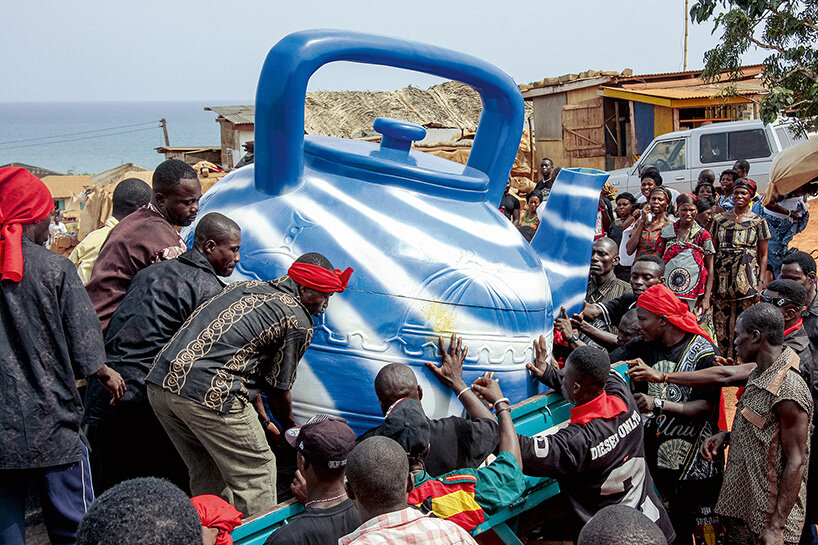
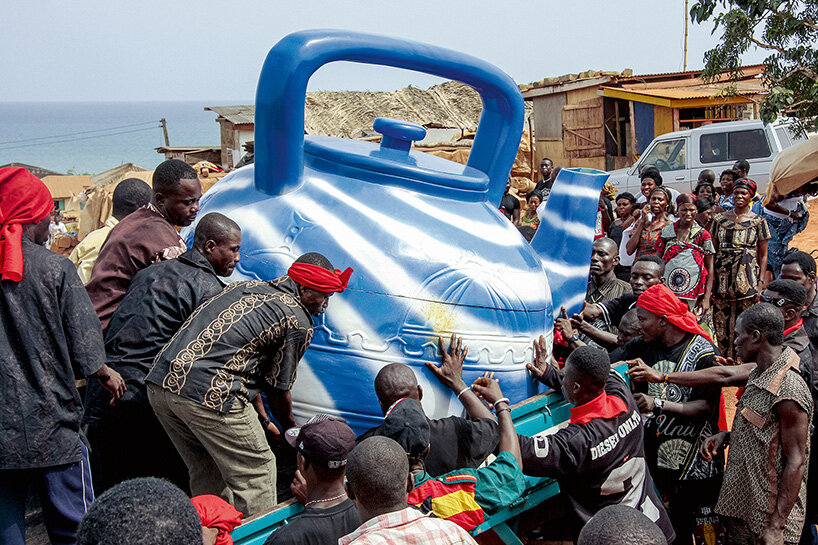
DB: These coffins are built to resemble teapots, fish, trucks, shoes. In your experience, what do they communicate most precisely about the deceased?
RT: You know, there are two different directions in these coffin designs among the Ga. One can be very reduced and simple, that’s linked to priests and traditional people. For them, the coffins began as extensions of their house symbols. Some families, for example, may have a lion as a house symbol. And it’s more than a symbol, it’s a totem, something that protects the family. It’s not like a civic emblem. In Bern, we have the bear as a symbol, but it doesn’t carry a religious meaning. For them, it does.
The other direction is Christian families, who have taken over these symbols, or the idea of using them, from the traditional people. But they were not allowed to use the symbols reserved for the upper class, the chiefs, and the priests. So instead, they began to use playful motifs. They can even have fun with it. A Coca-Cola bottle, for instance, is a way to surprise the mourners, but it’s not connected to a deeper religious meaning. So you have these two directions.
And then there are coffins that can be almost anything the family invents, finds interesting, and wants to use to surprise the mourners. But they could not choose a lion or an eagle, you see. That’s the difference.
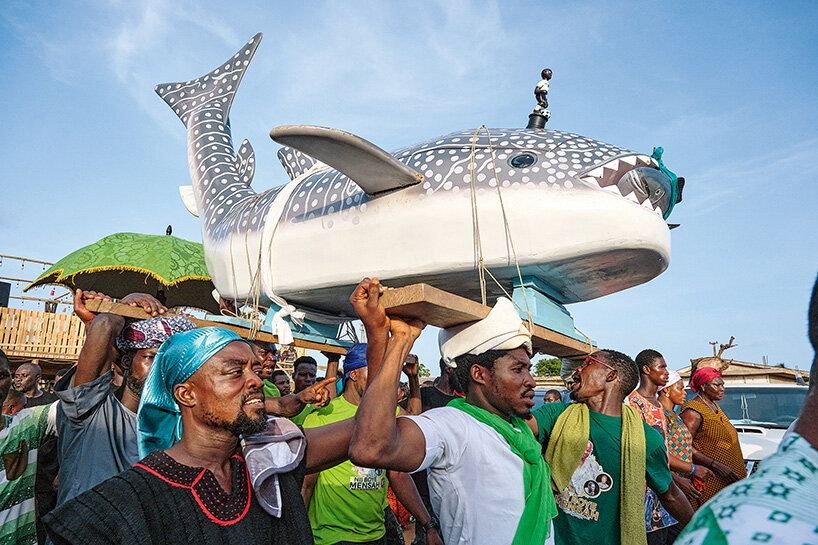
treating funerals as carefully negotiated public events rather than spectacles
DB: So they come up with the design right after the person passes away?
RT: Well, it also depends. Usually, the family decides what kind of coffin is going to be used. For traditional people, it can be the family symbol or something connected to a deity or an animal with power, like a lion or a leopard. For Christian families, though, it’s often the church that sets the limits by choosing the coffins they allow in their communities. Then the family goes to the coffin artists and discusses what’s possible. So the final design is always a compromise between the ideas of the family and the artist and what the church permits.
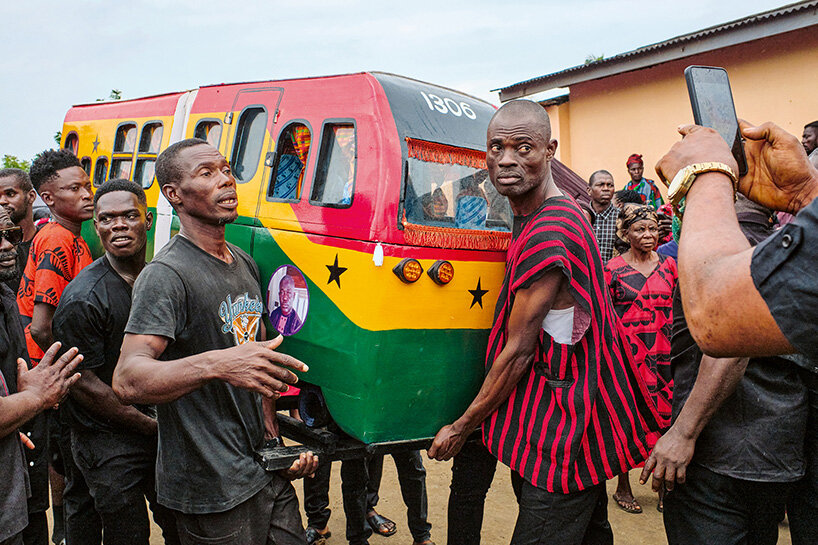
tracing how coffins, performances, and roles evolve across generations
DB: Your book frames funerals as carefully staged, multi-day public events that protect a family’s reputation and shape relationships with future ancestors. Can you walk us through the social logic of ‘putting on a funeral’?
RT: This also depends on what kind of funeral you are doing. It depends on where the funeral takes place, in which area, and it depends on the family and the budget. So you cannot just say all funerals are like this or like that. It’s a bit like in our culture, too. We have different ways of doing funerals. And in Ghana, if they have money, they try to surprise the mourners and make something special. It can be that they engage a cultural group to perform. It can be that they call somebody special to do the room decoration. But it also can be very, very simple. They just go to the church, bring the coffin, load it on a car, and bring it to the cemetery. So each funeral is different.