
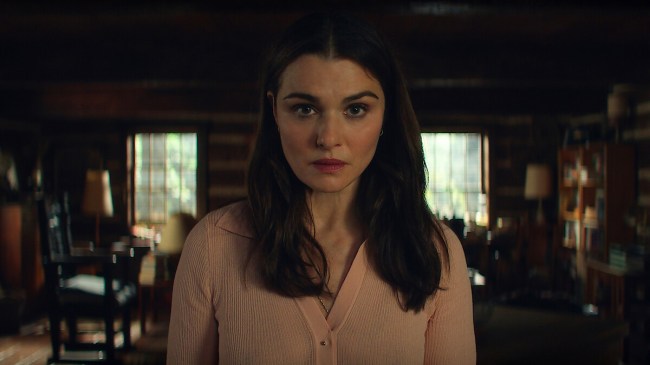

Two decades on, the #MeToo movement is still fresh fodder for cultural fare, even if its founding principles have fully fallen by the wayside. One of the latest small-screen treatments of cancel culture comes from Julia May Jonas, a playwright and theater professor who tapped into audiences’ desire for a more pulpy take on #MeToo’s fallout with her hit 2022 debut novel, “Vladimir.”
After landing an offer from Netflix, Jonas dove headfirst into adapting her erotic novel, narrated by a fifty-something English lit professor who becomes obsessed with her strapping junior colleague amid a scandal involving her husband and a number of former students. Despite a lack of experience in the TV world, Jonas also signed on to executive produce and show-run the eight-episode series, produced by Sharon Horgan’s Merman and star Rachel Weisz. And as a result, the show — accompanied by some quite instructive poster art — stays true to the book’s lusty approach to ethically ambiguous relationships in academia.


When asked about whether, with a few years’ distance from her novel, she considered changing elements of her story or modifying its tone, Jonas made it clear that her interest has always been in making art, not championing a particular cause.
“Sexual dynamics and power dynamics that occupy gray spaces are going to be perennial in terms of our reckoning with [them],” Jonas told IndieWire of her interest in portraying a post-#MeToo-era scandal in higher education — a topic recently tackled by Luca Guadagnino, to very different results, in “After the Hunt.”
“I just don’t think, I guess, either the series or the book is a form of advocacy, because I just don’t think art is very effective at that. I’m more interested in a character reacting to that in a very specific way inside of individual circumstances and looking at her moral choices,” she said, explaining that she’s more keen to ask questions about people’s behavior than she is to offer up a criticism — or presumably a defense — of #MeToo.
So if it’s not an ambiguously toned drama obsessed with accountability, like Guadagnino’s latest — or a skewering weaponization of the movement, like Todd Field’s “Tár” — what can audiences expect from the new Netflix adaptation of “Vladimir,” which premieres March 5? Unrolling in eight, bite-sized episodes, Jonas’ first foray into show-running, put simply, is the TV equivalent of a page-turner, complete with an alluring cast who knows how to hold an audience’s interest.
Even more so than the novel, which was written during a friendlier era for higher education, the mostly lighthearted limited series is largely uninterested in the failings of academia and the ethics of student-teacher relationships, and instead focuses intently on the fantasies of its unnamed female protagonist (Weisz). In the background, the looming threat of her husband and former department chair, John (“Mad Men” cad John Slattery), being formally disgraced for his dalliances with students provides a steady source of conflict. (The public aspect, not the affairs themselves, is the source of contention there per the terms of their open marriage.)

But the pulse driving the 30-minute episodes forward is the protagonist’s constant ruminations on her younger self and on Vlad (“The White Lotus” breakout Leo Woodall), a fitness-conscious fiction writer of Russian descent who has just joined the department — partially thanks to the unhappy story of his attractive memoirist wife (Jessica Henwick).
Sacrificing the fourth wall in hopes of getting an imagined audience on her side, Weisz’s protagonist — who is fun to watch despite the star being questionably suited to a self-conscious academic who’s rekindling her sex drive – spends a fair amount of the series delivering these ruminations directly to camera. Like the even-less-reliable, but certainly no-less-impassioned, author of an Elizabethan tragedy, she regularly stops the action to vent about the drudgeries of upholding the image of the dedicated wife or to wax on about the glories of Vlad’s physique.
“We thought about it as, instead of a Shakespearean aside — where someone is, like, ‘Actually, this is what’s happening’ — what if we have someone talking to the camera but she’s always kind of spinning it in a way so that you don’t really know if that’s the truth or if it’s not the truth?” Jonas said, explaining that, with the series, she wanted to continue playing with the idea that, as her protagonist increasingly focuses on herself and her desires, she loosens her grip on what’s actually happening around her.
“The book and the series are so much, for me, about a very forceful perspective and how when we take on that perspective — which can be amplified by lust or by stress or whatever it may be — we can lose sight of reality, we can lose sight of other people, and we can lose sight of ourselves,” she said.
With not a lot of airtime to transition her protagonist from reasonable to out of touch with reality, Jonas relegated much of her character’s contemplative qualities to the asides and exaggerated her more base characteristics by adding in some reckless behavior.
Outside of her unwavering interest in her queer lawyer daughter (Ellen Robertson), who ends up getting roped into the scandal as well, Weisz’s character becomes increasingly unreliable as a person and a professional, making uncharacteristic moves like failing to write a recommendation letter and blowing off a former student and flame of John’s (Kayli Carter) who has brought a complaint. So that in a total of four hours, we see Weisz go from a put-together career academic who at least seems to have it all to a feral, middle-aged woman making a series of bad decisions — all in the name of tugging at the shirttail of a muscular, if overly assured, younger man.
“The book is structured in a way where there’s a lot of action in the beginning, then there’s almost like a period of reflection, and then there’s a lot of action in the end. There’s a lot of elision in the middle section, and I knew that I would need to address that,” Jonas said. “So in terms of, for example, bringing on the character of Lila, who was involved with John… That was kind of the idea of, ‘How do we keep twisting the wheel of pressure against this character in a way that is supporting what is almost a break for her, at the end?’”
But don’t think “Vladimir” is just a show about a woman spurred on by scandal and careening into a series of unwise, and even dangerous, decisions until it all finally comes to an end. No, Jonas’ protagonist has much more agency (and fun) than that — especially in sexual fantasies about Woodall’s character.
Leaning into the page-turning aspects of her story, which definitely got more than a few real-life middle-aged hearts racing when it was released, Jonas sprinkles in a healthy dose of brief but pulse-quickening daydream sequences that feature Weiz pawing at and being pawed at by a rakishly handsome Woodall. The scenes bring to life passages from the novel in which the protagonist pines for her colleague in more explicit terms, while delivering the bodice-ripping romance the show’s built-in audience expects.
“In terms of the intimacy, when it comes to the protagonist and Vladimir, it’s really quite tame. It’s a lot of imagination and a lot of longing and desire,” Jonas said of figuring out the visual language for bringing the book’s very female-gaze-focused brand of desire to the screen.
“We kind of found that as we went along in the shooting process,” Jonas said, adding that she “thought a lot about ‘The Age of Innocence’ … in terms of the kind of longing” she wanted to portray in the fantasy scenes — which show the characters locked in clandestine embraces, furtively pulling at each other’s garments before reality cuts in.
“To me, [it] felt like, ‘What could be better than someone who just wants you so desperately you don’t even have to take your clothes off for it…,’” she said, laughing and stopping herself from explaining any further.
“Vladimir” premieres on Netflix March 5.