
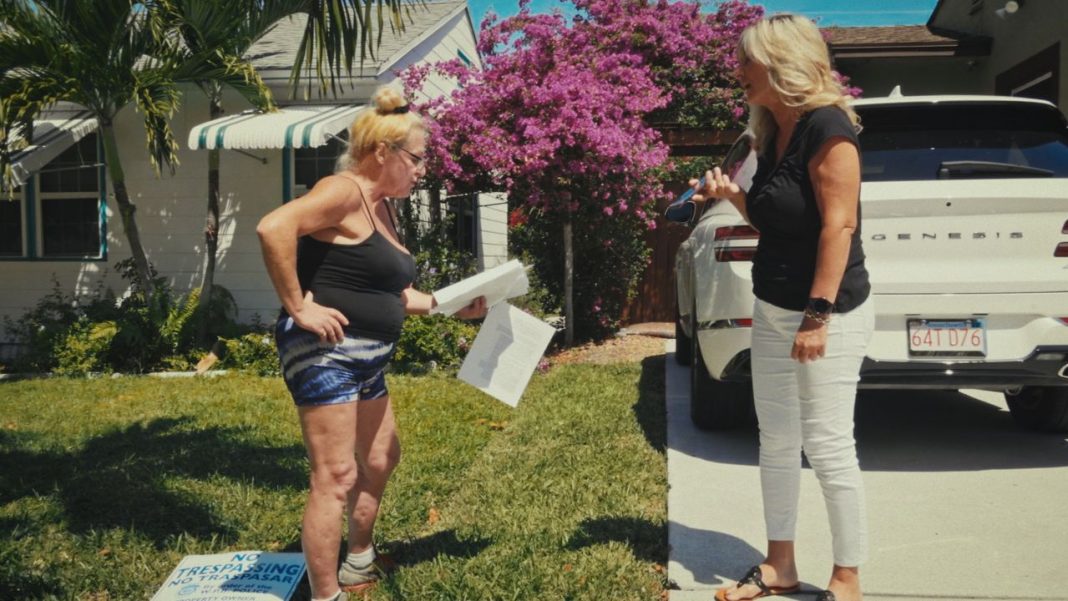

Sometimes, in a “Jerry Springer Show”-like twist, a character’s true nature doesn’t emerge until later on, forcing the viewer to swap allegiances. The third episode involves a story line in Palm Bay, Florida: Johnny, a former male dancer, has been feuding with Andy, a grizzled Vietnam vet, over lawn maintenance. (It seems that there’s potential for an entire spinoff series about Florida, or perhaps about grass.) Eventually, it becomes clear that Johnny is fully paranoid, having convinced himself that he is in a “Truman Show” situation where his neighbors are watching his every move. “I haven’t seen any of my family since 2012,” Johnny says, insisting that he’s unable to leave his house during the day. He adds that he has a step-aunt who lives in the neighborhood. “I don’t even know if she’s still alive.” We also discover that Johnny is obsessed with Ellen DeGeneres; he has attended several of her live tapings, deliberately placing himself next to a child in the audience under the assumption that it would increase his chances of getting photographed. (The gambit worked.) As the series continues—there are six episodes, four of which have already aired—it becomes more structurally ambitious, introducing conflicts within conflicts. I howled when a woman, in the middle of a rant about her next-door neighbor, got interrupted by a sound coming from her hallway: “There are two other individuals in my house that are what I call squatters,” she explains.
The most shocking aspect of “Neighbors” is probably how quickly the discord escalates to threats of violence. Not since “The Act of Killing” have I seen documentary subjects so eager to advertise their bloodthirst on camera. Andy, the Vietnam vet, threatens to throw acid in Johnny’s face. (“You’re going to be walking around like the Elephant Man.”) Johnny somehow manages to one-up him, suggesting that, if the show were to get him into trouble, he might kill the children of the documentary crew. Numerous characters show off their firearms; “I hope it’s unloaded,” one woman says, before pulling a gun out of her closet. Fishman told the Times, “In the beginning, we were like, ‘Hey, do you have a gun?’ They’re like, ‘Yeah, I do.’ As the season went on, we’re like, Everyone has a gun.”
Yet despite all the characters brandishing weapons, the only person in the entire series who seems capable of getting away with murder is Jeff Wentworth, a former Texas state senator who objects to an imposing wall that his neighbor Alexa has constructed around her property, in San Antonio. Jeff defeats Alexa and her wall, which he likens to “the compound where Osama bin Laden hid out,” without his pulse rising above sixty b.p.m.; he determines that Alexa ignored a city ordinance limiting walls to three feet, and he whittles her down with stop-work orders, before getting a final decision from the city that the wall must come down. One gets the sense that, for Alexa, the decision may be the defining trauma of her life; for Jeff, it’s just another item that he can check off his to-do list. By episode’s end, the wall is gone, and Alexa has put her house on the market.
Many of the characters seek the help of some kind of outside authority to adjudicate their neighbor disputes. We watch them make their cases to police officers, county commissioners, and zoning boards. Occasionally, they end up in court, with one demanding a restraining order against the other; one pair end up in front of Judge Judy. The most hilarious attempts at resolution involve the use of a mediator. In the first episode, the peacemaking mission between Josh and Seth, in rural Montana, completely falls apart, and the mediator—who explains that this is his first official mediation—mostly just stands there as the neighbors trade insults and issue threats. In the third episode, Melissa and Victoria meet with Stanley Zamor—a man we saw, earlier in the episode, selling Melissa a gun. “Besides doing this as a hobby,” he says, standing in front of a cabinet of Glocks, “I also am a Florida Supreme Court-certified mediator and qualified arbitrator.”
One watches “Neighbors” and can’t help but wonder, How did they find these people? I had a similar question while watching “How To with John Wilson,” and therefore wasn’t surprised to learn that the two shows share a casting executive, Harleigh Shaw. (“Neighbors,” which has the distinction of being the first unscripted series from A24, also counts Josh Safdie, and others from the “Marty Supreme” creative team, among its executive producers, which might have something to do with the series’ dynamic casting, as well as the generally chaotic, brash, and fast-paced nature of each episode.)