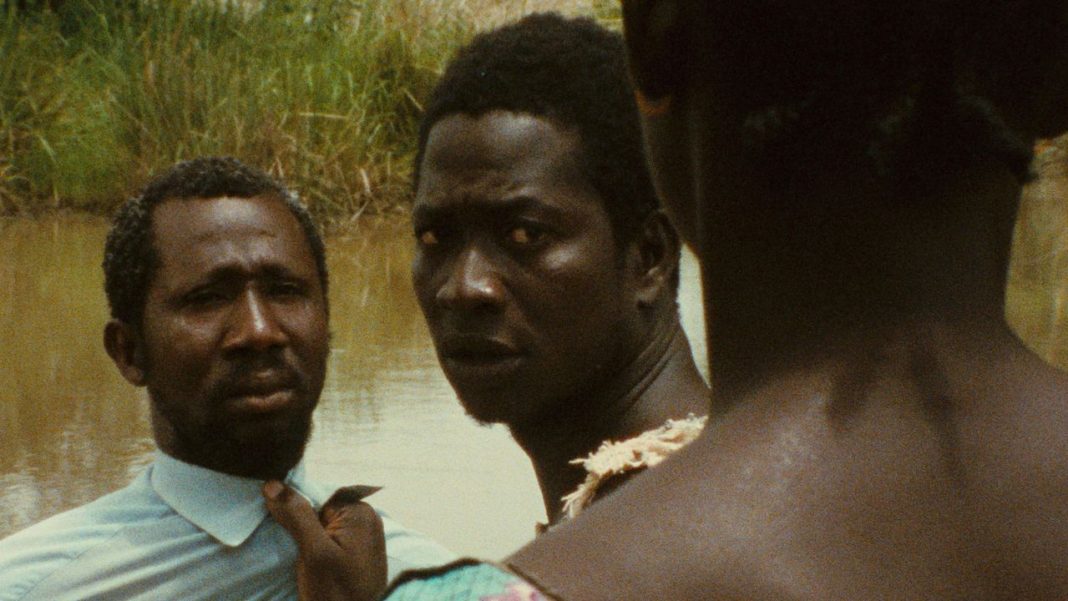

Though the movie is shot entirely outdoors and largely features people on the move, mostly in the countryside but also in several turbulent city sequences, Ouédraogo (working with three cinematographers) composes images with poise and concentration. Most of the shots, whether with fixed frames or fluid motions, suggest a camera set on a tripod. Although the drama has a quasi-documentary authenticity, the taut images convey a sense of thought along with action, as if the observed events were being discerningly excerpted not only for what they show but for what they imply. The peculiarity of Ouédraogo’s seemingly straightforward and classical practice is to evoke distances, conjuring wide spaces between the images—which is to say, between the characters depicted in them—and to bring those spaces to life. Avoiding documentary-like methods that presume to grasp events in large visual gulps, Ouédraogo offers visual fragments (however ample) that conjure a spectrum of experience that goes beyond what’s onscreen. Those unseen spaces have a kind of electrical charge, the power of bonds and conflicts, of underlying tensions and demands. His technique evokes a social sphere that’s filled with norms and rules, traditions and laws.
It’s a strange trope of modern cinema to film staged fictions with a camera that roves and prowls and reacts impulsively as if it were that of a documentary filmmaker plunged into unplanned and unpredictable situations. In its inspired and original forms, as in Shirley Clarke’s “The Cool World” and many of the Dardenne brothers’ dramas (“Rosetta” being a prime example), the sense of spontaneity and immediacy yields emotional intensity and symbolic resonance. But, like any method, this one risks becoming a mere habit, ossifying into a new convention both visual and thematic. (Visually speaking, I vote for a moratorium on using the Steadicam to follow characters, showing the backs of their heads as they walk.) And, thematically, the overuse of a documentary style for stories about poverty and social conflict makes it seem as if only privileged characters deserve the dignified artifices of an avowedly fictional style. Ouédraogo yielded to neither temptation—and, at the same time, he avoided the familiar tropes of unquestioned classical realism, with its posed groupings, its patterned editing from wider scene-setting to expressive closeups.
One of the marks of “Yam Daabo” is the reliance on point of view, on the shift from objective to subjective standpoints—exactly the sort of conspicuous composition that draws a line between documentary and fiction, as filmmakers, in lieu of observing characters, take their place. The movie’s story covers a long span; it involves death and crime and punishment; it enfolds another romance, between Bintou’s friend (Assita Ouédraogo) and another, long-absent man (Omar Ouédraogo); it involves an unplanned pregnancy and the resulting familial crisis; but it betrays no sense of haste or sketched-out action. In observing the characters as much, in effect, from within as from without—and in intertwining their individual perspectives with the lines of force that surround them—Ouédraogo builds the movie in two directions at once, internal and external, deeply personal yet broad in range. The result is that the dimensions of time are implicitly filled in, as naturally and as richly as the spaces where the action takes place.
Ouédraogo, who died in 2018, at the age of sixty-four, had a plentiful directorial career in both film and television, but one that, after an auspicious start, has been hard to track from the U.S. The films immediately following, which premièred between 1989 and 1992, brought him greater prominence: “Yaaba” (“Grandmother”) is a finely written drama of superstition, adultery, and young love; “Tilaï” (The Law), a grand and tragic historical legend about family honor, won the Grand Prix at Cannes, in 1990; “Samba Traoré,” which won a Silver Bear at the Berlin International Film Festival, is a modern moral tale of crime, guilt, and the lure of ill-gotten gains. But since then, as far as I’ve been able to find, none of his subsequent features, through to his final one, “Kato Kato,” from 2006, has had a U.S. release, and few have even made it to film festivals here. (Ouédraogo does, however, make a crucial appearance as an interview subject in Jean-Marie Téno’s documentary “Sacred Places,” from 2009, about movie theatres and the state of filmmaking in Burkina Faso.)