

Art Review
A smaller survey would have allowed for something more meaningful than just showing what Bove has been doing for the past decades.
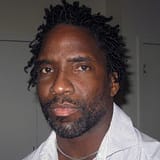
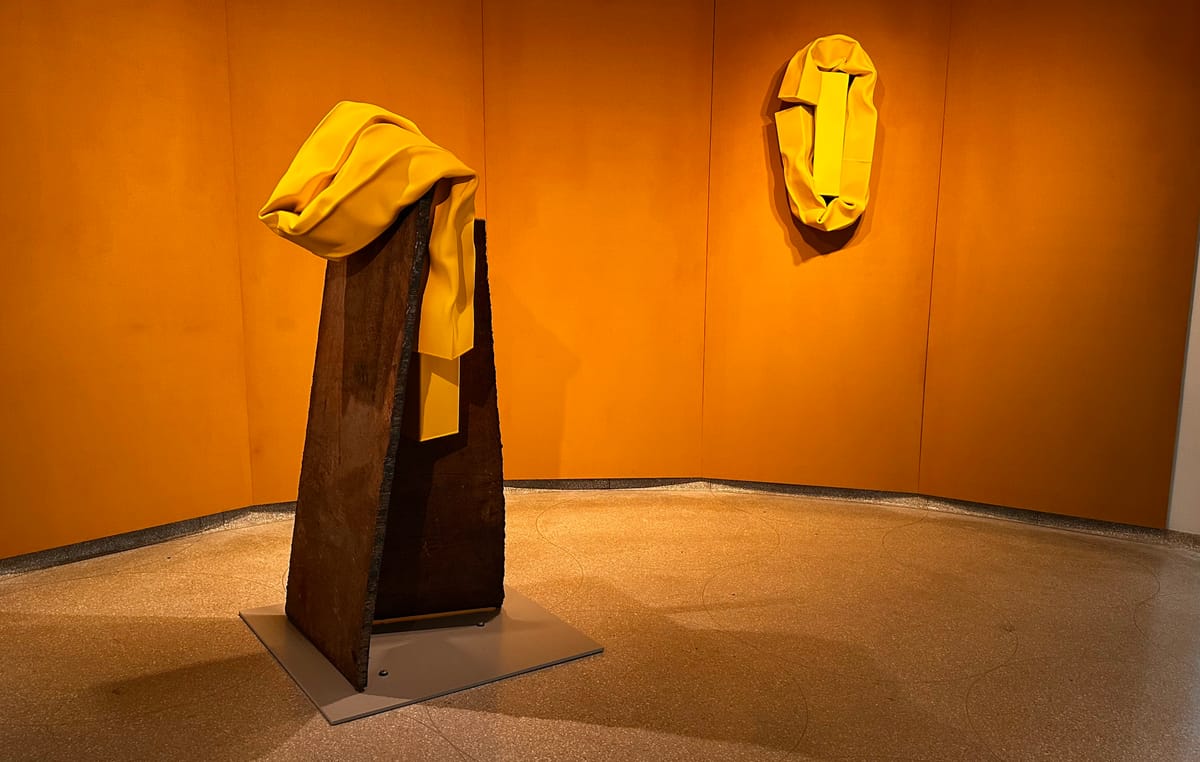
There was a moment in the Guggenheim’s sprawling new Carol Bove exhibition when the entire show began to make sense to me. It was when I chanced upon “10 Hours” (2019). Located on the museum’s third ramp, it consists of a hollow, crimped and bent rectangular tube, painted banana yellow, that’s been draped over an upright stanchion of roughly cut steel with a rust patina. It could be a bath towel that someone flung onto a drying rack after an ocean swim, which makes it befuddling: I know that this listless form is made of steel covered in urethane paint, but it doesn’t look like it or behave as I expect it to. It’s wondrous that Bove has taken material used in the construction of buildings, firearms, and bridges and made it feel like a piece of fabric nonchalantly deposited and forgotten. I found myself walking for quite a while before I encountered such revelatory work again.
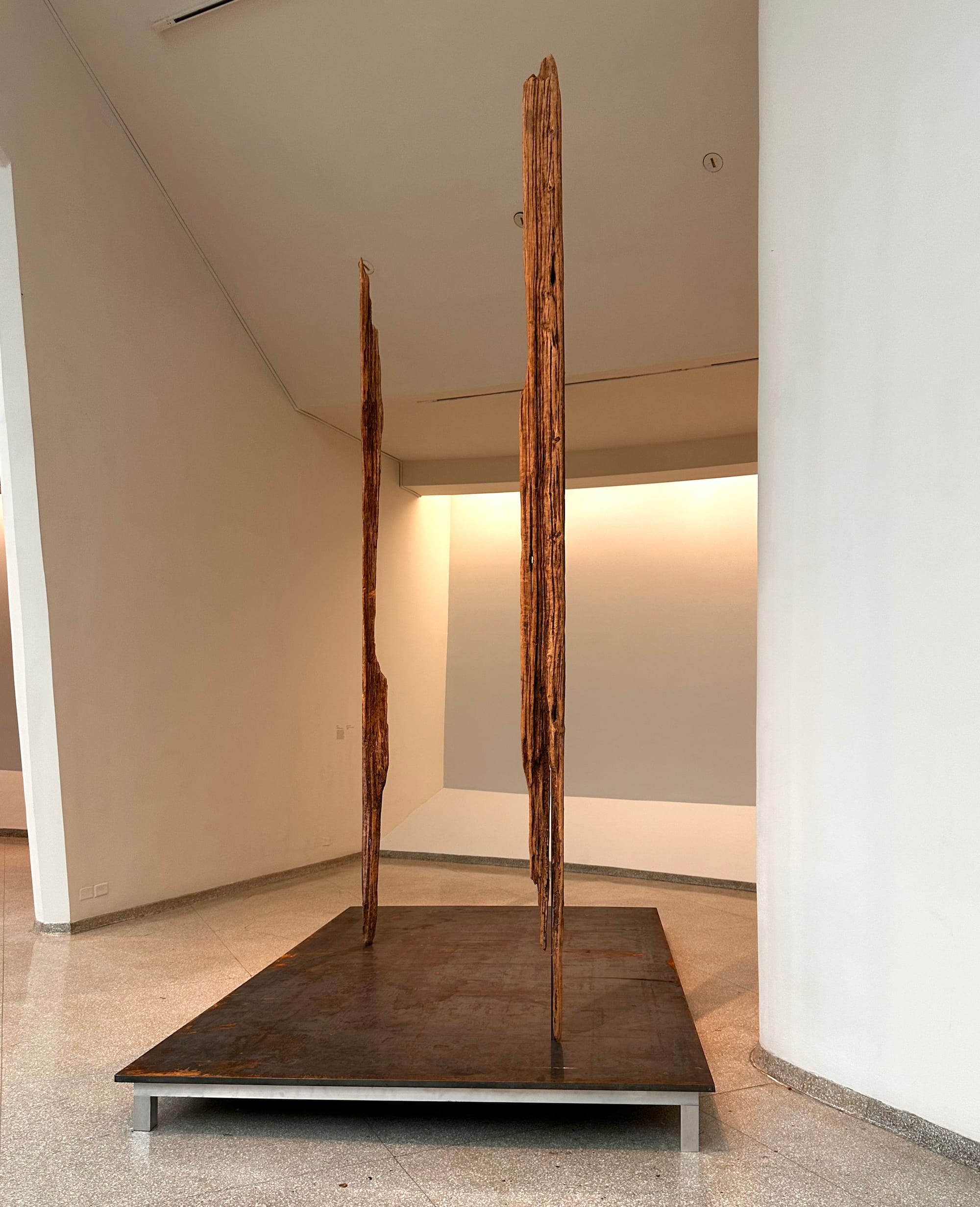
“Field Figures” (2008) is a combination of driftwood and steel, rising up tall from a flat steel base wherein the metal acts as struts holding up the weathered timber, as if it’s a memorial that will be discovered after a worldwide ecological apocalypse. It is forlorn and sad in a way that reflects almost every shrine: It recognizes that something or someone is no more. “Peel’s foe, not a set animal, laminates a tone of sleep” (2013), which mixes brass and concrete, appeared at first to be a scale model for a brutalist building, with some decorative elements, when I approached it from one side. However, circling it, it transformed into a labyrinthine collection of open, uniform bunkers concealed inside a small city turned away from the sunlight.
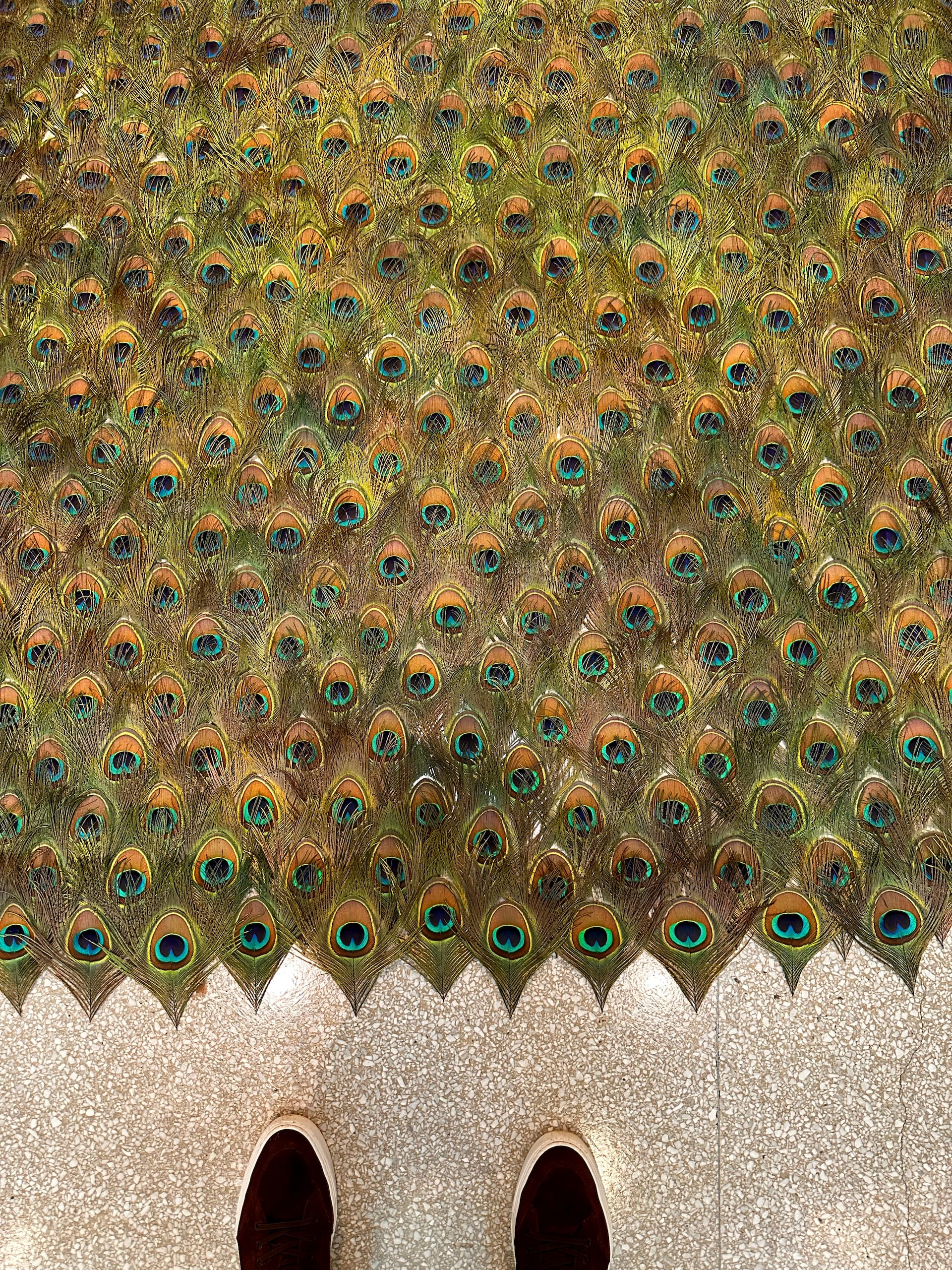
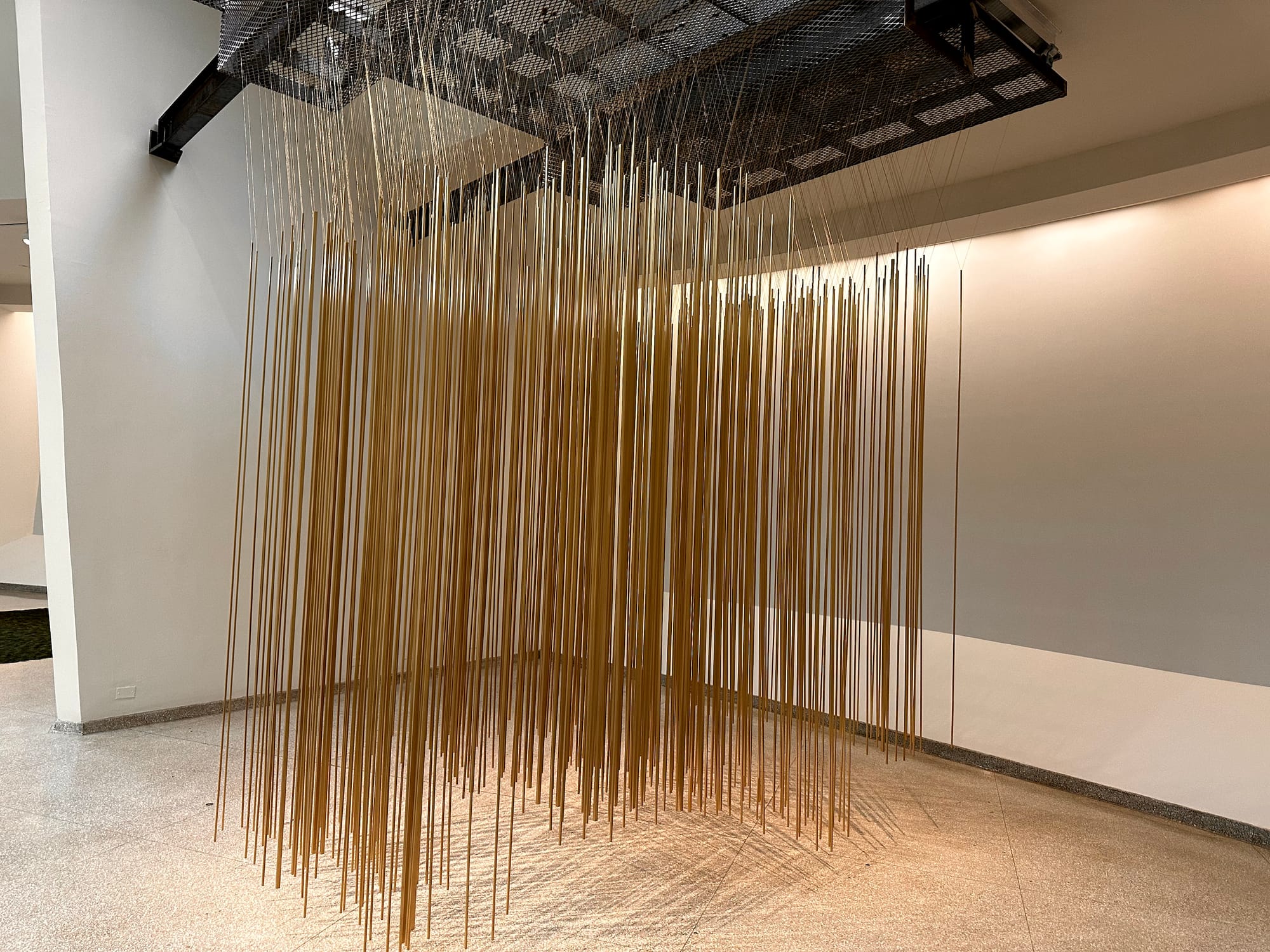
“The Night Sky Over New York” (2007) is a breathtaking combination of metallic elements. A square arrangement of long bronze needles hangs from a steel armature by bronze filaments; the whole feels like a cosmic rainfall frozen in time. An almost opposite register of material defines “Untitled (The Middle Pillar)” (2007), a carpet of peacock feathers lain on the ground, delicate and gossamer. They are full of color, the feathers’ vibrancy held in check because they are beneath me — it feels wrong to place them where visitors’ incautious feet could tread on them and destroy their natural elegance.
Bove is not indifferent to the faculty of touch. She and lead curator Katherine Brinson wisely devised a tactile library where visitors are allowed to handle materials from the artist’s studio. While investigating it, a museum staff member showed me a scaled-down version of a machine that Bove uses to crumple and fold steel and samples of her various paints. A few other pieces that visitors are allowed to touch are scattered throughout the exhibition. I enjoyed being able to pluck the string of a “monochord” instrument made for a 2023 exhibition Bove co-curated at the Whitney Museum on the work of artist Harry Smith.
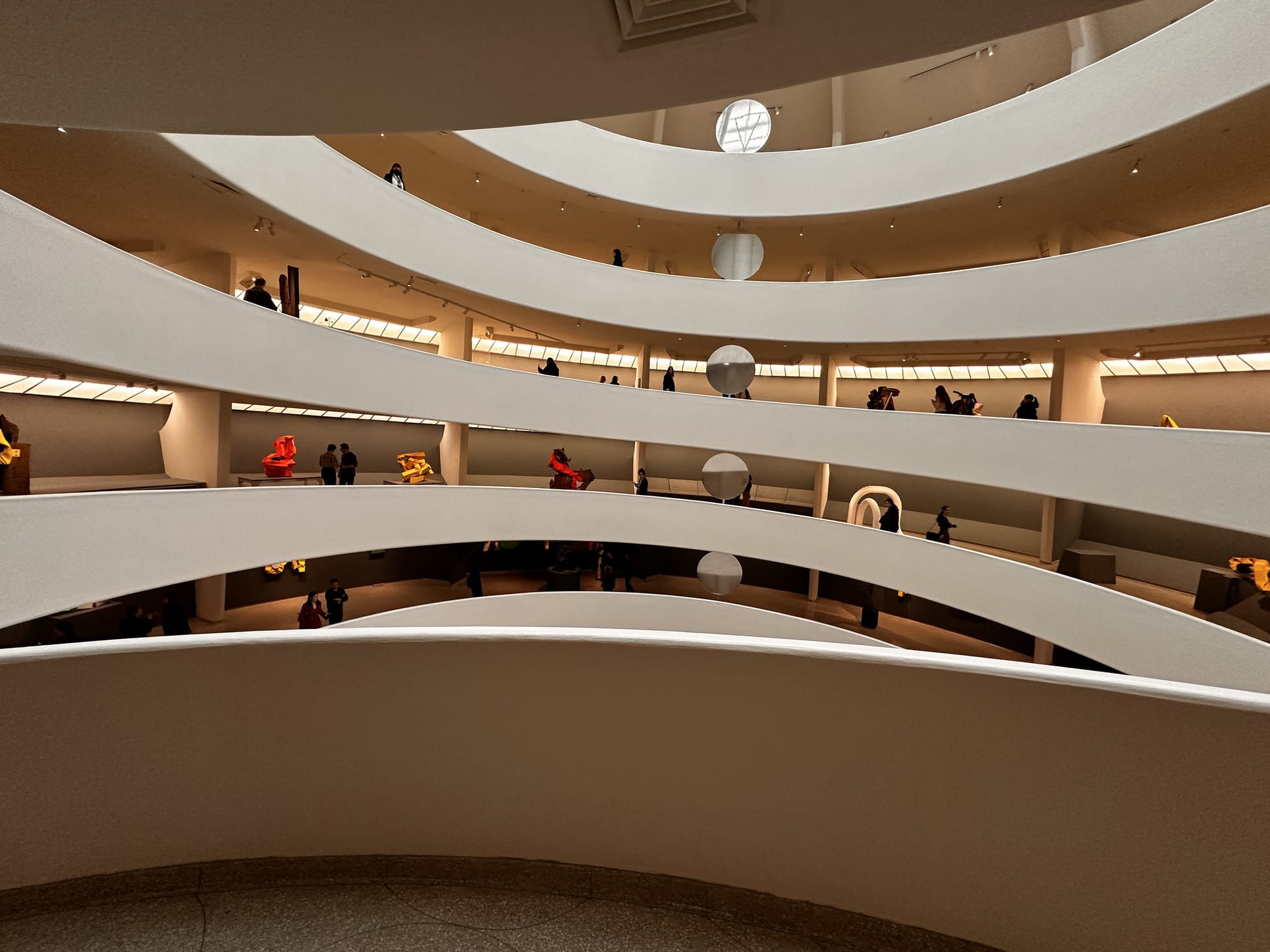
Works by other artists are installed throughout the show — Agnes Martin, Édouard Vuillard, Bruce Connor — as if in an ongoing dialogue with Bove, deepening the meaning of her art. In fact, in the first bay of the spiral ramp is a square cutout that Bove created to frame and reveal a site-specific mural by Joan Miró and Josep Llorens i Artigas that has not been on view for 23 years. But there is a drawback to these collaborations. Arguably the most beautiful piece in the show is made not by Bove, but instead by Richard Berger: “My Couch” (1976). It’s an evanescent concoction of thousands of silver beads arranged in such a way as to just barely visibly outline a sofa. As I approached, the beads shuddered in the air moved by my body, making the work appear even more gossamer than it seemed from several feet away. Such delicate grace feels like a benediction.
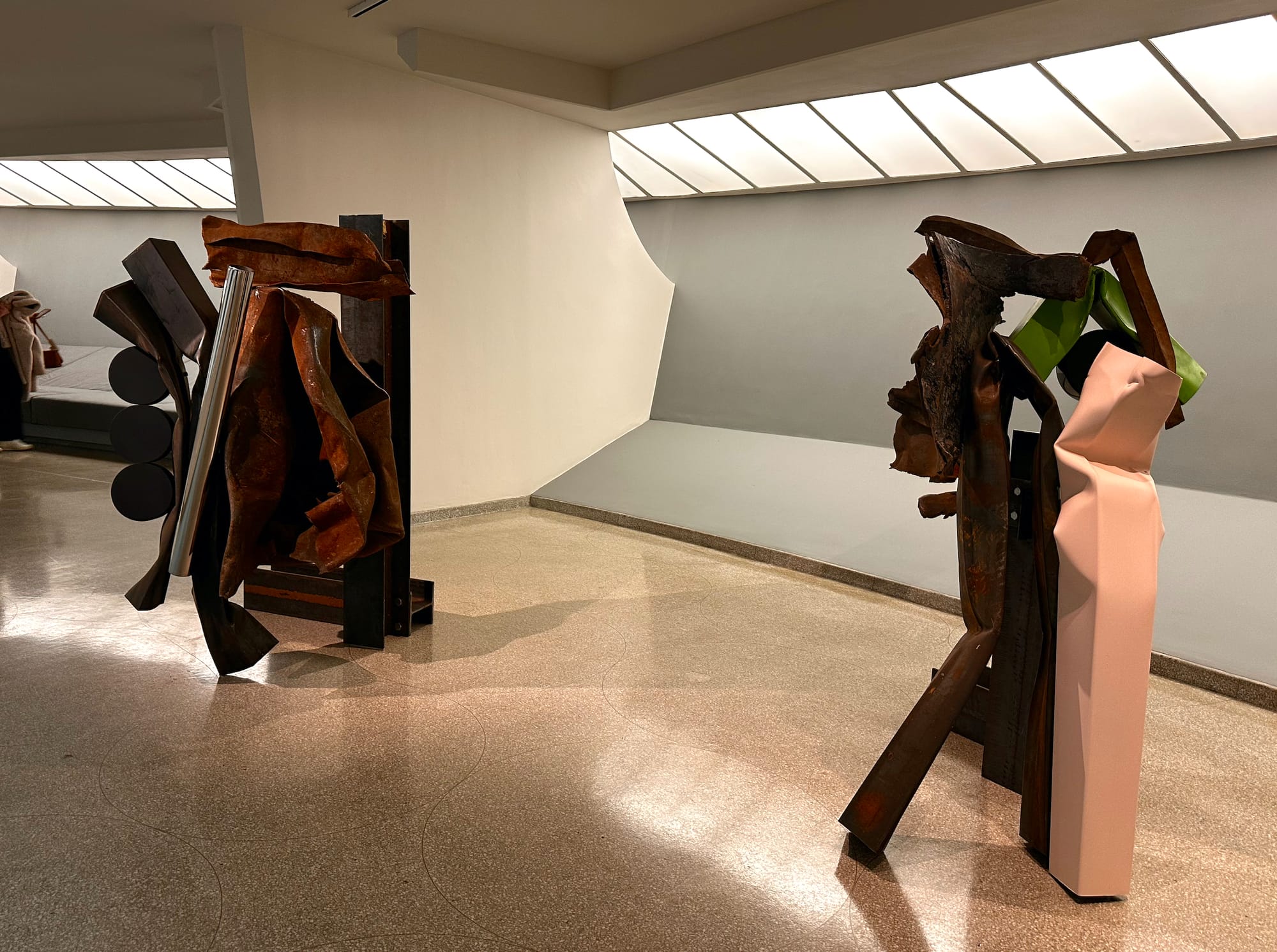
For me, the problem with this career survey is that most of what’s on view seems to be what Bove has produced in the past 25 years along the way to enlightenment. The cylindrical white sculptures that resemble smooth, headless snakes — one installed near the entrance opens the show — seem like plop art randomly inserted into the landscape. The many crumpled and painted stainless steel rectangular tubes, sometimes set around flattened painted spheres to position them as fulcrums for bending, have a similar energy — mostly inert and vague. The flat, anodized aluminum and urethane pigment paintings that depict squares and circles on a larger contrasting color field look like studies for work that has yet to be realized. Installations that incorporate peacock feathers, brass, concrete, glass, wood, and other materials, such as “The Equinox” (2013), come across as relatively arbitrary combinations that tell me nothing about the objects’ natures or why they are placed in proximity to each other.
Overall, the show feels like it’s drowning in the museum’s ambitions for a monographic retrospective, that is, that the spiral space should be filled to the brim. But it doesn’t have to be. The smaller galleries adjacent to the spiral would be ideal for an incisive exhibition that accomplishes something more meaningful than just telling us what Bove has been doing for the past decades.
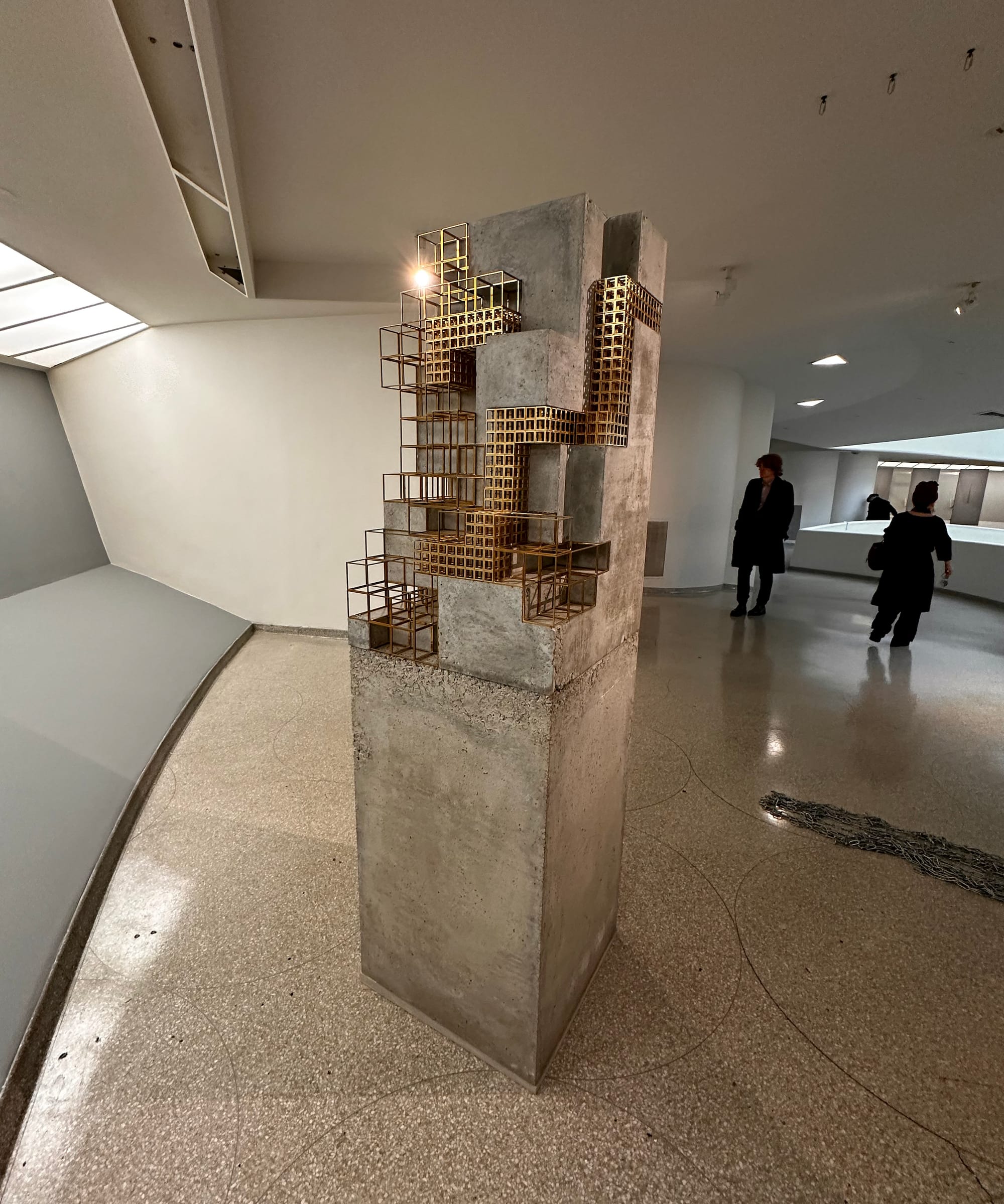
Carol Bove continues at the Guggenheim Museum (1071 Fifth Avenue, Upper East Side, Manhattan) through August 2. The exhibition was organized by Katherine Brinson, Charlotte Youkilis, and Bellara Huang.