
1942 was a year when Hollywood and world cinema were responding to global upheaval. The shadow of World War II hung over everything, and filmmakers were telling new stories about resilience, romance, suspense, and moral conviction. The best films of that year balanced wartime urgency with timeless human emotion, from shadowy noirs and daring political comedies to sweeping melodramas and animated masterworks.
These were movies that comforted, challenged, and inspired audiences in uncertain times, while advancing the craft of classical filmmaking. More than eight decades later, they still hold up.
10
‘This Gun for Hire’ (1942)

“I work alone. I always have.” In This Gun for Hire, Alan Ladd delivers a breakthrough performance as Philip Raven, a cold and methodical hitman betrayed by the employer who hires him. As Raven seeks revenge, his path intersects with nightclub singer Ellen Graham (Veronica Lake), who becomes entangled in a conspiracy involving industrial espionage and wartime intrigue. Their chemistry, wary, tender, and edged with distrust, established the stars as one of classic Hollywood’s defining duos. They would go on to collaborate three more times.
Director Frank Tuttle handles their intertwined stories with shadowy elegance, establishing many of the conventions that would define film noir. Visually, the movie embraces the stylistic hallmarks of noir: low-key lighting, deep shadows, urban nightscapes, and claustrophobic interiors. The shot framing frequently isolates Raven within stark compositions. All this amplifies the themes of identity and betrayal, which very much spoke to the day’s wartime anxieties.
9
‘Mrs. Miniver’ (1942)

“This is the people’s war.” That year’s Best Picture winner, Mrs. Miniver follows the everyday struggles of the Miniver family as they navigate air raids, separation, and uncertainty in an English village during World War II. At the heart of the story, Kay Miniver (Greer Garson) becomes a symbol of quiet strength, maintaining her household while supporting the war effort and caring for her loved ones. The star’s performance, for which she won the Best Actress Oscar, very much anchors the movie.
Released in 1942, as the United States had just entered the war, Mrs. Miniver served as a powerful piece of morale-building cinema. (Indeed, so much so that Joseph Goebbels considered it a formidable work of propaganda). Yet the film’s effectiveness lies in character, not rhetoric. Rather than glorifying conflict or big actions, it simply honors perseverance. The focus is on the family level, playing out against family dinners, village flower shows, and church gatherings instead of battlefields.
8
‘Now, Voyager’ (1942)

“Don’t let’s ask for the moon. We have the stars.” In Now, Voyager, Bette Davis is Charlotte Vale, a repressed woman dominated by her controlling mother. After undergoing treatment at a sanatorium, Charlotte emerges with newfound confidence and embarks on a transformative journey. Her encounter with a married man, Jerry Durrance (Paul Henreid), soon changes her understanding of independence and love. While certainly dated, Now, Voyager is nevertheless a solid study of personal awakening.
Davis’ performance is great. She charts Charlotte’s evolution with remarkable subtlety, convincingly going from hunched insecurity to poised self-assurance. Yet the story never settles for simple wish fulfillment. Charlotte’s romance cannot culminate in conventional happiness. Instead, the film embraces emotional maturity over fairy tale endings, which is a refreshing change of pace for a 1940s movie. Plus, this was also one of the earliest Hollywood depictions of psychotherapy, and it’s more grounded and realistic than one might expect for the era.
7
‘Yankee Doodle Dandy’ (1942)

“My mother thanks you, my father thanks you, my sister thanks you, and I thank you.” Yankee Doodle Dandy celebrates the life of entertainer George M. Cohan (James Cagney), tracing his rise from vaudeville performer to Broadway legend. We follow his career across musical numbers, personal struggles, and big contributions to American culture. Director Michael Curtiz infuses the movie with an exuberant energy befitting its subject. This fusion of spectacle, star power, and patriotism was well-suited to the mood of the moment.
This is polished studio-era craftsmanship: fluid camera movements, elegant lighting, and seamless transitions between backstage drama and stage performance. At the center of it all is Cagney, delivering one of the most electric performances of his career. Known primarily for tough-guy roles in gangster films, Cagney astonished audiences with his athletic dancing and boundless stage presence. His tap routines feel crisp and explosive, yet never mechanical. He won the Best Actor Oscar for his efforts.
6
‘The Pride of the Yankees’ (1942)

“Today, I consider myself the luckiest man on the face of the earth.” This one is a moving tribute to Lou Gehrig, who had passed away the year before. Gary Cooper stars as the baseball legend, and the film chronicles his journey from humble beginnings to sporting greatness. It delves into Gehrig’s career with the New York Yankees, his enduring partnership with his teammates, and his courageous response to the illness that ultimately ends his playing days. In other words, this is a fine balance of crowd-pleasing sports spectacle and smaller character moments.
While some sequences are overlong and repetitive, The Pride of the Yankees holds the audience’s attention thanks to the heartfelt romance between Gehrig and Eleanor (Teresa Wright). On the acting side, Cooper’s performance is fittingly restrained, almost modest. He doesn’t overplay the heroism. That understatement aligns with the film’s broader attitude: quiet strength over grandiosity. His climactic farewell speech lands precisely because it feels personal rather than theatrical.
5
‘To Be or Not to Be’ (1942)

“So they call me Concentration Camp Ehrhardt!” In To Be or Not to Be, a troupe of Polish actors in Nazi-occupied Warsaw becomes unexpectedly entangled in espionage when they help the resistance thwart a German spy. Led by the vain but resourceful Joseph Tura and his quick-thinking wife Maria, the group uses their theatrical skills to outwit occupying forces and protect crucial information. Their only weapons are disguises, impersonations, and quick improvisation.
In the process, director Ernst Lubitsch and his collaborators turn Nazi occupation into razor-sharp comedy without diminishing the horror beneath it. Even more impressive, they made this movie while that occupation was still underway. This satire of authoritarianism was daring, to say the least. Hitler and the Gestapo are mocked, reduced to bureaucratic buffoons. The humor is defiant. Beneath the laughter lies seriousness. The stakes are real. Characters risk torture and execution. All in all, the film balances levity and danger with remarkable tonal control.
4
‘Cat People’ (1942)

“She never could escape from herself.” Those who have only seen Paul Schrader‘s 1982 remake should check out Jacques Tourneur’s original. Cat People revolves around Irena (Simone Simon), a Serbian immigrant in New York who fears she is cursed to transform into a panther if she gives in to passion. Her marriage to Oliver (Kent Smith) becomes strained as jealousy and anxiety blur the boundary between imagination and reality.
Part of what makes Cat People an interesting horror for its time is what it refuses to show. For instance, the supposed transformation is never fully depicted. Instead, Tourneur uses shadowy lighting, off-screen space, and strategic editing to imply threat. The most striking example is the famous “bus scare” sequence, in which a sudden hiss of air brakes interrupts mounting suspense. Plus, the movie gets unusually psychological and symbolic, using its pulpy premise to explore themes of repression, desire, and alienation. Irena’s terror of her own desires gives the story emotional depth.
3
‘The Magnificent Ambersons’ (1942)

“Times change. People don’t seem to change as much.” The Magnificent Ambersons was Orson Welles‘ first feature after Citizen Kane, chronicling the decline of a wealthy Midwestern family at the turn of the 20th century. Young George Amberson Minafer (Tim Holt) grows up spoiled and arrogant, resisting the social and technological changes reshaping the world around him. Opposite Holt is a stellar Joseph Cotten as the warm Eugene Morgan. Welles crafts this into both a family saga and a meditation on progress, pride, and decline.
Visually, the film is astonishing. Cinematographer Stanley Cortez uses deep-focus photography and fluid camera movement to create immersive spaces. The most impressive moment aesthetically is the ballroom sequence, where the camera glides through conversations and dance partners in a single flowing movement. Despite studio interference that famously altered its ending, The Magnificent Ambersons remains powerful. Its melancholy tone anticipates later movie masterpieces about lost eras.
2
‘Bambi’ (1942)

“If you can’t say something nice, don’t say nothing at all.” Bambi is one of those early Disney classics that feels truly timeless. The story is famous the world over: a young deer (voiced by Donnie Dunagan) growing up in the forest, experiencing friendship, love, and the harsh realities of nature. From playful early adventures to encounters with danger, Bambi’s journey becomes a coming-of-age story shaped by both wonder and loss. The scene where his mother is shot is one of the most heartbreaking in all of animation. The violence is never shown. A gunshot echoes. Silence follows.
The imagery here is simply fantastic. The backgrounds are soft watercolor landscapes inspired by European art, creating depth and atmosphere without overwhelming the characters. The forest feels alive: light filters through trees, snow drifts gently, leaves shimmer in the wind. And, most importantly, Disney’s animators studied live deer extensively, achieving unprecedented anatomical realism in movement.
1
‘Casablanca’ (1942)

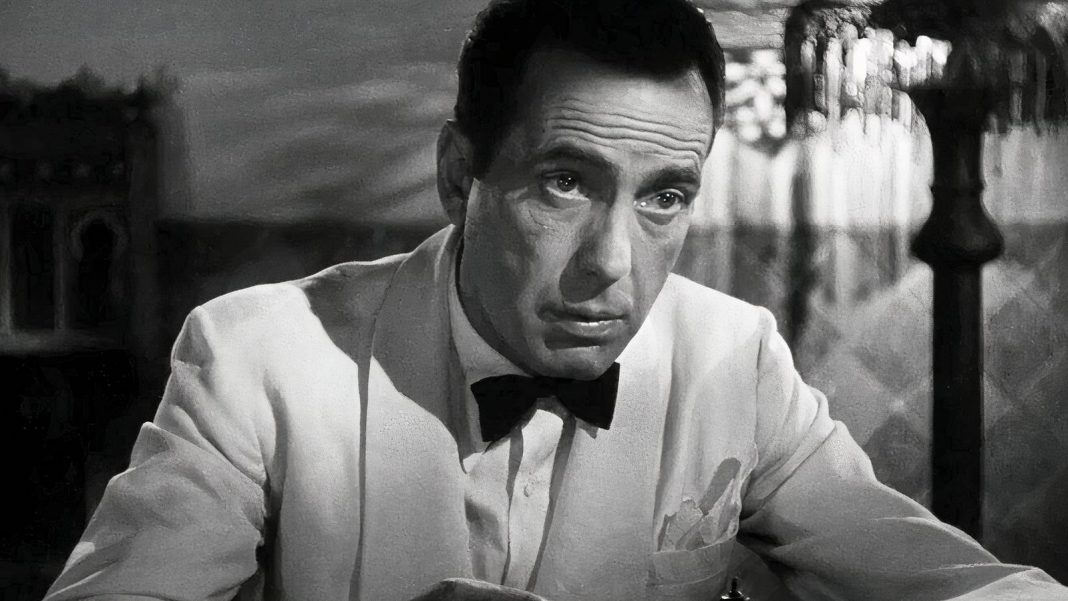
“Here’s looking at you, kid.” In World War II-era Morocco, expat Rick Blaine (Humphrey Bogart) runs a nightclub frequented by refugees and opportunists. When his former lover Ilsa (Ingrid Bergman) arrives with resistance leader Victor Laszlo (Paul Henreid), Rick must choose between personal desire and moral responsibility. That choice, fundamentally love versus sacrifice, forms the emotional spine of the film. In this regard, Rick’s transformation from cynical isolationist to engaged participant mirrors broader wartime shifts in American identity.
Themes aside, the best part of Casablanca is the dialogue. The screenplay layers wit, melancholy, and political awareness seamlessly. Even supporting roles sparkle, especially Captain Renault (Claude Rains), whose sly opportunism gradually evolves into something resembling integrity. Crucially, the lines aren’t just flashy or gimmicky, but rooted in the characters and their psychology. Everything feels effortless while being meticulously constructed. Ultimately, Casablanca endures because it’s both specific to its historical moment and universally human.

Casablanca
- Release Date
-
January 15, 1943
- Runtime
-
102 minutes
-

Humphrey Bogart
Rick Blaine
-