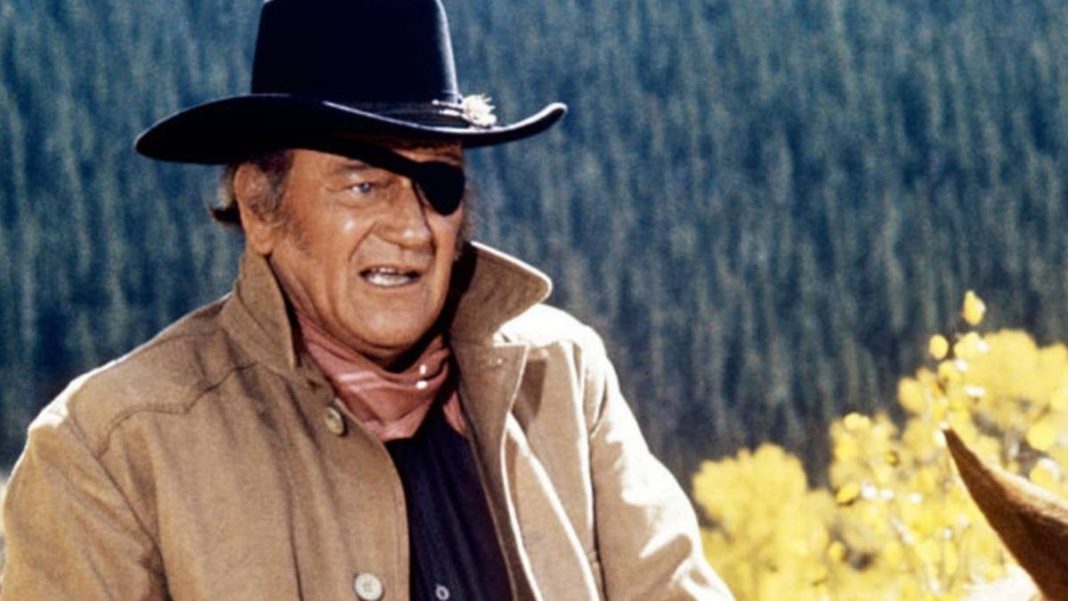

It’s safe to say that the Western genre would not have developed into one of the most popular categories of film if it weren’t for the extraordinary career of John Wayne. While it was not the first Western ever made, the 1939 classic Stagecoach fulfilled everything cinephiles could want from the genre, and kicked off a notoriously illustrious partnership between Wayne and director John Ford. Although Wayne’s work with Ford was arguably the highlight of both of their filmographies, Wayne worked with many great filmmakers, and began to make darker and more reflective films in the last decade of his career. In addition to finally earning him the Academy Award for Best Actor that he had long been denied, Wayne’s performance in True Grit contains what he believes is the best acting of his career.
‘True Grit’ Has One of John Wayne’s Greatest Performances
True Grit is based on the novel of the same name by Charles Portis, which also inspired a 2010 remake by Joel and Ethan Coen that starred Jeff Bridges. Wayne stars as the aging U.S. Major Marshall Rooster Cogburn, whose cantankerous behavior and constant drinking have caused many of his peers to think that he is past his prime. However, a violent insurrection forces Cogburn to jump back into the line of fire. In Yell County, Arkansas, the farmer Frank Ross (John Pickard) is murdered by the outlaw Tom Chaney (Jeff Corey), whom he had once employed as a hired hand. Although the Texas Ranger La Boeuf (Glen Campbell) is determined to hunt Chaney down and bring him to justice under the law, Ross’ young daughter Mattie (Kim Darby) decides to hire Cogburn to help track down her father’s killer.
While he had starred in countless Westerns by the time of the film’s release, Wayne was uniquely cast in True Grit as an aging protagonist who was past his prime. Cogburn did not have the excitable energy of Sheriff John T. Chance in Rio Bravo, nor did he have the incisive rage of Major Ethan Edwards in The Searchers. Rather, Cogburn is a character who is no longer respected and uses his new mission to help Mattie as a means of solidifying his reputation. In many ways, this felt like a self-reflective performance on Wayne’s part. While the 1960s saw the emergence of new Western stars like Clint Eastwood and Lee Van Cleef, Wayne proved in True Grit that he hadn’t lost a step with the genre that had paved the way for his career.

Collider Acrostic — The Collider Movie Quiz!
Can you answer these movie questions, wherein each correct response begins with a successive letter of the word “Collider”?
Although the film strays radically from the original source material, True Grit’s depiction of Cogburn made use of Wayne’s inherent strengths as an actor. It’s often unspoken how comedically adept Wayne was, as he starred in many romantic comedies throughout his career. While True Grit is first and foremost a drama, Wayne was able to add a touch of humor to the adventure throughout the film, specifically in his interaction with La Boeuf. Cogburn’s cantankerous, somewhat nontraditional approach to following the law ends up rubbing the stuffy and proper Texas ranger the wrong way. It was also a great depiction of Wayne as a reluctant hero. Although he initially views his mission to avenge Mattie’s parents as merely one that is financially beneficial, Cogburn begins to believe in the merits of his assignment, and forms an attachment with his young employer.
John Wayne Showed His Range in This ‘True Grit’ Scene
Although the film certainly allowed him to chew the scenery, Wayne showed his range as a dramatic actor during a moving monologue in True Grit. When Cogburn and Mattie are waiting for the film’s villains to discover them, the aging U.S. Marshall reveals that he had once been married, and that his wife had left him at an unaccepted moment. Although he reflects on the sadness of not being able to have a family, Cogburn insists that he’d rather lose his wife than sacrifice his independence. It’s a rare moment of intimacy from a character who is uneasy about expressing his emotions. While director Henry Hathaway deserves credit for setting up the scene, it’s Wayne’s subtle performance that makes True Grit one of his greatest films ever.
While he had appeared in no shortage of memorable Western shootouts, Wayne cited the True Grit monologue scene as the greatest moment of acting in his entire career. He called the part of Cogburn his “first decent part in twenty years,” as it gave him his “first chance to play a character role instead of John Wayne.” By leaning away from his inherent idiosyncrasies and investing in the character’s backstory, Wayne felt that Hathaway had made True Grit into “a fantasy, and yet he kept it an honest Western.” Wayne revealed that Cogburn was “not like what I’ve done before,” and that the opportunity to show his range excited him.
‘True Grit’ Shows a Softer Side to John Wayne

Wayne’s True Grit monologue showed us a softer side of the actor we so rarely got to see during his legendary career. You get the sense as Cogburn opens up about his ex-wife that there is a heartbreaking wistfulness for the past, even if it’s a life that no longer suits him. This is particularly poignant when Mattie asks about his son. After telling her that his wife took him with her after the divorce, Cogburn looks down with a pause, shaking his head for a few seconds before stating matter-of-factly, “He never liked me anyway.” Wayne relies on a quiet understatedness here, a stark contrast to the swaggering, assertive cowboy persona that made him a Western icon.
To see Wayne portray a man in a state of vulnerability towards the end of his career only adds to the scene’s power. Cogburn is opening up, showing a side to Mattie she doesn’t normally get to see from the U.S. Marshall. It feels like a triumphant victory lap for Wayne, who is giving us one of the most intimate performances of his entire career, something that was often sorely lacking from his more traditional films.
‘True Grit’ Was the Summation of Wayne’s Career
Although it ended up inspiring the sequel Rooster Cogburn, True Grit was one of the last films of Wayne’s career. In that sense, it’s hard to not see Cogburn’s touching speech as a moment of reflection on Wayne’s part. Cogburn is reminiscing about what he missed out on as the result of his career, and Wayne was once again playing a Western gunslinger who is forced to show his heroism. This connection between the two makes the film even more powerful. Just as Cogburn decides to aid Mattie and prove himself worthy of wearing a badge, Wayne reaches unexpected emotional depths and delivers one of the most stirring performances of his career.
Although the Academy Awards frequently disregard great Westerns, Wayne’s performance in True Grit earned him his first and only Best Actor Oscar. Some actors earn major awards towards the end of their careers as “career prizes” for their entire body of work, but in the case of True Grit, Wayne won his award on merit alone.
Wayne Had a Shaky History at the Oscars

As a Western Fan, These Are the 10 Movies in the Genre I Rewatch the Most
Yee-haw!
One of the reasons that the acclaim for True Grit was so satisfying was that Wayne’s work had consistently been overlooked by the Academy Award before he finally earned the Best Actor trophy. The Oscars have not historically been kind to “genre” movies, as the only western that had won Best Picture prior to the release of True Grit was Cimarron, which was released way back in 1931; the Oscars would show more willingness to accept the genre in subsequent years, as Unforgiven, Dances With Wolves, and No Country For Old Men also earned the Best Picture award. Nonetheless, True Grit wasn’t nominated in any other major categories, signifying once again that awards voters were rather close-minded. Wayne’s victory may have been the exception to the rule, rather than the initiation of a new trend.
Even though True Grit is a film that is cited as a western classic, many of Wayne’s best performances were overlooked by the Oscars. Wayne is best known for his collaborations with John Ford, who is the most decorated filmmaker in history thanks to his four victories in the Best Director category. Wayne appeared in Best Picture nominees directed by Ford, such as The Long Voyage Home, The Quiet Man, and Stagecoach, but did not get recognized for any of his performances. Prior to True Grit, he had been nominated for Best Actor in the war drama The Sands of Iowa Jima and received a Best Picture nomination for the historical epic The Alamo, which he both directed and produced. However, it is unfortunate to see that Wayne did not get any recognition for The Searchers, a classic cited by critics’ groups like the AFI and Sight & Sound as being one of the greatest films ever made. Wayne’s performance as a ruthless Marshall with a serious sense of bloodlust predated many iconic anti-hero characters, such as Travis Bickle (Robert De Niro) in Taxi Driver, Tyler Durden (Brad Pitt and Edward Norton) in Fight Club, Patrick Bateman (Christian Bale) in American Psycho, and Arthur Fleck (Joaquin Phoenix) in Joker.
Ironically, the remake of True Grit fared much better at the Academy Awards, as it earned ten nominations, including Best Picture and Best Director for the Coen Brothers (both of which it ended up losing to The King’s Speech). Among the nominees for the film was Jeff Bridges, who took on the role of Rooster Cogburn that Wayne had crafted in such a delicate way. Bridges did not win the award, but this is not entirely surprising, as he had won the previous year for his performance as an alcoholic country singer in the acclaimed music drama Crazy Heart. That being said, there is a legitimate argument to be made that Bridges should have earned the prize two years in a row; he managed to bring a lot of depth to his portrayal, as it did not feel like he was simply trying to do an impression of what Wayne had already done before.

True Grit
- Release Date
-
June 11, 1969
- Runtime
-
128 minutes