

Making a movie is hard, and sometimes, things go wrong. So, mishaps can be expected, and sometimes, they’re accidental, but people can be careless or sometimes even malicious, and such a thing is going to make a legacy darker. It’s worth noting, though, that a movie’s legacy can be dark – or that movie can be viewed in a different light – for external reasons, too.
With the following movies, some of them have stories attached to them that overshadow either parts of the films themselves, or sometimes even the entire film that those stories are attached to. Some of them are very good films that had very unsettling things happen while they were being made, or sometimes a little after. Either way, legacies were impacted, for better or worse, and all that is what’s covered below.
10
‘Pulgasari’ (1985)

On the surface, Pulgasari might seem like a goofy monster movie, and sure, it kind of is. A mostly forgettable and also not very good goofy monster movie, and a Godzilla knock-off, but ordinarily, that wouldn’t be enough to taint a legacy. It’d sort of just come and go, if that was all, but no, Pulgasari is best remembered because a kidnapping was involved during its production.
Specifically, a South Korean director and his wife (Shin Sang-ok and Choi Eun-hee) were kidnapped by North Korea, with the director being made to make movies while there. Pulgasari was one of them, and the whole baffling behind-the-scenes aspect of it is probably the most interesting thing about it. But given the kidnapping happened years earlier, and Pulgasari wasn’t the only film Shin Sang-ok was made to make while being held in North Korea, there are inevitably other films he directed that themselves have dark legacies.
9
‘The Wizard of Oz’ (1939)

Genre-wise and tonally, The Wizard of Oz is much milder than some of the movies that are going to be mentioned further down the line, since this one’s a fantasy musical, and a classic family film, too. It was infamously much harder to make than it is to watch nowadays, with the difficulty of the production being pretty much legendary. Or notorious. That’s a better word.
Multiple directors were churned through, lots of the makeup used caused incredible discomfort, asbestos was used in the production, and stress was put on various actors – especially Judy Garland – because of how demanding the shoots were, with shooting days having infamously long hours. There were injuries, too, including Margaret Hamilton and her stunt double getting burned by pyrotechnics. Fun for the whole family to watch, maybe, but apparently no fun for anyone involved in the actual filming.
8
‘Roar’ (1981)

Roar is more of a behind-the-scenes story than it is a movie. If you were to watch it without knowing anything about its production, then you might consider it a fairly mediocre – and sometimes alarming – adventure film of sorts; one where the filmmakers seem to be doing a weirdly good job at making the actors look like they were all in genuine danger around all the big cats in the wildlife preserve the film is set in.
Roar had a re-release tagline that was: “No animals were harmed in the making of this film. 70 cast and crew members were.”
But then, it turns out, everyone was in actual danger. Roar had a re-release tagline that was: “No animals were harmed in the making of this film. 70 cast and crew members were.” And that about sums it up perfectly. It’s an offbeat and fairly mediocre comedic adventure/thriller movie of sorts, but it had a ridiculously violent production because of all the dangerous animals used throughout the movie. No one died, perhaps miraculously, but dozens upon dozens of injuries are more than enough to give Roar its rather harrowing legacy.
7
‘Last Tango in Paris’ (1972)

A movie about a dark and unusual sexual relationship, some of the discomfort in Last Tango in Paris is a bit too intense. To some extent, you need a film like this to be uncomfortable and boundary-pushing when it deals with the things it does, but there is a line that shouldn’t be crossed when it comes to how the actors actually feel while making something that’s transgressive.
That’s all putting it delicately, because it might not be proper to go into details here, since the details are upsetting. There are things you can read about if you do want to know more, but there’s one scene in particular in Last Tango in Paris that really sours the whole film, and what it otherwise might have to offer, once you learn how it was filmed, and what it involved for the lead actress, Maria Schneider.
6
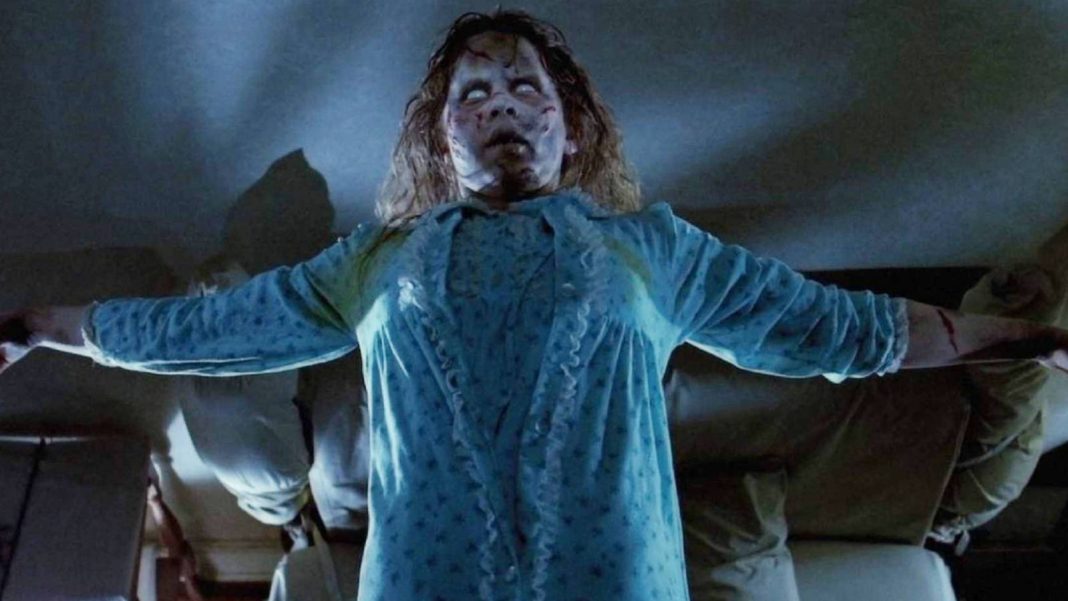
‘The Exorcist’ (1973)

Not that it needs an alarming behind-the-scenes legacy to be frightening, but yeah, it’s easy to look at and single out The Exorcist as a movie that’s horrifying to watch, and would’ve also been horrifying to make. Narratively, it’s about a young girl who starts behaving in increasingly strange ways, eventually to the point where her mother starts to fear she might be possessed. Hence, an exorcism gets performed.
It was directed by the always fiery William Friedkin, and he was probably at his most unapologetic here, apparently using a firearm to get shocked expressions out of his actors, for one thing. People were also injured while making the film, fell ill, got stressed, and then other mishaps occurred regarding sets being damaged, and you couple all those distressing (some say cursed) events happening with a skilled but abrasive director purportedly being a tyrant, and you’re ultimately left with quite a lot that further darkens an already dark and oftentimes terrifying film.
5
‘Poltergeist’ (1982)

While Poltergeist didn’t have quite the same drama as The Exorcist as far as the directing was concerned, it did ultimately become another horror movie some thought might well have been cursed, owing to the unfortunate events that happened during – and a little after – its production. Two young actors in Poltergeist died prematurely, with Dominique Dunne (only 22) being murdered the same year Poltergeist came out, and Heather O’Rourke passing away at just 12 years old in 1988.
It’s not because of the film, but a movie can pick up a dark sort of legacy after its release because of reasons unrelated to the film itself. That happened here, and those deaths do hang heavy over Poltergeist (the film itself, though, is noticeably light on actual characters dying), but if you’re looking for other dark things legacy-wise, you’ve also got controversy surrounding who might’ve directed the film, real skeletons used during a pivotal (and horrific) scene, and some sequences where the child actors got genuinely terrified by what they were asked to do, and react to.
4
‘An Elephant Sitting Still’ (2018)
Before it was released, the director of An Elephant Sitting Still, Hu Bo, took his own life at the age of just 29. With how heavy-going the movie itself is, and the fact that his death made it feel like the cinematic equivalent of a suicide note, it’s hard to view An Elephant Sitting Still in any other way, or without thinking about the death of its director. It was indeed impossible for the vast majority of people to see this in a world where Hu Bo was still alive.
As for the film? It’s about a bunch of people who are all emotionally despondent and lost in various ways, and they struggle for a while, with the film being about such struggles. For almost four hours. It would’ve been a relentless and difficult watch without the tragically sad life story of Hu Bo attached to it, but it’s made inevitably darker and more despairing because of said story.
3
‘The Birth of a Nation’ (1915)

It’s The Birth of a Nation. There were things here on a filmmaking front that were adventurous and influential, but various other things here are basically impossible to overlook. The troubling stuff. It’s a movie that has members of the Ku Klux Klan ultimately play a heroic role, and people have written about how the release of the movie might well have not just increased the popularity of, but effectively revitalized the KKK.
There’s also racism in the way it portrays Black characters as villainous and like caricatures, and then so much more, to the point where it’s very obvious to say that The Birth of a Nation is controversial. That’s a huge understatement and all. The attitudes of the time, and then what the film might’ve inspired… both work hand in hand to give the movie the legacy it has. Again, not a good one. Just watch Intolerance instead, which is the better D.W. Griffith epic made in the 1910s.
2
‘The Conqueror’ (1956)

While people weren’t necessarily killed on set, The Conqueror is notorious nowadays for being a production that led to illness and death for a surprising number of cast and crew members. It was filmed near a nuclear test site, and so the proximity to nuclear fallout could well have led to 91 of the 220 people involved in the film getting some kind of cancer.
It could be a terrible coincidence, but even if it were, it’s still something you think about (and can’t really avoid thinking/reading about) when it comes to The Conqueror. Not that a good movie would make it worthwhile, necessarily, but the illness and possible deaths were all in service of a movie that’s notoriously not very good, either, and that lack of quality is also sometimes talked about, regarding The Conqueror. Oh, and the fact that John Wayne played Genghis Khan in this movie, which is one of the strangest and most infamous casting choices ever.
1
‘Twilight Zone: The Movie’ (1983)

Unlike with The Conqueror, deaths very much occurred on the set of Twilight Zone: The Movie, and they were horrific for so many reasons. Anyone dying on a film set is bad enough to begin with, but the disaster during filming here caused three violent deaths, and two of them were child actors, via a helicopter crash. Worse still, the child actors weren’t supposed to be working at the time, so they were killed while child labor laws were being violated.
It was all horribly negligent and obviously sours the entire film. It’s surprising it even got released, or that the segment it happened during wasn’t cut entirely (Twilight Zone: The Movie is an anthology film, so you can get something out of the other segments, maybe, but even then, it remains hard not to think about what happened during the filming of John Landis’ segment, “Time Out”).