
Since Donald Trump’s election in 2016, popular entertainment has struggled with how to reflect the resulting upheaval in American politics and culture. Many Hollywood projects have taken a heavy-handed approach: Think of how often you’ve been told that a certain movie or TV show is “exactly what we need right now.” During Trump’s first term, these direct, if unsubtle, approaches felt like honest reactions to the moment. Now nearly 10 years later—and one year into Trump’s second term—audiences are savvier and more suspicious about such transparent messaging.
Perhaps sensing this wariness, the creators of some of the more politically compelling movies and TV shows of the past year have instead explored how being alive feels during a tumultuous period. They capture the atmosphere, the mood, the ambient existence of everyday people who are living through a transformative time in history, whether or not they recognize that they are doing so.
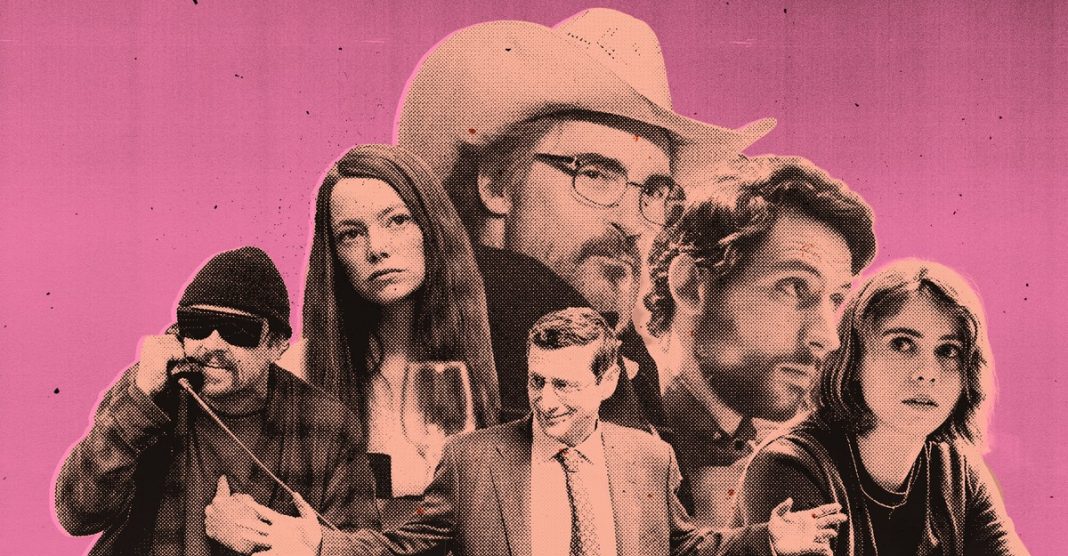
Consider James Blaine “J.B.” Mooney, the museum-robbing protagonist of Kelly Reichardt’s The Mastermind, which is set in suburban Massachusetts in 1970. Played as both a careful schemer and a lazy layabout by Josh O’Connor, J.B. is not pushed into a life of crime—he chooses it because he’s just that bored. This wayward boredom is more striking when you consider what he ignores: Whenever the news is on, J.B. listens nonchalantly, apathetic about the war in Vietnam. He behaves as though current events are so far beyond his control or influence that participating at all is utterly pointless. He may as well try robbing an art museum if nothing matters.
Toward the end of the movie, he joins an anti-war protest—but only accidentally, as he’s attempting to blend into the public after stealing an older woman’s purse. But the police can’t tell the difference, and when the protest is broken up, J.B. is thrown into the back of a paddy wagon all the same. His experience may be identifiable to many in the audience: the feeling that you are separate from the news, until it slaps you in the face. We are left to wonder whether he will finally be able to appreciate the world around him now that he has been implicated in it.
One Battle After Another is another example of a film that adroitly channels modern anxieties. Set in a vaguely familiar United States, the story focuses on a man named Bob Ferguson (played by Leonardo DiCaprio), a former member of a far-left revolutionary group called the French 75. When an enemy from his past reemerges to kidnap his daughter, Bob must tap back into his old network and relocate her to safety. The movie is purposefully ambiguous about details within its version of American reality: Although white supremacists scheme in hidden conference rooms about controlling the nation’s population, we never learn anything about the government in power.
Many of the film’s standout sequences, though, engage with this alternate world from the ground up. Benicio del Toro earned an Oscar nomination for his role as Sergio St. Carlos, a local activist who is deeply involved with his undocumented-immigrant neighbors as ICE-like agents search for them in the streets of Baktan Cross, a city that strongly resembles Los Angeles. Sergio is One Battle’s beating heart and its hero, someone who is focused on helping out where he can. The film is not concentrated on who or what is responsible for society’s militarized turn, but audiences get an intimate feel for how people like Sergio have decided to respond.
These recognizable universes, in which characters attempt to make meaning for themselves amid jarring headlines, can be seen across contemporary media. Eddington takes place in a small southwestern town during the early pandemic: Sheriff Joe Cross (Joaquin Phoenix) butts heads with Mayor Ted Garcia (Pedro Pascal) over mask mandates and the encroachment of data centers, while the town itself is met with Black Lives Matter protests, supposed antifa agitators, child-trafficking pedo cults, and clout-chasing influencers. Rather than stake out any specific stances, Eddington convincingly depicts the confounding environment that its characters—and many of its audience members—are forced to interpret.
Tim Robinson’s The Chair Company is likewise uncomfortably adept at depicting how navigating our immensely complicated, interconnected society can feel. Robinson plays an average man who, upon probing the origins of a poorly made chair that collapses under him at his job, is swept into a convoluted conspiracy that grants him a monomaniacal sense of destiny. Like The Mastermind, the show may not outwardly seem like a response to the current moment, but it taps into a desire—a compulsion, even—to understand how the world really works amid the conflicting, overwhelming phenomena shredding any shared sense of normalcy. Robinson’s protagonist has no idea what’s going on, but he’s desperate to find out.
Of course, Hollywood hasn’t entirely abandoned more obvious takes on the Trump era—and in particular, its starring character: Bong Joon Ho’s first film since he won a Best Picture Oscar for Parasite is Mickey 17, a wacky sci-fi tale about clones facing off against a braying tyrant who seems very clearly a figure modeled in part on Trump (although the director has claimed otherwise). Mark Hamill shows up in The Long Walk as a cartoonishly fascist major barking about boosting the economy through grotesque violence, a character easily perceived to be a caricature of Trump. Tune in to Saturday Night Live, and almost every week you’ll get James Austin Johnson’s dutiful imitation of the president. But after a certain point, you get the idea. None of these examples seem particularly invested in what the audience, whatever its political persuasion, is actually feeling or experiencing in Trump’s America.
More intriguing are the honest and intentional stories about how regular people move through landscapes defined by entropy and division but also community. Such works treat their characters as political beings with complex lives worth interrogating. They leave behind obvious targets, let new figures emerge, and keep moving forward.
*Illustration sources: Warner Bros; A24 Press; MUBI / Everett Collection; Sony Pictures Entertainment Inc.