
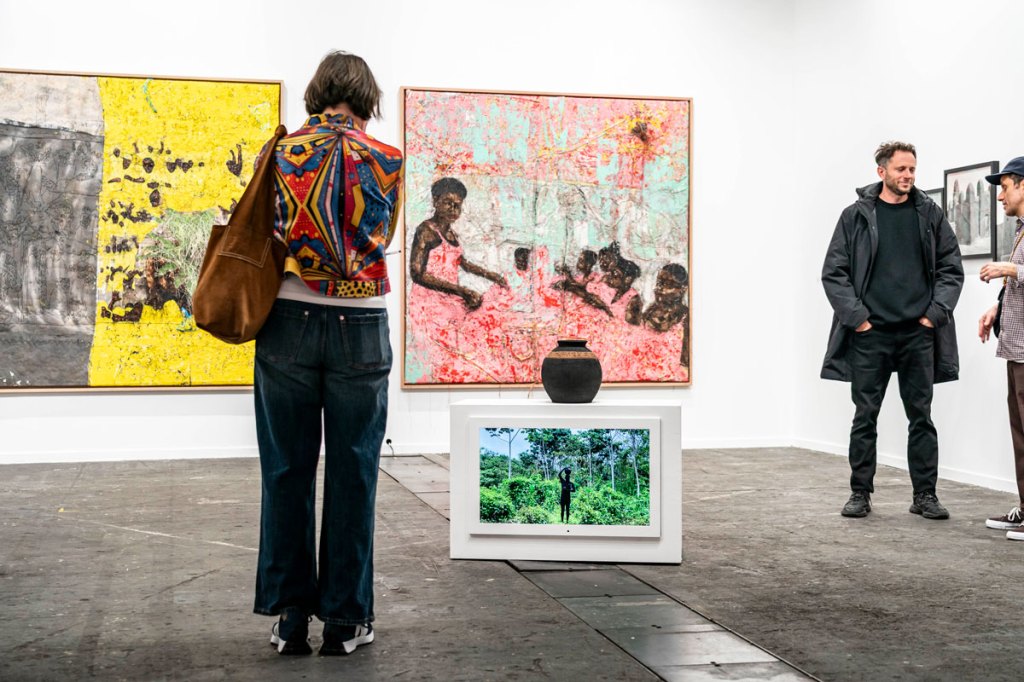

The 45th edition of Arco Madrid, which runs until Sunday, March 8, opened under an unseasonably cloudy Madrileño sky—an atmospheric departure for a fair more often associated with early spring brightness. Inside IFEMA Madrid, the city’s sprawling exhibition and convention complex, a second surprise awaited.
Despite bringing together 211 galleries from 30 countries, the fair floor did not immediately hum with its usual intensity. At the entrance to the first booths in sight, waiters and waitresses lined up with trays of champagne glasses and pastel de nata, ready to greet collectors and VIPs. But by 10 am, the aisles remained relatively uncrowded and unusually navigable. “It’s kind of empty, which surprises me,” said an exhibitor who asked to remain anonymous. “We have been coming for 20 years to Arco, and this morning proves to be particularly slow.”
Related Articles

Some mentioned a competing breakfast event that may have diverted VIP attention. Others speculated whether the current geopolitical climate had prevented the attendance of collectors from the Gulf. But Arco has always followed its own tempo, and by noon, the aisles were teeming with visitors.
“We haven’t sold much yet, but I believe that in the coming days we’ll reap the rewards,” Chantal Crousel, founder an eponymous Paris gallery, told ARTnews. “It’s a slightly slower fair. There’s a great deal to see, and people really take their time looking. When they experience an initial spark, they tend to step back and verify it first.” The gallery has participated in each edition of Arco since its founding in 1982, building a strong network of Spanish collectors over the decades that has caused it to return year after year.
On display in Crousel’s booth is a selection of untitled works by Rirkrit Tiravanija and Wade Guyton, alongside an abstract self-portrait by Abraham Cruzvillegasmade of newspaper clippings, postcards, and tickets painted in red acrylic, reflecting the gallery’s longstanding commitment to conceptually engaged practices. “I enjoy this fair immensely, mostly because it takes place in Madrid—a city I love. The first day feels like an enthusiastic joyride, approached with a connoisseur’s eye,” Crousel said. “People here feel more open, more curious, and genuinely eager to be surprised.”

View of Janis Rafa’s installation in Callirrhoë’s booth at Arco Madrid 2026.
Courtesy Callirrhoë
Athens-based gallery Callirrhoë is participating in the fair for the second time, in Arco’s “Opening. New galleries” section. Founded in late 2020 by Olympia Tzortzi, the gallery has slowly ramped up the number of art fairs it does, having shown at the Liste Art Fair in Basel, Switzerland, and Independent in New York. “Compared with Basel or the US, this fair feels more relaxed, I may say.” Tzortzi said. “You can tell from the architecture: big booths, wide aisles. People have time to look at the works; you don’t feel the pressure.”
Callirrhoë has brought a solo project by Athens-born artist Janis Rafa, who had a solo exhibition at EMST – National Museum of Contemporary Art, Athens, last year. The installation, consisting of 10 saddles and 5 pairs of riding boots, explores the entanglements between the human and non-human world, particularly the relationship between humans and horses. The piece could be bought as one installation, priced at €28,000 ($32,500), or individually. Two works by the artist in the booth sold on the first day of the fair for €7,500 ($8,700) each.
“Over the past few years, one thing has become evident: many artists are looking back to traditional techniques—or even traditional technologies. Instead of rushing toward the future, they are reconnecting with the past and drawing from it to produce something that feels distinctly contemporary,” Arco co-director Maribel López said.
She has also noticed a generational shift among collectors. “We have seen strong interest from a younger generation.” The fair recently partnered with MACBA Studio, an initiative at the Museu d’Art Contemporani de Barcelona for patrons of the museum under the age of 35. “The hope is that all of them will eventually become collectors—though about half of them may already be collecting.”

Maribel López, co-director of Arco Madrid.
Rodrigo Gatinho/Courtesy Arco Madrid
According to López, the more significant shift, however, concerns the galleries themselves. “After two or three years we see how they move from the Opening sector to the General Program sector and that for me is part of the success.”
Curated by Rafa Barber, Anissa Touati, and Cristina Anglada, the Opening section features 19 galleries in business for eight years or fewer. Method Gallery, which has spaces in Mumbai and New Delhi, hopes to expand its European presence and give visibility to artists from India and Pakistan. “We met Portuguese and Latin American collectors at Arco Lisbon last year. We thought it would be a good idea to come to Madrid to reconnect with them,” said Sahil Arora, the gallery’s founder.
In Method Gallery’s Opening booth is a work by Sajid Wajid of a hammer with a head shaped like a small house. The piece addresses “bulldozer justice,” a controversial practice in parts of India whereby local authorities demolish homes and properties—often belonging to members of minority communities—allegedly as punitive action following accusations of unrest or criminal activity, frequently without due judicial process.

A sculpture by Sajid Wajid in Method Gallery’s booth.
Photo Sarah Belmont for ARTnews
Beyond its appeal to emerging galleries, one of ARCO’s biggest draws continues to be the “Profiles | Latin American Art section, which is curated by José Esparza Chong Cuy this year. The program brings together 11 projects of Latin American artists and galleries. “There is still so much to discover,” López said of the decision to keep the section going for the past 15 years. “It would be easy to look somewhere else, but the relationships with [galleries] across Latin America have been built over more than a decade. I’m not one to rush on to the next big thing—I think what we are doing here is very special.”
Exhibitors also reported strong engagement from Latin American collectors. Mor Charpentier, a French gallery with an outpost in Bogotá, has a group presentation of several artists, many of whom have ties to Latin America, including Teresa Margolles, Carlos Motta, Paz Errázuriz, Guadalupe Maravilla, and Daniel Otero Torres. The gallery sold about 15 works across all categories, with prices ranging from €10,000–€60,000 ($11,600–$70,000).
“We have loyal Spanish and Latin American collectors who come here. Many have made the trip to see us. Madrid is a key hub for us,” said Mor Charpentier director Arthur Gruson. “It seems that here we can afford to show edgier, more experimental works than at other fairs, perhaps because the financial stakes are lower.”

Nevena Aleksovski and Maja Babič Košir’s installation Letters from the South: Milena, at Ravnikar’s booth at Arco Madrid 2026.
Photo Sarah Belmont for ARTnews
Piera Ravnikar, whose namesake gallery is based in Ljubljana, Slovenia, also described Madrid as more experimental, more open to emerging and less codified practices. For her, Arco offers a chance to reconnect with Spanish collectors first encountered in Basel, while also testing ambitious presentations.
This year, she invited Nevena Aleksovski and Maja Babič Košir to collaborate for a site-specific project. The resulting installation, composed of drawings, ceramics, and photographs suspended from a wooden structure, pays tribute to women who fought in anti-fascist movements during the World War II, including Milena, Košir’s grandmother. Titled Letters from the South: Milena, the work, priced at €29,000 ($33,600), interweaves personal memory and collective history.
“It’s always risky to show a site-specific installation, because you never know what you are going to get,” said Ravnikar. “Of course, it would be nice to sell, but the goal is to highlight the collaboration between two artists. At a time when society is so focused on ‘me, myself, and I,’ it’s important to present a harmonious alliance—two creators sharing authorship in a genuinely horizontal way.”
One of the stars of the General Program this year seems to be Mallorcan artist Miquel Barceló, shown at Thaddaeus Ropac, which reported a “very positive first day with around half of the booth sold by the afternoon.” Barceló is also featured at Elvira González, one of ARCO’s historic participants located right at the fair’s northern entrance. “We are very happy with our first sales,” a gallery representative said, without providing details. Barceló also took over the booth of Madrid’s daily newspaper El País to mark the publication’s 50th anniversary. Titled “El pintar diario,” the exhibition includes 50 works on newsprint.

An installation by Jesús Rafael Soto, brought to Arco jointly by neugerriemschneider and Elvira González.
Courtesy Arco Madrid
It was difficult not to raise the question of the VAT protests that took place in Spain in early February. Spanish galleries and art professionals had mobilized to denounce the relatively high VAT applied to art sales, arguing that it undermines the competitiveness of the local market compared with other international hubs. López, Arco’s co-director, did not say whether the issue might affect sales at the fair when asked, replying instead by saying that she was in support of the VAT protests and that a reduced VAT would “make it easier to sell [artists’] work.”
Vanessa Carlos, founder of the London-based gallery Carlos/Ishikawa, said she had not been aware of the protests. “VAT is set at around 20 percent in the United Kingdom and can reach approximately 40 percent in Brazil,” she noted. At the fair itself, however, the issue seemed largely absent from conversations, overshadowed by the pace of sales and the international mix of collectors circulating through the aisles.