
Beyond Shanghai’s glittering luxury shopping malls, an alternative — and perhaps even more compelling — way to enter the city’s competitive retail market is to set up shop along the tree-lined streets of its downtown neighborhoods.
One of the latest brands to embrace that approach is Nanamica, the Japanese fashion label whose name translates to “house of the seven seas.”
The nautically inspired brand unveiled its latest store Saturday on Wukang Road, a leafy enclave that founder Eiichiro Homma likened to the Daikanyama of China.

Eiichiro Homma at Nanamica’s Wukang Road store in Shanghai, China.
Courtesy
Neighboring Le Labo, and a stone’s throw away from Lemaire‘s Shanghai location — its biggest store yet — the Nanamica shop sits within Ferguson Lane, a small Art Deco complex that was named after the American scholar and Chinese art dealer John Calvin Ferguson.
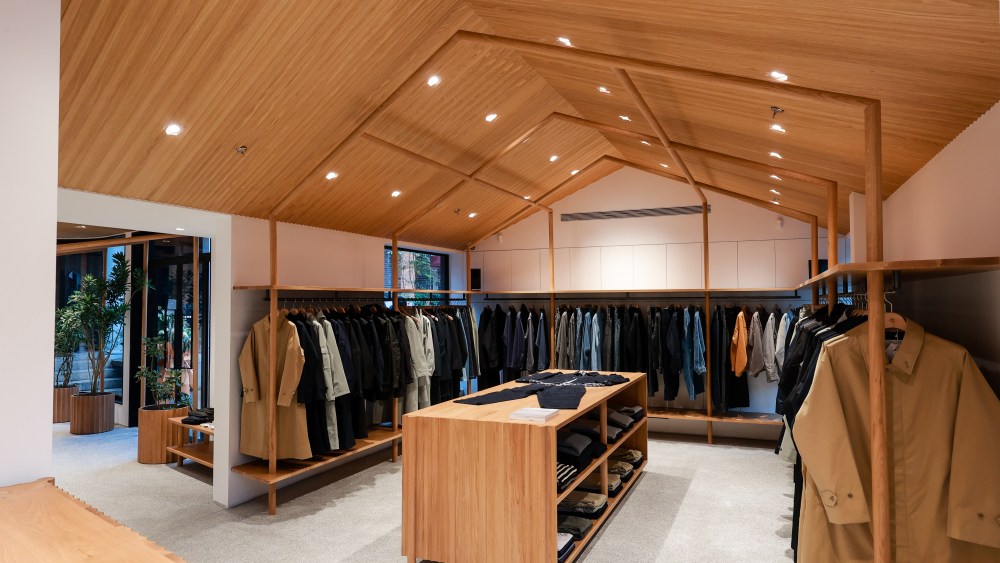
The store, with its navy-tiled exterior and wooden cabin interior, is L-shaped and boasts a “beach house in the city,” spanning around 750 square feet.
For Homma, the store is meant to create a relaxing atmosphere for staff and shoppers alike.
“My decision on a location must be where we like to go, where we like to live, yet not too noisy and crowded. We don’t really have an interest in having a standalone store in a mall — that we can do through wholesale partners,” said Homma, adding that shopping malls’ number-driven culture could become an unwanted pressure for the brand, and come into conflict with the brand’s “consumer-oriented composition.“
Nanamica currently works with around 30 retailers in China.

Inside Nanamica’s Shanghai store.
A street shop will also become a natural backdrop for documenting staff members’ daily looks, which Homma expects employees to spend 20 to 30 minutes a day putting together.
“They [the staff] should coordinate something stylish, something different — if you have five brothers and sisters, everybody still looks different, even though they share the same DNA,” said Homma.
“When the shoppers open our door, they can see our staff looking better than their expectations, they can also see their genuine love and knowledge of fashion — if that’s not the case, some customers might feel, ‘I am better than you,’” said Homma.
Landing on Wukang Road also means that the brand can easily convey a lifestyle, which in turn better explains its “new outdoor” brand proposition.
“Nanamica is based on our experience of making outdoor garments for nearly 20 years,” said Homma, who also launched The North Face Purple Label in Japan after joining Nanamica’s parent company Goldwin in the 1980s. “But Nanamica is meant to be worn casually, and it’s made for daily life.”
Acknowledging Chinese consumers’ growing appetite for outdoor fashion, Homma said the market still lacks true diversity. For now, Nanamica is focused on attracting what he calls “the 20 percent minority who want something that feels genuinely new.”
For Homma, who splits his time between developing technical fabrics and designing two collections a year, small changes to the styles are key to outdoor fashion design.
“If you look at the sketches of our designs, compared to the first ten years, they may look almost the same, but the sizing difference and the technology behind the fabrics might be different,” said Homma. “Mixing that with fashion tendencies, we can create something different.”
After opening four doors in Japan and one in New York, China marks the brand’s second global destination, with London set to follow.
“Since the brand name means ‘seven seas,’ the initial plan is to have at least seven stores, ideally one on each continent, so we can experience the regional character of each place,” Homma said.