


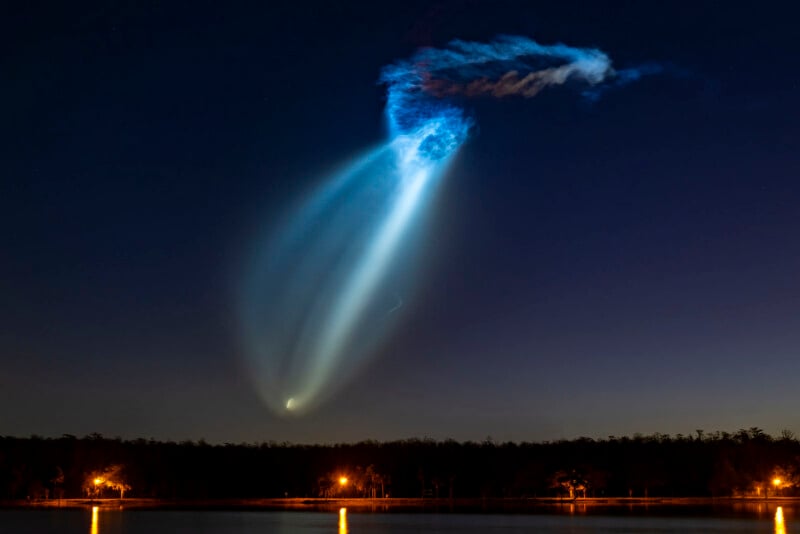
A lucky few in Florida got to see a spectacular space jellyfish early on Wednesday morning. The phenomenon was caused by a SpaceX rocket and a still hidden Sun.
A Falcon 9 rocket blasted off at approximately 5.50 AM on March 4 carrying 29 Starlink satellites for low Earth orbit. As the rocket climbs high, its exhaust gases spread into the thin upper atmosphere, often in the shape of a big dome like the head of a jellyfish.
But although people on the ground are still in darkness, the rocket plume above is being illuminated by the Sun. As the exhaust expands outward in the shape of a large bell, from the ground it looks like a gigantic jellyfish drifting across the sky.
The plume can sometimes be from 1,000 miles away: the Falcon 9 rocket blasted off from Cape Canaveral Space Force Station in Florida but the space jellyfish was likely visible as far away as Georgia and along the East Coast.
SpaceX shared some spectacular photos of the launch.


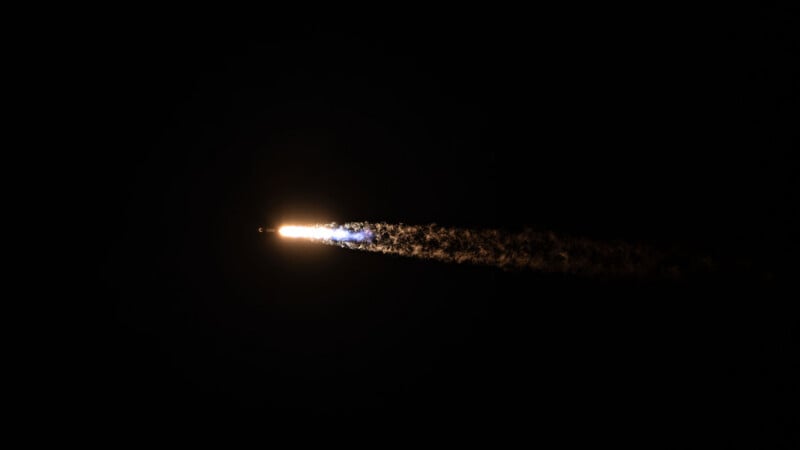
Photos I got from Orlando, FL pic.twitter.com/NcsbMh4aDf
— frogger (@TroyM2002) March 4, 2026
Space.com reports that space jellyfish aren’t uncommon in Florida and they appear regularly when SpaceX rockets take off at dawn or dusk.
After the Falcon 9 had dropped off the Starlink satellites, its first stage, Booster 1080, then landed on a droneship called “A Shortfall of Gravitas” that was waiting for it in the Atlantic Ocean off the coast of Florida.
Space.com notes that the satellites, which are used for SpaceX’s broadband internet service, are fast approaching 10,000 units. The 29 added to SpaceX’s megaconstellation this week is the company’s 28th mission in 2026 alone.
The growing number of satellites in the night sky is a cause for concern among astronomers who fret that they will impede humanity’s view of the Universe. Even space telescopes like Hubble are being affected.
Image credits: SpaceX