
The Producers Guild Awards are always about the power players.
Last weekend’s show pulled in Oscar contenders trying to woo undecided voters: Paul Mescal and the next day’s Actor Awards-winner Jessie Buckley presented the “Hamnet” clip, while others on hand included Kate Hudson, Amy Madigan, Elle Fanning, Wunmi Mosaku, Delroy Lindo, Jacob Elordi, and Teyana Taylor.
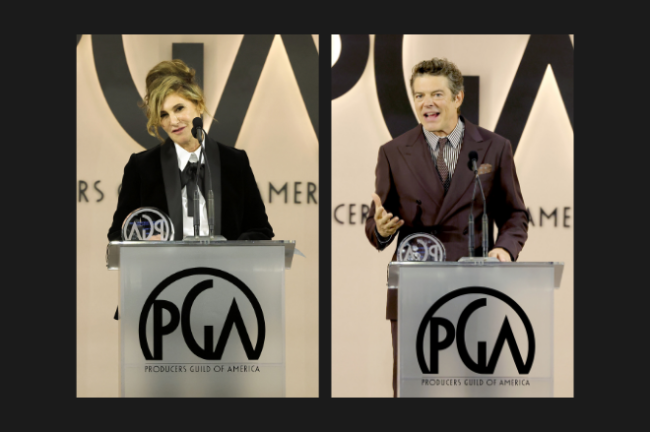
However, the CEO wattage was super-sized. Mingling at the front of the room were IAC chairman and author Barry Diller, Marvel CEO Kevin Feige, Sony Motion Picture Group chairman Tom Rothman, and CAA chief Bryan Lourd. They were on hand to recognize two wildly different mega-producers: Amy Pascal, who received the David O. Selznick Achievement Award in Theatrical Motion Pictures, and Jason Blum, who received the Milestone Award.


Greta Gerwig, who has no horse in this year’s Oscar race, presented to Pascal. Why would she abandon her New York post-production on “Narnia: The Magician’s Nephew” and schlep to Los Angeles? Because Pascal produced it — and when she had Rothman’s job, she took the meeting with Gerwig when she pitched “Little Women.”
“When I met Amy Pascal, I had never directed a film,” said Gerwig. “I sat in her office with her with nothing but a burning desire to make ‘Little Women’ and a very specific take on it. At first, I was pitching her just as a writer. And at some point, she said, ‘Who do you think should direct it?’ And I said, ‘Oh, I’ll be directing it. I’ve seen the future, and that’s what I’m doing.’ She didn’t laugh at me, and she didn’t flinch. She liked the song. She simply believed in me. That’s who she is.”

Michael Buckner/Deadline/Shutterstock
Pascal forges an ex-studio chief’s knowledge, relationships, and favors into big-budget commercial pictures. She is the last of her kind.
Her talent in pulling off a powerful post-studio career is rare. But beyond that, the future of Hollywood leaves little room even for the possibility. Legacy studios face extinction at worst or continued contraction at best (whatever debt-burdened Paramount chief David Ellison may claim about maintaining two studios that churn out 30 films a year). Ask any successful producer about the difficulties in getting quality commercial movies made. It’s IP or bust.

Pascal knows how to play the game — and, notoriously, to overspend. She most recently produced Phil Lord and Christopher Miller’s live-action outer space epic “Project Hail Mary” (Amazon/MGM, March 20). Like “The Martian,” it’s based on an Andy Weir sci-fi novel, this time starring Ryan Gosling as a scientist in space who encounters an alien. Early reveiws suggest a crowd-pleasing spectacle and likely box-office juggernaut. It also cost $248 million to produce.
When Amazon turned to Pascal (and fellow quality producer David Heyman, of “Harry Potter” fame), to produce the next James Bond, it inspired a Hollywood sigh of relief: Two producers who reliably make smart movies with commercial instincts.
But what are the odds that a future Hollywood could accommodate a future Pascal? She began in development, worked through Twentieth Century Fox (gone), Turner Pictures (gone), and then Columbia Pictures, where she first joined in 1988 and became chairman in 2006.
Her specialty is high-quality big-budget films that feed the studio beast. Sometimes that was “The Da Vinci Code,” a “A League of Their Own,” or “Sleepless in Seattle.” She also loves finding a broad canvas for more challenging material: “Zero Dark Thirty,” “The Social Network,” “Captain Phillips,” Spike Jonze’s “Adaptation,” and David O. Russell’s “American Hustle.” This is where her heart lies.
But in the year 2026, how many of those films could be made today, and at those budgets?
 “The Social Network”
With Christopher Nolan and Steven Spielberg as the outliers (both at Universal), studios don’t prioritize high-quality, big-budget filmmaking. Even when it comes to the popcorn movies provided by tentpole franchises, Hollywood wants to cut spending. Pascal is the best we have, but there are very few franchises like James Bond.
The transitional figure for the future could be horror master Jason Blum and his Blumhouse (“Paranormal Activity,” “Insidious,” and “Black Phone” franchises among their best grossers). At the PGAs, Diller cited his claims to fame: “300 films made on the lowest pay scales in film history,” he said. “But he also did something quite extraordinary in itself, and that’s helping artists tell stories and helping them make a lot of money along the way, and rarely did the two go hand in hand.”

Blum learned taste at his father Irving’s Ferus Gallery in Los Angeles; he learned how to make movies at Miramax with Harvey Weinstein. At the PGAs, Blum said that his father taught him “taste doesn’t come from consensus, that belief has to come before validation.”
Blum is the kind of heat-seeking producer who, as soon as he saw low-budget gay hockey romance “Heated Rivalry,” tracked down Canadian producers Jacob Tierney and Brandon Brady to find out how it got made. He fervently believes that hits like that one “tell the next generation that producing matters, that passion matters, that belief matters, that sometimes, oftentimes, the market is wrong.”
What Blum represents is not only a belief in the continued appetite for the right horror movie, but also the bloodhound instinct to sniff out new talent. As the indie universe and all those film festival farm teams get smaller, that’s what the future needs.
Blum has proved that sharp genre scripts, an eye for talent, and a disciplined approach to the bottom line can yield strong results; by seeking greater volume through Blumhouse’s merger with “The Conjuring” director James Wan’s Atomic Monster, he next wants to prove it can scale. If the answer is yes, expect much of Hollywood to follow suit.