
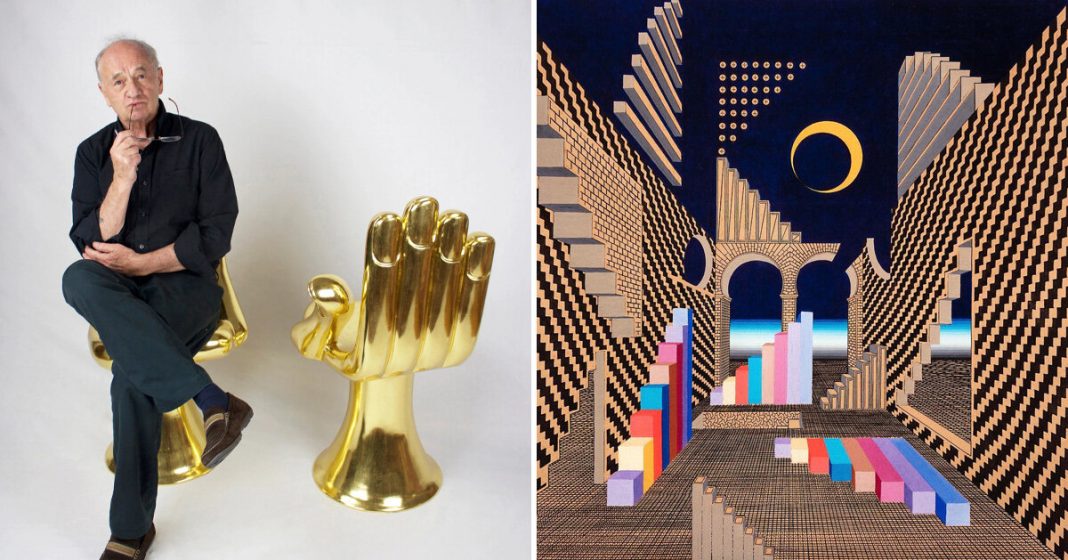

artist pedro friedeberg has passed away at the age of 90
Mexican artist Pedro Friedeberg, celebrated for his ornate architectural drawings and the iconic hand-shaped chair, has passed away at the age of 90. Following the news of his passing, designboom looks back at a visit and interview in the artist’s Mexico City home and studio, stepping inside the fantastical world he constructed over more than six decades. Trained as an architect but celebrated as a surrealist artist and designer, Friedeberg developed an instantly recognizable visual language where gothic architecture, optical patterns, symbolism, and humor come together.
When designboom visited Friedeberg in Mexico City, the artist described living deliberately out of step with contemporary culture. ‘I try to live a very old fashioned lifestyle,’ he told us, admitting he relied on an assistant to handle computers and email while he focused on drawing, painting, and reading. His studio mirrored this attitude: a dense, eclectic environment where classical music played and artworks accumulated like artifacts from an alternate architectural universe.
Despite decades of international recognition, Friedeberg remained skeptical of the contemporary art world and resistant to easy explanations of creativity. Asked what advice he would give young artists, he answered with characteristic irony. Real artists, he said, would never follow anyone’s advice anyway. Becoming an artist, in his view, was simply a matter of fate.

Golden Hand Chair, 2013, mahogany wood and gold leaf, 79 x 60 x 60cm
architecture turned dreamscape
Born in Florence in 1936, Friedeberg moved with his family to Mexico City at the age of three, where he would spend most of his life and career. Originally studying architecture at Universidad Iberoamericana, he soon gravitated toward the artistic circles surrounding Mathias Goeritz and Remedios Varo, who encouraged him to pursue his own work. His first solo exhibition took place in 1959 at Galería Diana in Mexico City, quickly gaining attention and leading to his inclusion in a retrospective of Mexican painting at the Museo de la Ciudad Universitaria the following year.
Although Friedeberg trained as an architect, the discipline left a permanent imprint on his work. His intricate drawings and paintings often resemble elaborate imaginary buildings, labyrinths, and ornamental structures.
Reflecting on those early fascinations during our studio visit, Friedeberg explained how architecture first captivated him as a child. ‘I found them fascinating because in Mexico, there were no buildings like them. The perspective in which they were drawn and the detail mesmerized me. I thought gothic architecture was the best thing in the world!’ he told us back in 2014.
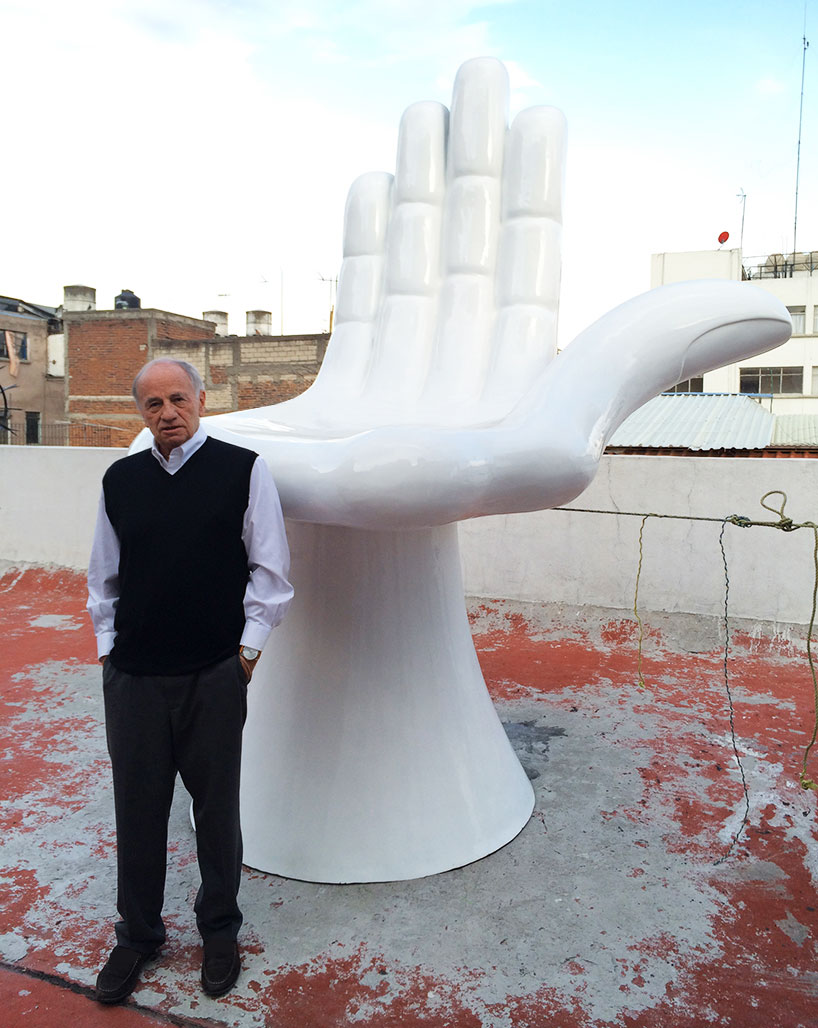
Pedro Friedeberg on the roof of his home / studio with a giant fiberglass hand chair | portrait © designboom
a surreal pastiche and the birth of the hand chair
Friedeberg’s practice soon evolved into a surreal and highly eclectic visual universe, drawing inspiration from a wide array of sources, including Renaissance architecture, surrealist storytelling, and graphic illustration. ‘I think of my work as a pastiche. There’s a little bit of everything I like in there, a bit of Piranesi, a bit of Beardsley, a bit of Escher,’ he shared with designboom.
This playful hybridity became a defining feature of his work, most famously embodied in the hand chair he designed in 1961. Carved from mahogany, the sculptural chair takes the form of an upright human hand, with the palm serving as the seat and the fingers forming the backrest. Friedeberg recounted to designboom that the piece began almost as a joke while he was working with Goeritz and a master carpenter named José González. ‘Truth be told, I made the hand chair half jokingly,’ he admitted. Yet the object quickly became a sensation. Shortly after its creation, a collector visiting Friedeberg’s studio ordered several chairs for a gallery in New York, launching what would become one of the most recognizable designs in twentieth-century art and design. Versions of the chair have since appeared in museums, galleries, and design collections around the world.
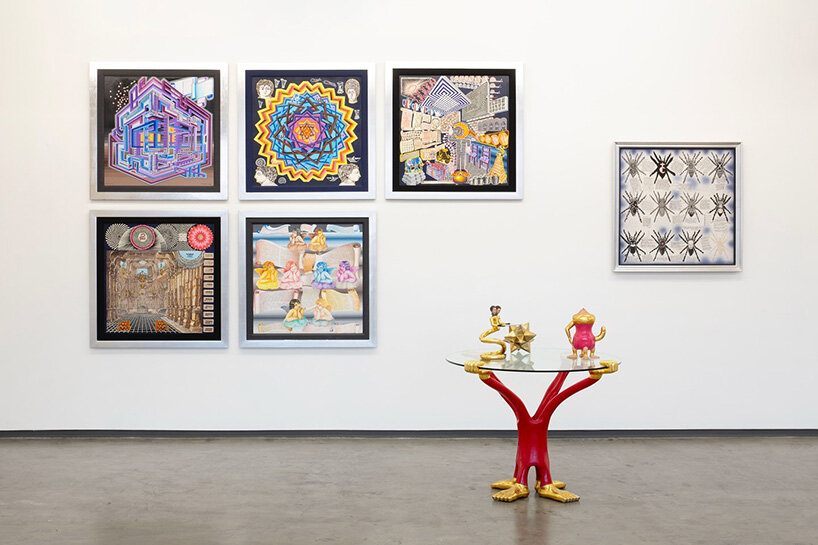
70 Years of Creation curated by Michel Blancsubé at SAENGER Galería | image via @pedrofriedeberg
los hartos and the rupture generation
Beyond his objects and drawings, Friedeberg also played a role in reshaping Mexico’s artistic landscape during the 1960s. In 1961, he joined Goeritz in founding Los Hartos, a group that included José Luis Cuevas, Chucho Reyes, Ida Rodríguez Prampolini, and Alice Rahon. The group rejected the grand narratives and seriousness associated with modern art, advocating instead for irony, eclecticism, and irreverence.
Friedeberg also became associated with the broader movement known as the Ruptura, a generation of artists who challenged the dominance of Mexican muralism and opened the country’s art scene to international experimentation. Throughout the 1960s and 1970s, his work was widely exhibited internationally, including presentations in New York, Paris, Washington DC, Lisbon, Munich, and numerous biennials across Latin America and Europe. His surreal architectural drawings, prints, and sculptural furniture entered museum collections worldwide while his exhibitions continued to expand across the United States, Europe, and Japan.
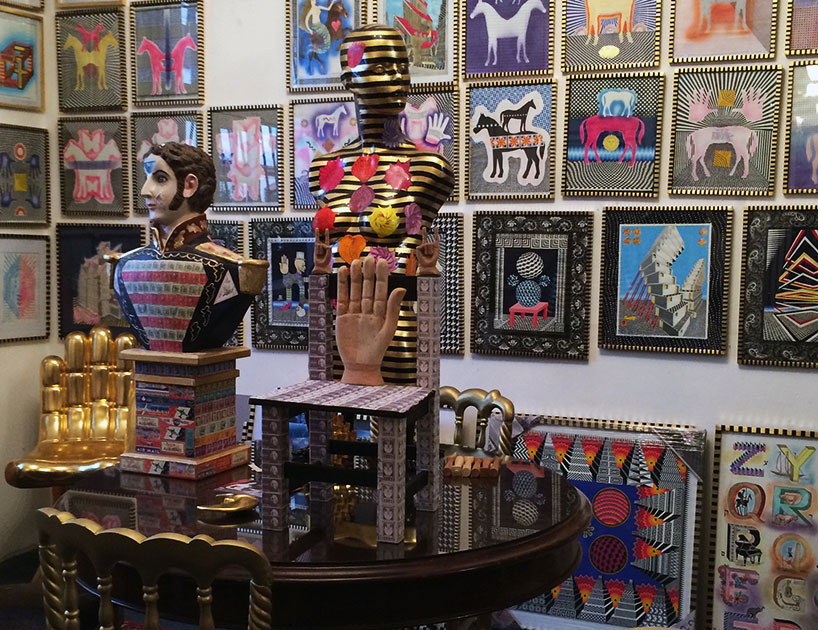
view of Pedro Friedeberg’s home / studio | image by © designboom
an old-fashioned life inside a surreal studio
Despite his international recognition, Friedeberg maintained an eccentric and deliberately old-fashioned lifestyle. When designboom visited him at his Mexico City studio, the artist described himself as someone who preferred a slower pace of life, far removed from contemporary digital culture. ‘I don’t even know how to use the internet properly,’ he noted. The studio itself reflected the same layered aesthetic as his work, filled with artworks, books, sculptures, and architectural references that formed a dense personal universe. His tastes in music were similarly rooted in tradition. ‘I’ve been listening to the same classical music for almost 75 years now; Bach, Brahms, Boccherini, and Strauss.’
Friedeberg’s reflections on art often carried dry humor and a skepticism toward contemporary trends. During the conversation, he spoke candidly about his mixed feelings toward much of what passes for art today. ‘I don’t like very much of it, because a lot of what people say is art isn’t, in my opinion.’ That wit extended to the hand chair itself, a work he sometimes joked had taken on a life of its own. ‘Sometimes I fall out of love with the hand chair because I’ve seen it so much now, but it’s become an important part of my work as well, so I can’t hate it completely – it’s kept food on my table,’ he said.
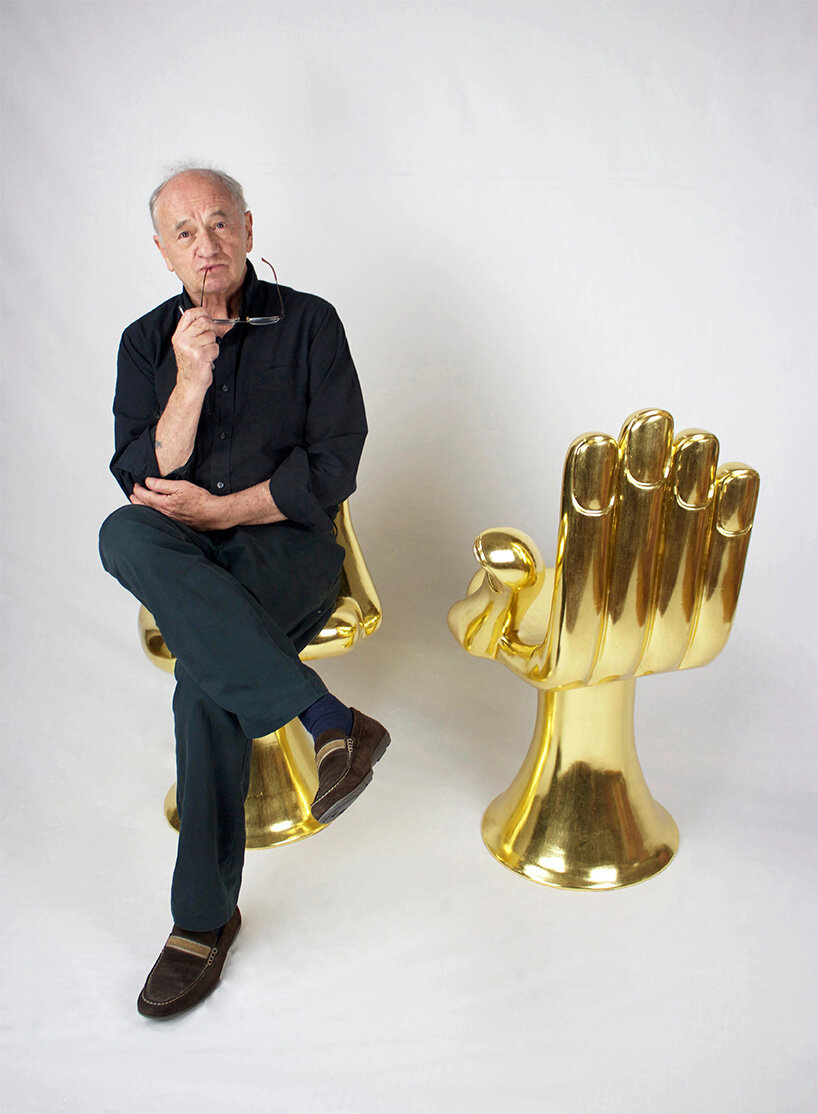
Pedro Friedeberg sitting on his Hand Chair | image via Friedeberg Fine Arts
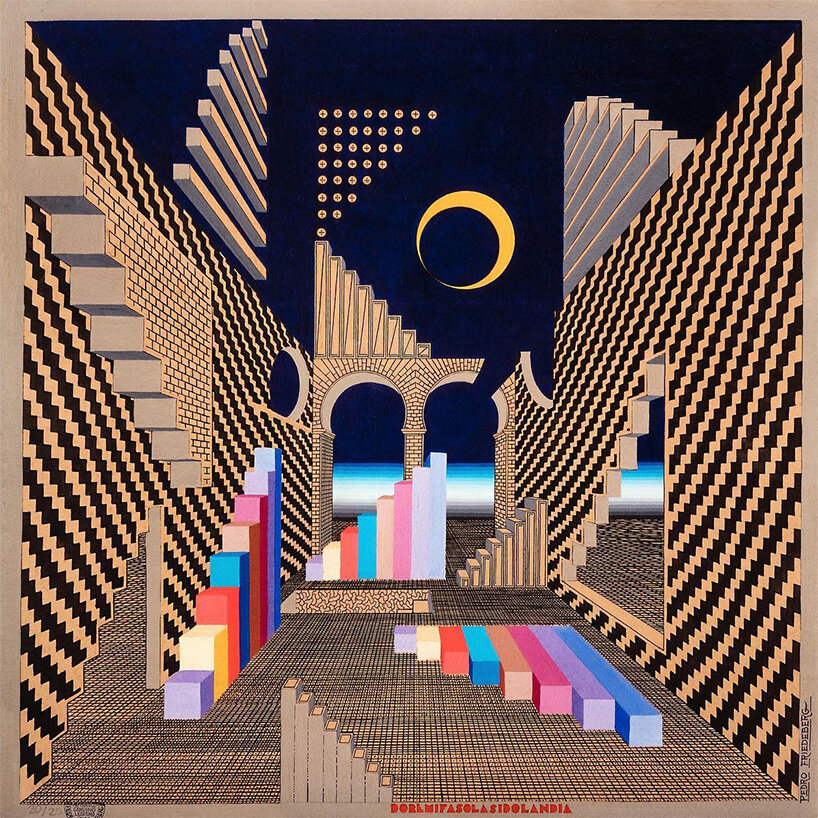
Doremifasolasidolandia, 2016 | image via @pedrofriedeberg
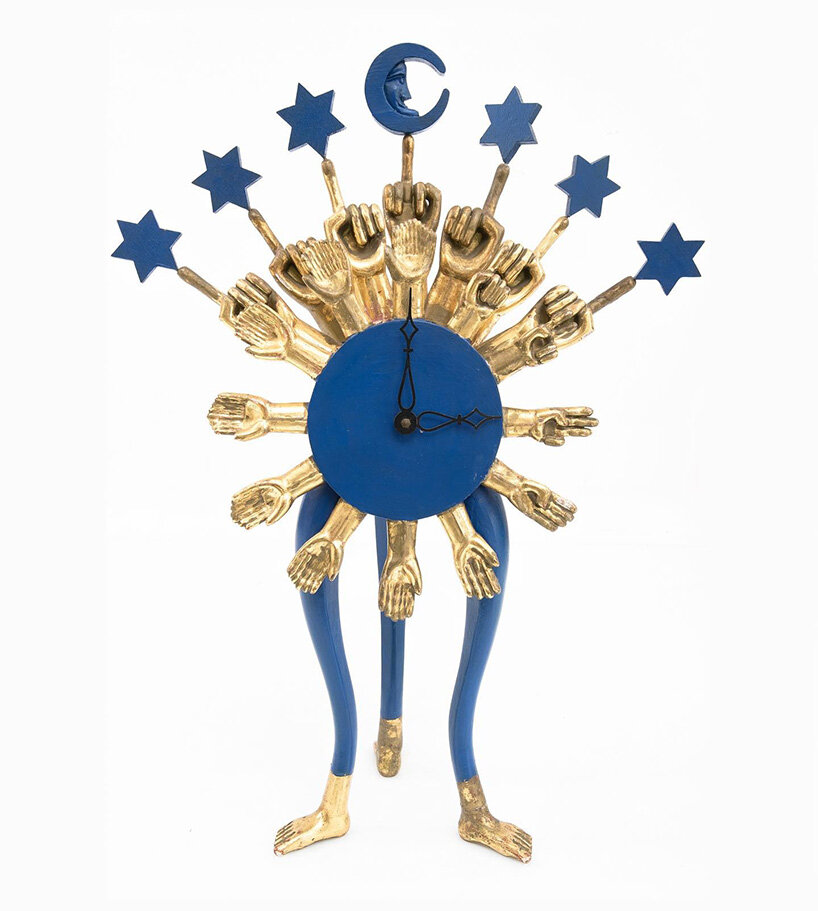
Astroclock-Ological Time, 1979 | image via @pedrofriedeberg
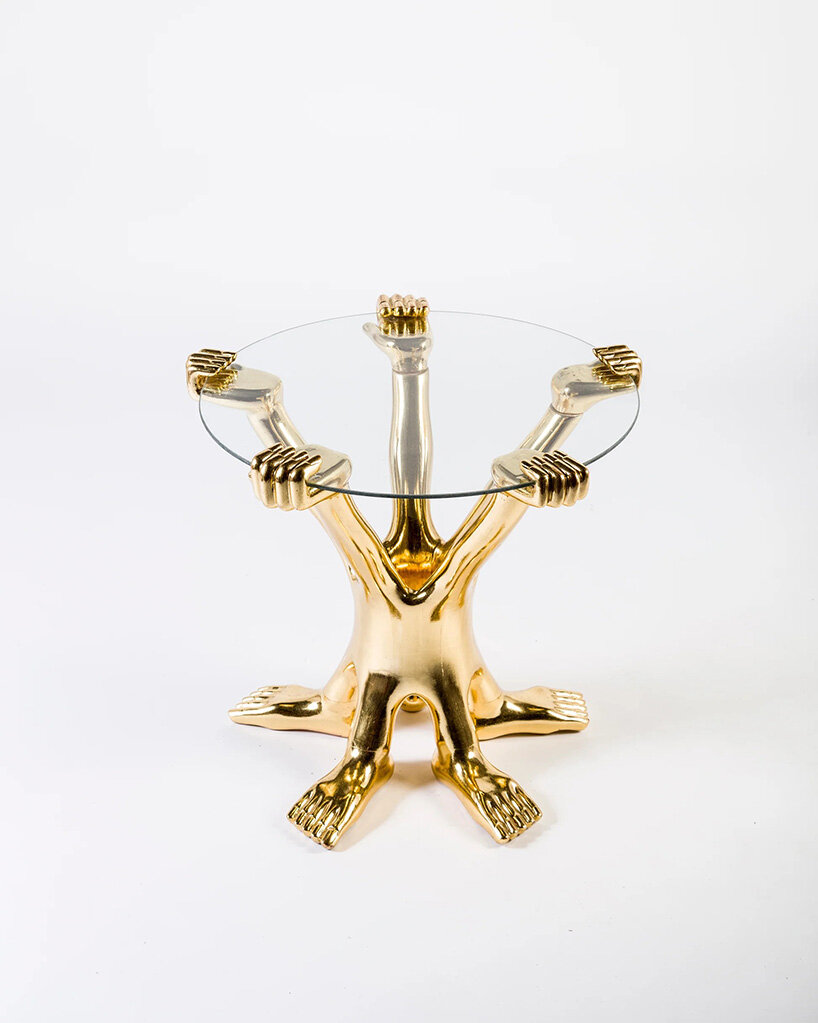
Gold Five Hand and Foot Table | image via Friedeberg Fine Arts
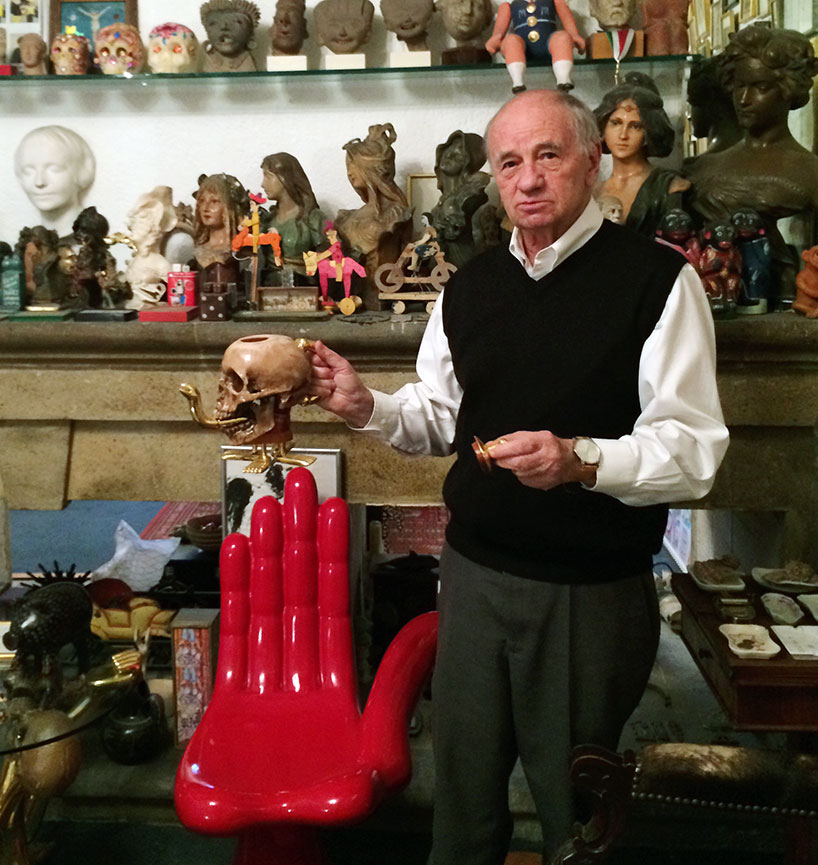
Pedro Friedeberg at his home / studio in Mexico City | portrait © designboom
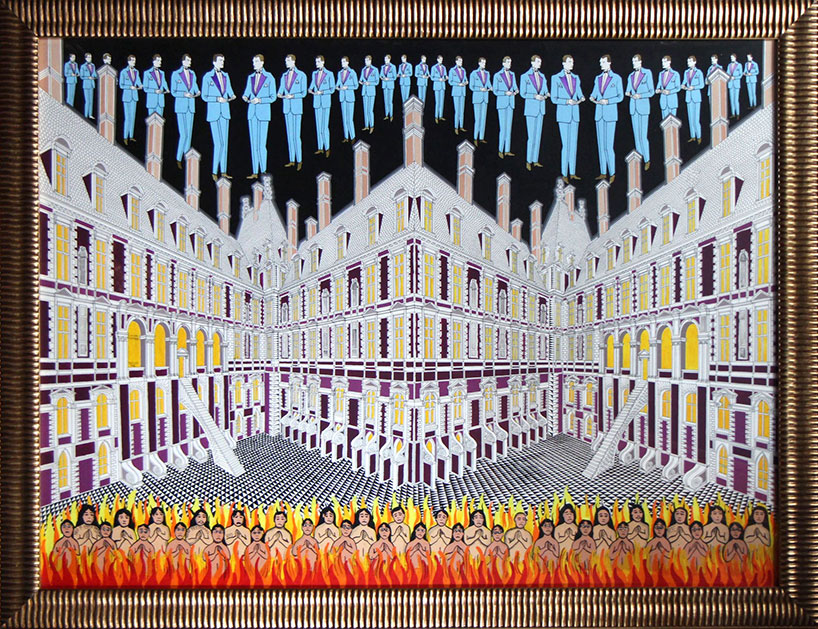
Hell is Other People
project info:
artist: Pedro Friedeberg | @pedrofriedeberg
born: January 11th, 1936, Florence, Italy
died: March 5th, 2026