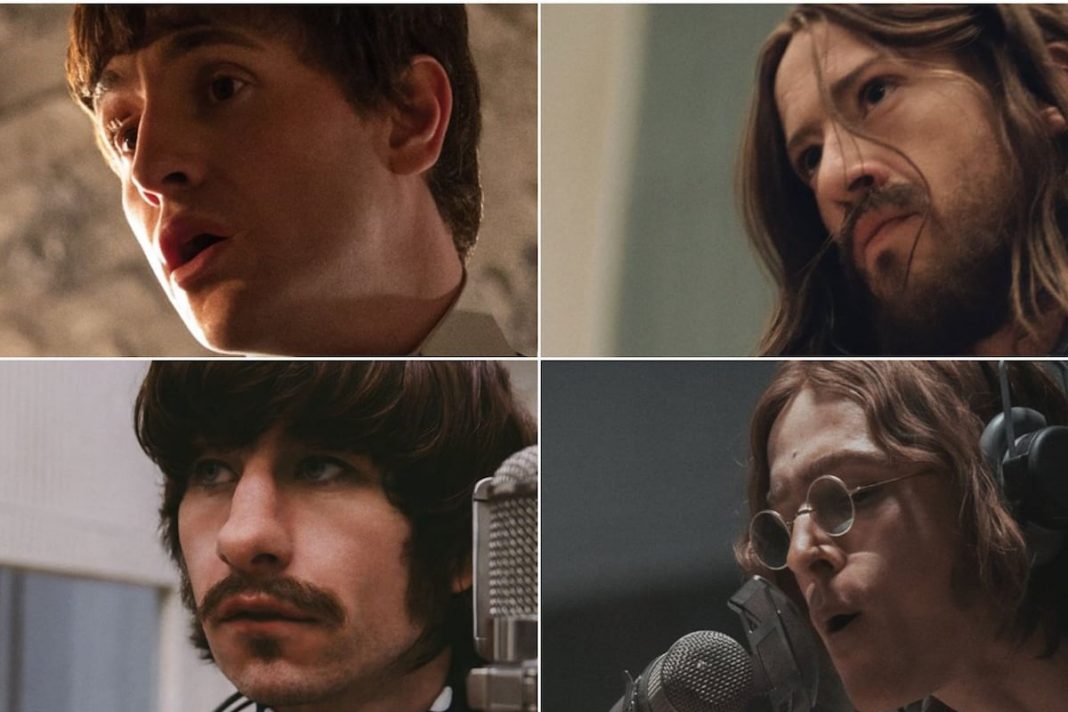

Back in early 2024, Sam Mendes announced his latest venture: a mammoth series of Beatles biopics, with one standalone film per member of the Fab Four. By early 2025, it was confirmed that Paul Mescal, Harris Dickinson, Joseph Quinn, and Barry Keoghan would be starring as Paul, John, George, and Ringo respectively.
We’ve now had a glimpse at the cast in their roles. In January, postcards featuring the four leads in character were left dotted around the Liverpool Institute for Performing Arts, with the images circulating on the internet soon after. More recently, behind-the-scenes clips of the actors filming in London and Liverpool have spread across social media. One short video posted on TikTok sees Mescal cycling down a suburban street, guitar slung over his back, filming a scene which is presumably meant to take place in the late 1950s; another captures Keoghan pacing around wearing the band’s signature Cuban-heeled boots.
These new sneak peeks have, unsurprisingly, raised some eyebrows. Some are taking issue with how old the cast are: Joseph Quinn, for example, is currently 32 years old, when Harrison was just 15 – more than half Quinn’s age – when he first auditioned for the group on the top deck of a bus, impressing the typically steely Lennon with a rendition of Bill Justis’ “Raunchy”. Others believe the actors are simply too famous already, which will make it difficult for audiences to suspend their disbelief and immerse themselves in the narrative.
Many are also troubled by the fact that none of the film’s stars come from Liverpool (or Northern England, more broadly): Mescal and Keoghan are both Dubliners, while Dickinson and Quinn were born and raised in London. “Four unknown lads from Liverpool being played by four world-known actors, and not a single one from Liverpool,” reads one comment under a TikTok clip depicting filming in Crosby. “No Scousers in this movie is wrong,” reads another. Some Scousers have been cast in the film, admittedly – including Leanne Best, Bobby Schofield, and David Morrissey – but the fact remains that none of the leads hail from Merseyside.
The furore has thrown up an interesting question: should Northern roles go to Northern actors? The Beatles biopic aside, the lack of opportunities afforded to Northern actors has been a hot topic in recent months, thanks to Emerald Fennell’s decision to cast two iPhone-faced Australians as Cathy and Heathcliff in her adaptation of Wuthering Heights. Like the Beatles’ origin story, Charlotte Brontë’s tale of two doomed lovers is another narrative distinctly grounded in the North of England and, parallel to the controversy around the ‘whitewashing’ of Heathcliff, many objected to the absence of Northern talent at the heart of the film.
On the one hand, arguing that actors should be limited to playing roles which neatly align with their own identities seems antithetical to the craft. Acting is, after all, supposed to be the art of embodying a character, no matter how different their story is from your own. Plus, inserting identity politics into casting processes could be a slippery slope. Where does it end? Should straight characters only be played by straight actors? White characters by white actors? Should actors of colour be barred from taking on coveted Shakespearean roles like Hamlet or Lady Macbeth? (Obviously not, would be my answer).
But directors casting non-Northern actors in Northern roles feels like a missed chance to give up a leg-up to underrepresented talent. The British entertainment industry is painfully London-centric, with most major casting directors, agents, and respected drama schools (such as RADA and LAMDA) located in the capital, and casting Northerners in Northern stories would be an easy way to encourage the decentralisation of film and TV.
Of course, it would be reductive to assume that all four leads in the Beatles biopic are as ‘underrepresented’ as one another, simply because none of them come from the north of England. Keoghan, for example, has been candid about the extreme adversity he faced growing up between foster homes in a working-class area of Dublin. And while Dickinson was born and bred in northeast London, there’s “no public school, no Oxbridge, no drama school” on his CV, as a 2022 Guardian article put it, which makes him an “outlier in British acting these days”. Quinn, who attended a Battersea private school costing nearly £25,000 a year, is arguably the only one out of the four who had a more-than-comfortable childhood.
With research finding that 73 per cent of performers in British theatre and film are middle-class, it’s undoubtedly a win to see actors from modest backgrounds like Keoghan, Mescal, and Dickinson achieve global success. But it would be nice for directors to give more underrepresented actors a chance (especially those who haven’t already been nominated for Oscars). Plus, it would likely level up the entire industry, too.
Because there’s a lot of undiscovered talent outside of the capital. Take Skins, the Channel 4 comedy drama: creators famously scouted their cast from drama clubs and local schools in Bristol, lending the show a gritty, raw edge, which quickly emerged as its USP – and more importantly, the cast were good. Many world-leading British actors today first cut their teeth on the set of Skins, from Kaya Scodelario to Dev Patel to Hannah Murray to Nicholas Hoult to Daniel Kaluuya (who, in 2021, bagged the Oscar for Best Supporting Actor).
Or, for a more recent example, take Adolescence. Stephen Graham, the co-creator of the Netflix hit, acknowledged in an interview that he made a conscious effort to cast a budding Northern actor as the show’s lead, and that he felt Owen Cooper’s subsequent success has been the show’s “biggest achievement”. To date, Cooper has won an Emmy, a Golden Globe, a Critics’ Choice Award, and an Actor Award for his startlingly powerful performance as a teenage killer. He also landed a minor role as a young Heathcliff in Fennell’s “Wuthering Heights” off the back of his successful turn in Adolescence – ironic, really, given that he likely wouldn’t have been on Fennell’s radar if it wasn’t for Graham’s willingness to take a chance on a then-unknown teen from Warrington.
With all this in mind, the Beatles films feel like a wasted chance to cast some new, Northern talent. I can understand why Mendes plumped for his four leads: their star power will likely get audiences – particularly younger audiences – to the cinema in droves, and it’s likely he felt pressure to cast reliable, established actors, given the project marks the first time The Beatles and Apple Corps Ltd have granted full life story and music rights for a biopic. But at the same time, the films could have potentially launched lifelong careers for a quartet of young Scouse actors and, moreover, helped craft a more emotive, believable piece of art. In any case, Mendes’ film isn’t the first Beatles biopic, and it certainly won’t be the last. Here’s hoping that one day we’ll get a film about the four lads from Liverpool starring, well, four lads from Liverpool.