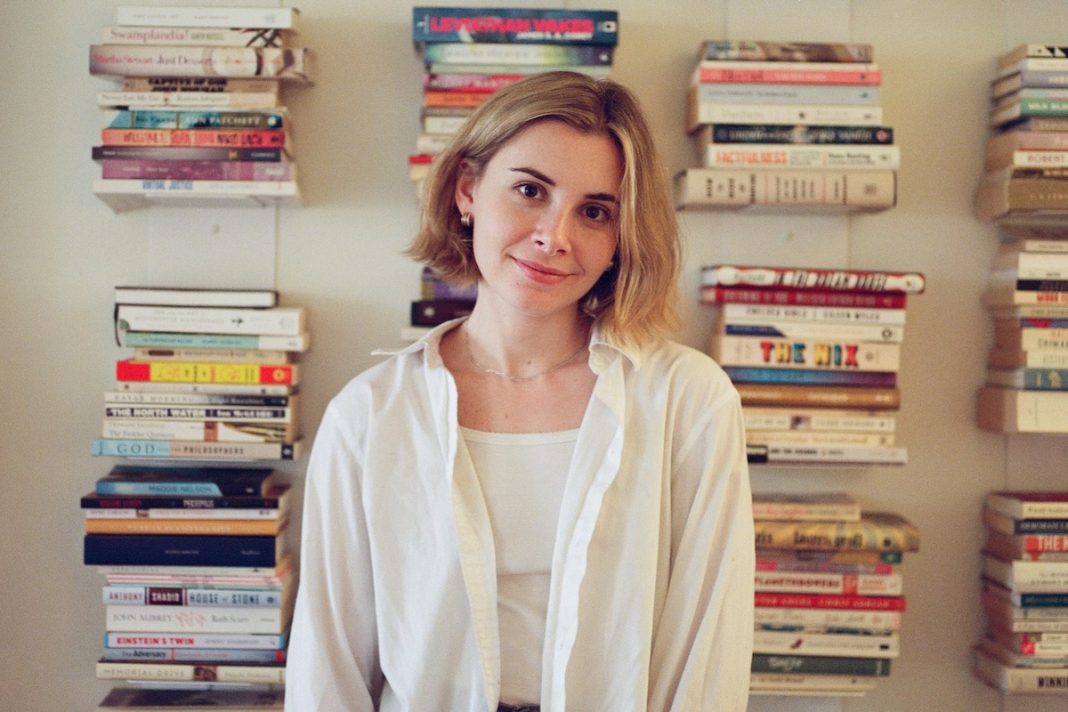

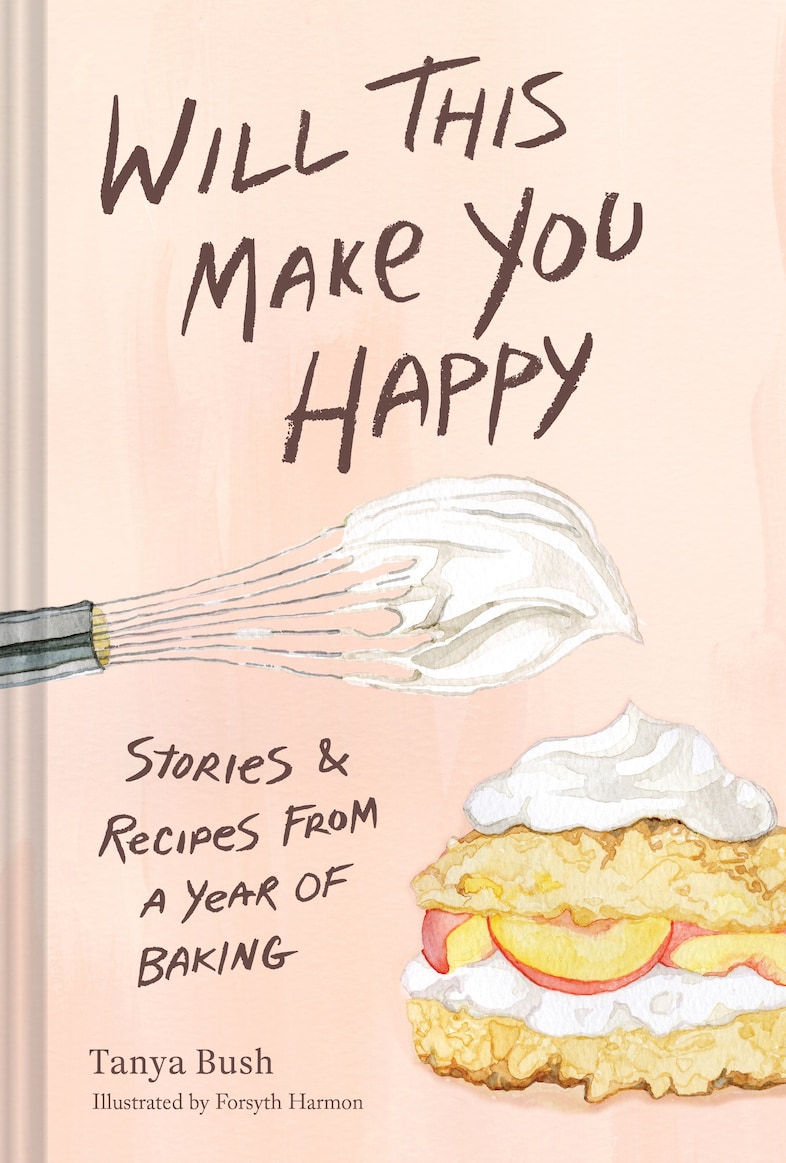
At the start of Tanya Bush’s new narrative cookbook, Will This Make You Happy, she and “the boyfriend” (whose name we never get) are eating a lot of takeout. “It’s just function and utility over pleasure,” she says. By the end, he’s more attentive to her appetite. Food serves as a love language of sorts, reflecting their relationship status. The tale of self-discovery through appetite, complete with 50 inventive but approachable baking recipes, is fitting for a time when Ozempic culture has raised questions on just how important appetite is to pleasure. “When I’m not hungry, I feel dead inside,” Bush says. “My appetite for physical food and for life are so linked.”
I first met Bush at Little Egg in Brooklyn, a community restaurant where she works as a pastry chef. She brought me over a vegan apple fritter as soon as I sat down. In between crunchy, delicious bites, we talked about the year of baking chronicled in her first book, where she perfectly balances the anxieties of growing up and the gloom of youth alongside the practical, assured nature of her recipes. It’s a journey that started when she was 23, depressed, unemployed and in a long-term relationship that had lost its spark. One day, she randomly decided to bake a cake. This sent her on a path from her tiny apartment to an Italian agriturismo to working in restaurants in New York and, eventually, onto her work now, both as a self-taught pastry chef and the co-founder of the literary food publication Cake Zine with Aliza Abarbanel.
Bush is not a newcomer to injecting narratives into food writing – Cake Zine has been exploring art, history and pop culture through food since 2022 – and Will This Make You Happy does so with ease. The book is split into seasons, with the recipes getting more difficult as the narrator herself gets better. I use the term narrator on purpose. Now 29 years old, Bush tells me she thinks of the younger version of herself as a character she, at this point, feels fairly disconnected from. Still, some things never change. “I think the pleasure of revisiting that time is that I have a critical distance, so I’m not contending existentially with who I am and how I want to be in the world, but those questions remain at every juncture of life,” she says.
Ahead, Bush spoke to us about pleasure and pastries, failure, and chronicling one particularly transformative year of life in between recipes for Neapolitan pavlova, hojicha tiramisu and blueberry jam corn muffins.

Congrats on the book! It’s wonderful. Can you tell me more about who you were when you first started baking?
Tanya Bush: I was unmoored, to say the least. It was this moment in the early days of the pandemic when everyone was fixated on the notion that baking banana bread would cure our existential dread. I thought, ‘I’m on every SSRI under the sun, and it’s not remedying my depression, so could baking do that?’ And it turns out that I actually really liked making something. When learning, I was encountering a lot of these sorts of blockbuster glossy cookbooks, which presented the perfect finished pastry. But, in writing this, I wanted to articulate what it feels like to learn something new, and the humiliation and failure associated with that.
What made you want to combine the personal stories with recipes?
Tanya Bush: I thought this coming-of-age story made a lot of sense in the context of baking, which, to me, has such a narrative arc. There’s envisioning what you want to make, the assembling of ingredients and then the whisking, mixing and depositing in the oven, allowing for heat and time to do its work and hoping that this thing is going turn out as you want it to. When you are endlessly making things, you’re naturally giving them to someone you love or want to love you, right? The food is intrinsically narrative. I hoped the stories would galvanise people in the kitchen because, if you care about a character, it hopefully inspires you into action in your own life.
There’s a part in the book where you go from applying for a job, writing a cover letter about how enthusiastic you are about copy machines, to making madeleines. How does what you decide to bake correspond to what you are feeling?
Tanya Bush: In the beginning, it was all appetite-driven and emotional for me. The madeleines were born out of a nostalgic moment: the possibility of delivering her back to a better time when she was out in the world with The Boyfriend, experiencing pleasure together. I was really driven by what I needed in that moment. But now, working professionally in a kitchen, I’m much less driven by my own appetite. Baking is a lot about reproduction. I’m making the same things over and over again and trying to figure out how to keep it fresh for myself. I still reckon with the fact that I have professionalised something that was once a true, uncomplicated source of pleasure. But that’s capitalism, baby!
The book itself also deals a lot with expectations. Why did you want to use baking to talk about failure?
Tanya Bush: If you see this narrator, this younger version of myself, fail so many times, to the point that the almond cake is falling in and the olive oil cake never works, hopefully it gives people permission to remember that things don’t always work out the first time. I think that we live in a culture oriented around immediacy, and one of the things I like about baking is that it helped me orient myself to feeling proud of something that isn’t even close to being the best. The end result never lives up to your expectations, but it’s about the process of smelling, tasting and whisking. And I think what this narrator realises at the end is that she’s still her, reckoning with the same things and not everything is magically better because she has a job now.
“When you are endlessly making things, you’re naturally giving them to someone you love or want to love you, right? The food is intrinsically narrative”
How did you connect with your younger self to write this?
Tanya Bush: It’s strange to feel like both the subject and the perspective, but I knew I wanted to be very unsparing of myself at that time. I was insufferable. But I was actually very anxious about writing it because we were opening Little Egg, I was doing an MFA and Cake Zine was coming into being. That anxiety was actually useful in replicating the feeling of depression and anxiety that is an important part of the book. I was method acting, writing under my kitchen table in my pyjamas next to the cockroach on the floor and snatching hours where I could.
The book ends after one year. Where are you at with your relationship to baking now, years later?
Tanya Bush: Some of the pleasure in it being one year is that it doesn’t end neatly. A year doesn’t end with everything wrapped up so precisely. Now, I’m so surrounded by pastry at all times that sometimes I wonder how I can possibly enjoy it anymore when every aspect of my job is orientated around it? I’m hoping to take some time out after this book to think about what feels good to me in desserts and, hopefully, fall in love with it again.
Aside from trying the recipes, what do you hope people take away from Will This Make You Happy?
Tanya Bush: I hope people can look back on younger moments in their lives with generosity. The questions they were asking themselves are probably something that will come up at every juncture. Right now, I feel like I’m hurdling towards the second iteration of this story, but the thirties version. Also, try something new. You can just make something to get out into the world and bring yourself back into your body. Maybe that’s a cake, or something else entirely.