
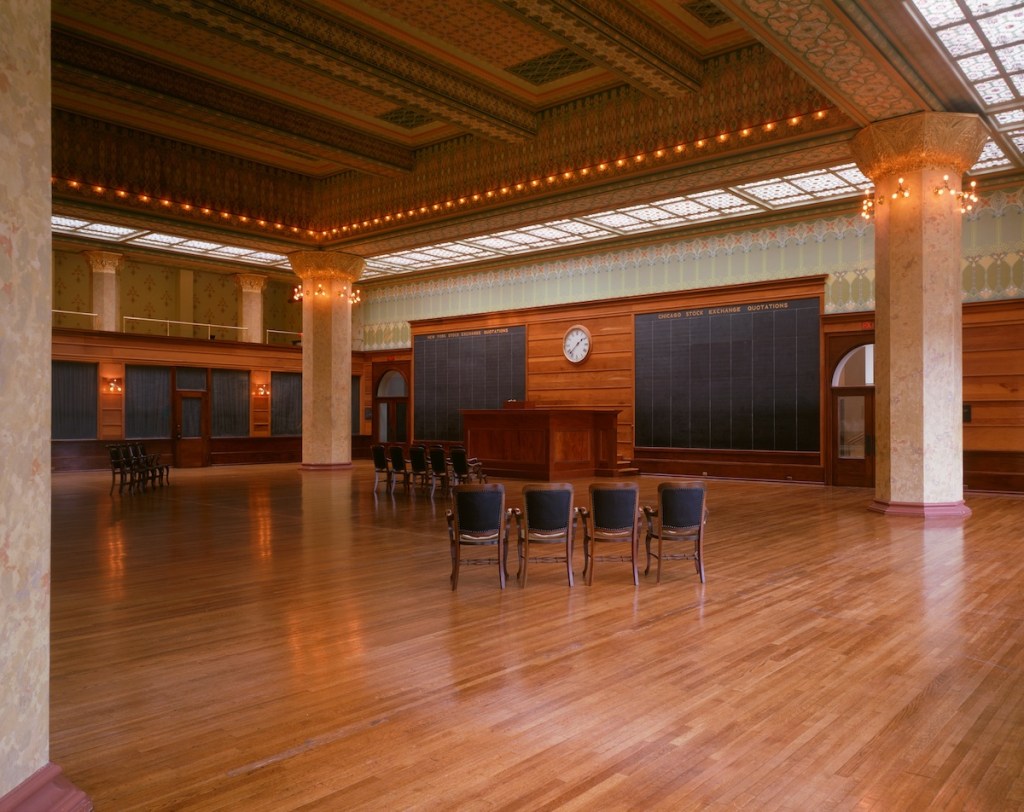

A treasured area of the Art Institute of Chicago may be reshaped by an expansion plan that would see the gallery spaces grow significantly in size.
That area of the museum is the Chicago Stock Exchange Trading Room, which was originally built between 1893 and 1894, and which was spared from demolition during the ’70s. Since then, this monumental room has functioned both as a point of pilgrimage for visitors to the museum and an event space available for rental.
While the room may not receive crowds on the scale attracted by Grant Wood’s American Gothic, Georges Seurat’s A Sunday on La Grande Jatte, and other masterpieces owned by the Art Institute, it is a sizable space within the museum, occupying about 5,700 square feet. It also has historical significance: the room currently contains the Stock Exchange’s original 19th-century stencils alongside reconstructed elements.
Related Articles

According to a report co-published by the Chicago-based broadcaster WBEZ and the Chicago Sun-Times, the room may now be reshaped yet again by the Art Institute’s expansion plans, few details of which been announced thus far.
“As we have assessed which part of our campus has the most potential for expansion, the east side of the building — where the Trading Room is located — represents the area where gallery space could increase the most,” a museum representative told the Chicago Sun-Times. “If our campus evolution did impact the Trading Room, our first priority would be to work with partners to find a new location for the space. No decisions have been made at this time.”
While the expansion is still coming into focus, news of its funding arrived in 2024, when Art Institute trustee Aaron Fleischman and his partner Lin Lougheed provided $75 million for the project.
In a prior interview with the Chicago Sun-Times, Art Institute director James Rondeau said the expansion was needed because the museum has so many works that it cannot show right now. Rondeau reported that the museum is currently exhibiting just 15 percent of its modern and contemporary art holdings, for example.
“We have very concrete aspirations,” Rondeau said in that intervew. “We do not have an approved building project.”