
The history of movie musicals is quite fascinating. In the Golden Age of Hollywood, you saw original stories that began to define movies. Then, as Broadway became a grand event, some of the best stage plays were adapted for the screen. Now, we’ve gone through the cycle of screen-to-musical adaptation and back to screen. If there’s one thing that’s not evolved in the genre, it’s that we simply cannot get enough!
We are here to celebrate ten of the most perfect movie musicals of all time. As a theater kid, this is essentially a cruel Sophie’s choice! There are so many brilliant titles that just fell short—Funny Girl, Once, A Star Is Born—but they still have a special place in our hearts. This list will focus on live-action films, sorry, Disney animated-only classics! And it must fulfill the classic ideals of musicals: when you can’t speak, you sing, and when you can’t sing, you dance. Now that the ground rules are out of the way, let the curtain rise on these ten musical masterpieces!
10
‘Dreamgirls’ (2006)

No, no, no, there’s no way Dreamgirls could be left off this list. It might be a controversial selection compared to those it eeked out, but Dreamgirls’ influence on the genre is exceptionally important. Based on the 1981 Broadway show, the drama follows a 1960s Motown-style girl group, “The Dreams,” who rise from obscurity to superstar fame, navigating the high costs of ambition, fame, and internal betrayal. Inspired loosely by Diana Ross and the Supremes, the drama rises when manager Curtis Taylor Jr. (Jamie Foxx) focuses on crossover success and pivots the group’s image, ultimately pushing out lead singer Effie White (Jennifer Hudson) in favor of the more pop-friendly Deena Jones (Beyoncé). A film à clef, the behind-the-scenes-style story has been celebrated beyond one night only. A truly dazzling celebration of music, the passion to become a star, and a visually stunning picture with a wardrobe money can’t buy, Dreamgirls was a film adaptation that arrived at just the right time.
The story is made and broken by the singers’ performance prowess. But there was one powerhouse performance that nearly mirrored the story that propelled a young star to great heights. The casting of Hudson was a tad controversial because, while we knew she had the pipes, she was still considered a reality star. Reality stars in the early 2000s were seen as just that. At yet, Hudson as Effie White couldn’t have been more perfect. She took “And I’m Telling You I’m Not Going” and made it her own. She essentially made us all forget about Jennifer Holliday’s emotionally perfect original rendition. At the time, to be able to outshine and overshadow Beyoncé was a feat in and of itself. The reality was, though, Beyoncé was rightly cast as the, well, Beyoncé of the group.
9
‘Mary Poppins’ (1964)

Let’s get it out of the way right now: Mary Poppins is practically perfect in every way! Blending live action wonder with whimsical hand-drawn animation, Mary Poppins became a beloved masterpiece. Based on the character by P.L. Travers, Mary Poppins is the story of a magical, “practically perfect” nanny, played by Julie Andrews, who arrives by wind to care for the neglected Banks children, Jane and Michael (Karen Dotrice and Matthew Garber), in early 20th-century London. Through amazing adventures and stern but loving guidance, Mary Poppins teaches about family, imagination, and finding joy in everyday life. A flawless blend of iconic songs, groundbreaking visual effects, and dazzling world-building, Mary Poppins has become a film that’s united generations, even to this day.
Led by the dynamic duo of Andrews and Dick Van Dyke, the film captured the joy that we may have been seeking. A completely escapist film, Mary Poppins allowed our imaginations to run wild. Thanks to Mary Poppins, we were given the freedom to laugh, dance, and make up our own silly little words. This film continues to resonate because the songs maintain a hold on us. Whether it’s the toe-tapping “Step in Time” or the emotionally triumphant “Fly a Kite,” the Sherman Brothers provided the perfect soundtrack that still hits home. Through humor, heart, and fantasy, Mary Poppins has become a timeless classic. The sequel, Mary Poppins Returns, instilled the same charm we fell for, but as delightful as Emily Blunt was, she was no match for the OG Mary.
8
‘The Rocky Horror Picture Show’ (1975)

I’d like, if I may, take you on a strange journey. One of the most influential and important pieces of queer cinema is The Rocky Horror Picture Show. Lifted from the stage to the screen, the Richard O’Brien musical tells the story of two weary travelers, Brad Majors (Barry Bostwick) and Janet Weiss (Susan Sarandon), who become stranded and seek refuge from the rain in a mysterious castle. Inside, Dr. Frank-N-Futter (Tim Curry), a mad scientist and transsexual alien from the planet Transsexual in the galaxy of Transylvania, is throwing a party for his newest creation, Rocky (Peter Hinwood). An homage to science fiction and horror B movies, The Rocky Horror Picture Show is camp to the max. Both a parody and tribute to all things kitsch, the film influenced the genre even 50 years later.
A celebration of individuality and identity, The Rocky Horror Picture Show’s high-energy score and dance-along ability have played a crucial part in musical history. The ultimate cult classic, where else can you join your fellow creatures of the night for a participatory midnight showing? The Rocky Horror Picture Show epitomizes community. Deep within the film, O’Brien, who also plays Riff Raff, is an important theme of queerness. Sure, the terminology we use has certainly evolved since the film debuted, but Dr. Frank-N-Futter’s experience in searching for love while loving their own self still resonates. The Rocky Horror Picture Show is a cinematic liberation.
7
‘Moulin Rouge!’ (2001)

There will forever be a debate regarding the legitimacy of jukebox musicals. As defenders of the trend, from &Juliet to Mamma Mia, jukebox musicals are important to the genre’s tapestry. This is all to say that jukebox musicals’ relevance may be, in part, thanks to Baz Luhrmann’s masterpiece, Moulin Rouge! The beloved romance tells the story of Christian (Ewan McGregor), a writer, and his passionate, forbidden love affair with Satine (Nicole Kidman), the star courtesan of the glamorous yet seedy 1899 Parisian nightclub, the Moulin Rouge. As the lovers struggle to be together, they must face a devastating love triangle with a wealthy Duke (Richard Roxburgh) and a fatal secret that could destroy their love forever. Easily one of the most beloved musicals of love, Moulin Rouge! brings the energy of an opera with the spectacle of a musical, all through Luhrmann’s sensational eye.
Part of his Red Curtain Trilogy, Moulin Rouge! is filled with fervent passion that soars thanks to the tactical song choices. You may moan and groan at certain pigeonholed tracks, but by the time you reach the “Elephant Love Medley,” you’re desperate to find your own lover to recreate such a sensational moment. As Christian poetically sings, “all you need is love!” At the time of release, it seemed the movie musical was all but dead. Then Moulin Rouge! arrived, and the desire for more was reignited. Moulin Rouge! is a work of truth, beauty, freedom, and above all things, love.
6
‘Cabaret’ (1972)

First, John Van Druten’s play, I Am Camera, took inspiration from Christopher Isherwood’s Goodbye to Berlin. Then, John Kander, Fred Ebb, and Joe Masteroff took the play and gave it the musical treatment under the title Cabaret. Then, Bob Fosse took that, brought it to the big screen, and gave us one of the most iconic movie musicals. Though some characters were adapted to fit the stars, while songs were added and subtracted, the screen adaptation of Cabaret is simply sensational. The musical explores the hedonistic, desperate nightlife of the Kit Kat Klub amidst the rise of the Nazi party. Inside, American cabaret singer Sally Bowles (Liza Minnelli) meets British academic Brian Roberts (Michael York), who, despite his confusion over his sexuality, begins an intimate relationship with her. Then, the arrival of the wealthy playboy Maximilian von Heune (Helmut Griem) complicates matters for them both as their love triangle plays out as war rages on. And then, of course, there’s a Master of Ceremonies (Joel Grey) who links the music and story together. A story of denial under the guise of normality, Cabaret serves as an allegory for the dangers of political apathy and the loss of personal freedom.
The stage and screen versions have some crucial differences that almost make them their own entities. But the film version soars because of Fosse’s vision and the career-defining performance of Minnelli. With Fosse pulling out the nuances of Sally, Minnelli gave a full-body performance. Her defining moment came through “Maybe This Time,” the Kander and Ebb song that became synonymous with the film, and earned its place as the definitive Minnelli track. Blending a gritty wartime melodrama with the dazzling sparkle and safety of the stage, Cabaret’s ability to balance the two worlds without breaking the narrative flow makes it an almost immersive experience. Anxiety is felt through the darker visual tones in the libretto, which melt away when the stage lights shine. There’s a reason why Cabaret won eight Academy Awards. It’s perfectly marvelous.
5
‘The Wizard of Oz’ (1939)

Thanks to The Wizard of Oz, we learned how beautiful it is somewhere over that rainbow. Based upon the L. Frank Baum‘s novel, The Wizard of Oz is the classic fantasy tale about Dorothy Gale (Judy Garland), a young Kansas girl swept away by a tornado to the magical Land of Oz. Alongside her dog, Toto, she travels the Yellow Brick Road to find the Wizard (Frank Morgan) to help her return home, befriending a Scarecrow (Ray Bolger), Tin Man (Jack Haley), and Cowardly Lion (Bert Lahr). A timeless story about friendship and the power of learning your strength lies inside, The Wizard of Oz reminded us that there truly is no place like home.
Providing a visual aesthetic that has become ingrained in pop culture, The Wizard of Oz is one of the most recognizable films ever made. Through its groundbreaking use of Technicolor, The Wizard of Oz’s production design is just as dynamic as the songs by E. Y. Harburg and Harold Arlen. The characters were crafted so strikingly well that they’ve become a part of us. From Dorothy’s journey to the Wicked Witch of the West’s (Margaret Hamilton) revenge, the characters made The Wizard of Oz what it is. Of course, it also elevated the icon that is Garland. One of the greatest performances in cinema history, Garland’s Dorothy became an inspiration for generations. There has never been a film quite like The Wizard of Oz, nor will there ever be.
4
‘Singin’ in the Rain’ (1952)

There’s no glorious feeling quite like singing in the rain, and we have the classic Hollywood musical to thank. Directed and choreographed by Gene Kelly and Stanley Donen, the film, set in the 1920s Hollywood, explores the chaotic transition from silent films to “talkies”. It follows Don Lockwood (Kelly), a charming silent star who falls for chorus girl Kathy Selden (Debbie Reynolds), while navigating his annoying co-star Lina Lamont’s (Jean Hagen) screechy voice and the industry’s shift to sound. From timeless songs to the satirization of celebrity culture and the frantic nature of the movie industry, Singin’ in the Rain is more than just a meta-commentary. The epitome of the classic Hollywood musical, Singin’ in the Rain is a genuine homage to the industry.
For a 50s film to feel so technically flawless speaks to the brilliance of the film and the creatives’ vision. But what sets the film apart from many of its contemporaries is the sensational production numbers. From the choreography to the artistry, there was simply nothing like what was found within this film. We tend to reference the iconic title song, but take a moment and rediscover the sheer brilliance of “Make ‘Em Laugh.” That’s a choreography masterclass in dance. Having an ensemble who were genuine triple treats set the film up for tremendous success. There is enduring pride and joy that will forever be attached to Singin’ in the Rain.
3
‘The Sound of Music’ (1965)

Perhaps having the most memorable score of any movie musical is The Sound of Music. From top to bottom, there’s not a song that gets skipped. Based on the Richard Rodgers and Oscar Hammerstein II musical, The Sound of Music follows Maria (Julie Andrews), a young postulant in the 1930s Austria who becomes a governess to the seven children of a widowed naval captain, Georg von Trapp (Christopher Plummer). She brings music and joy back into their lives, falls in love with the Captain, and helps the family escape the Nazis. Another musical that finds some semblance of joy during the world’s darkest time, The Sound of Music’s true story has inspired generations.
With a backdrop of fascism playing an extraordinary role in the film, The Sound of Music’s courageous narrative serves the story. The light and peppy moments are not a moment to shield, but serve as a reminder about how the world around us was inflicting tremendous influence on those with free will and mind. By balancing tonal shifts without comprising storytelling, director Robert Wise masterfully mixes comedy, romance, and high-stakes drama, shifting from lighthearted musical numbers to the dark reality of the Nazi annexation of Austria. With its sweeping cinematography and iconic titular track, very few movie moments have effortlessly captured the spirit of a film quite like this one. There’s a reason why we see it utilized in so many montages. It’s a perfect scene that brings you directly into this world. Of course, filming on location in Salzburg certainly helped the cause! To close out this entry, we simply must give immense credit to Andrews’ perfect performance. Never overtly sentimental, Andrews gives Maria the ultimate journey, becoming the definitive performer to ever take on the part.
2
‘West Side Story’ (1961)

Inspired by William Shakespeare’s remarkable romantic drama Romeo and Juliet, West Side Story was effortlessly dropped into 1957 New York City for another tragic ending. Based on the musical by Stephen Sondheim, Leonard Bernstein, and Arthur Laurents, West Side Story tells the story of the forbidden romance between Tony (Richard Beymer), a former Jet, and Maria (Natalie Wood), a Shark. Their romance is threatened by racial tension and gang violence over territory, ultimately leading to a torturous end. Through prejudice, hate, violence, and the immigrant experience, West Side Story was cinematic realism at its best.
Beautifully brought to life by Robert Wise and Jerome Robbins, West Side Story provided some of the most stunning musical moments of all time. Examining the “Dance at the Gym” and “The Rumble,” West Side Story reminded audiences of the power of storytelling through choreography. Through the integration of Robbins’ athletic and balletic numbers, matching the innovative, rhythmic editing that synchronized with camera movement, West Side Story’s groundbreaking approach influenced every movie musical that followed. Though Wood will forever be remembered for her performance, it was Rita Moreno as Anita that stole the show. As we saw with the remake, the part continued to earn its actor awards. Now, to the 2021 version. No shade to Steven Spielberg or the talented cast of the remake, but they’ll never hold a candle to the original.
1
‘Chicago’ (2002)

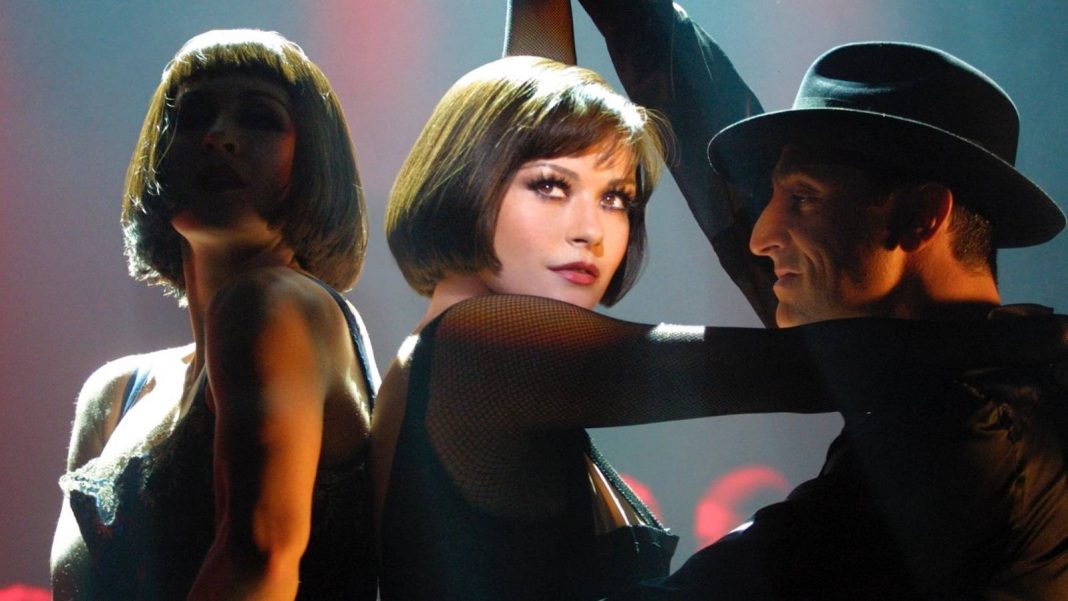
Murder, greed, corruption, exploitation, adultery, treachery, and all that jazz! For decades, musical theater fans patiently awaited a big-screen adaptation of the Kander and Ebb musical Chicago. In 2002, they finally received their wish in perfect fashion. Directed by Rob Marshall, the stage-to-screen sensation tells the story of Velma Kelly (Catherine Zeta-Jones), a nightclub performer, who murders her philandering husband, and Roxie Hart (Renée Zellweger), a housewife who murders her two-timing lover, as they await trial at the Cook County Jail. The duo fights for fame, celebrity, and attention from their flashy lawyer, Billy Flynn (Richard Gere). Showcasing the media circus exploiting the Jazz Age obsession with celebrity and scandal, Chicago is simply a perfect movie musical.
Thanks in part to Marshall’s highly stylized vision, one that has been borrowed in many subsequent films, Chicago’s innovative approach captured the magic of the stage through imagination and dream. Rather than having the characters simply break into song, Marshall infused these fantastical numbers as they came to life in their mind. And each number captured various styles of vaudeville performance. Chicago’s ability to present the numbers in this manner became its shining element, helped only by its top-notch cast. The film was awarded six Academy Awards, including Best Picture, and rightly so. Thanks to Chicago’s monumental success, the desire for the movie musical returned, and it’s yet to cease.