


This article appeared in the February 27, 2026 edition of The Film Comment Letter, our free weekly newsletter featuring original film criticism and writing. Sign up for the Letter here.
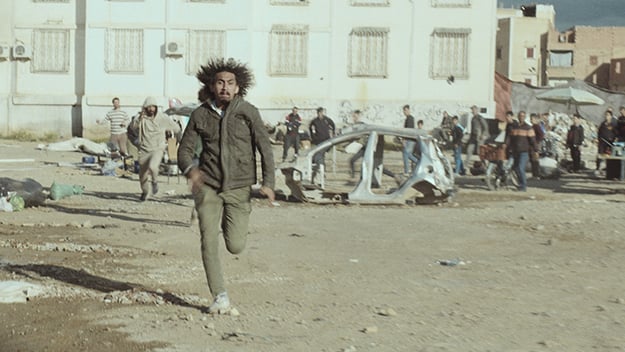
Chronicles from the Siege (Abdallah Alkhatib)
How political must a festival be for it to be considered properly political? This question has haunted the Berlinale since its founding in 1951; and it became newly charged two years ago, amid a call for a boycott of state-funded German cultural institutions, and certain German politicians’ troubling response to the Best Documentary Award for No Other Land, directed by a collective of Palestinian and Israeli filmmakers.
This year, the debate was raised notch by notch throughout the festival. It began with jury president Wim Wenders arguing that filmmakers “should stay out of politics,” which prompted author Arundhati Roy to angrily withdraw her attendance from the premiere of the new restoration of In Which Annie Gives It Those Ones, a film she wrote and starred in in 1989. Festival head Tricia Tuttle responded with a statement on the Berlinale’s position, saying artists “should not be expected to speak on every political issue raised to them unless they want to.” A group of eminent actors and filmmakers then published an open letter criticizing the festival for “censoring artists who oppose Israel’s ongoing genocide against Palestinians in Gaza,” and Tuttle replied by invoking the festival’s history of “inclusion, multiple perspectives, and understanding.”
We surely haven’t heard the end of this debate, which is certain to be reignited this time next year. At any rate, the 2026 Berlinale concluded with the competition jury—as if specifically hoping to refute charges of being apolitical—awarding the top prize, the Golden Bear, to what might be considered the most explicitly political film in competition: Yellow Letters by German director İlker Çatak (2023’s The Teachers’ Lounge). Shot in Germany but set in Turkey (captions specify that Berlin is standing in for Ankara, Hamburg for Istanbul), the film is about a couple, an actress and a playwright-academic, who fall foul of the authorities following their collaboration on a politically themed drama and her personal snub to a dignitary.
The film follows their comprehensive outlawing. While the setting appears to be a version of Turkey under the current Erdoğan government, the film can be read as a broader warning about authoritarianism and the repression of dissident voices, echoing the fates of artists in Nazi Germany and Stalin’s USSR. If you wanted to read it—as per Damon Wise in Deadline—as “the most important film yet made about Donald Trump’s America,” that wouldn’t necessarily be an invalid interpretation either.
The problem is that Yellow Letters, for all the urgency of its message, is not an outstanding film: it’s too manifestly polemical, too much executed in a vein of heated melodrama, with an even more torrid meta dimension as the playwright’s new drama, also called Yellow Letters, awkwardly takes the foreground. This is a political film in a particular Berlinale tradition of “These are the issues, and these are the contradictions arising”: in other words, dialectical on the surface, but spelling the topic out rather than truly engaging you with its complexities.
Wenders, setting out to clarify his position in a closing night statement, attributed cinema’s power to a quality known in German as Anschauung: roughly translatable, he said, as “a visual, sensual, existential immersion.” There were certainly other films on show that displayed Anschauung to much better effect than Yellow Letters. One was the Audience Award–winner for best fiction film in the Panorama section, Prosecution, by German-Iranian director Faraz Shariat. It’s about a state prosecutor, a young woman of Korean heritage, who is viciously attacked by far-right thugs. She attempts to investigate the assault, but is warned by her boss that she must stand back from the case to ensure objectivity. What the famed objectivity of the German legal system really means, and what it is built on, is compellingly unpicked in a taut thriller—mainstream in form and style, but rivetingly executed. And if the film ends over-demonstratively by pitching its protagonist, played by Chen Emilie Yan, as a kickass, uncrushable social avenger, Prosecution is nevertheless a very satisfying example of polemic and entertainment fused together under the umbrella of Anschauung.
Similarly, there was competition title Salvation by Turkish director Emin Alper, which won the Silver Bear Grand Jury Prize. As in his 2022 Burning Days, Alper adopts a bold, landscape-focused visual approach with inescapable echoes of Sergio Leone westerns. Set in a Turkish mountain region, the film depicts the slow-burning culmination of a territorial feud between occupants of two neighboring villages. Residents of one community take arms to help local police in their pursuit of alleged, never-seen terrorists; the conflict heats up as one man decides to unseat his brother as village leader, projecting himself as a visionary prophet. Salvation is another film that can be interpreted on many levels: as a depiction of so many contemporary conflict zones, including Gaza and Ukraine, and as a critique of strongman populism and the use of othering as a means to power. But the film registers as the resonant telling of a specific, and specifically rooted, story, rather than as an allegory whose “real” meaning is plastered on the surface.
Also outstanding was Chronicles from the Siege, which won Best First Feature award in the Perspectives section. Directed and written by Palestinian-Syrian former documentarist Abdallah Alkhatib, the film offers a string of anecdotes set in a city under bombardment, some brutal, some caustically humorous: a demented, deprived old man trying to eke out the smallest drop of sustenance from what remains in his home; a group of smokers desperate for one puff of a cigarette (Alkhatib’s own cameo provides the punchline); lovers trying to get through their carefully planned tryst without interruption. Chronicles is partly inspired by Alkhatib’s own experience during the starvation siege of Yarmouk in Damascus (the subject of his previous feature, the documentary Little Palestine, Diary of a Siege), but the writer-director’s notes also allude to the experience of siege conditions as a fundamental part of the modern Palestinian condition. So, while the setting is never identified as Gaza itself, the thematic scope covers Gaza and beyond. It’s a powerfully angry film but also a very positive, compassionate one—arguably this festival’s most inventive and energetic riposte to political and existential despair.
There were other films focused on the crisis of authoritarianism, but in the form of warnings from South American history. Juan Pablo Sallato’s The Red Hangar follows a Chilean Air Force officer through the first days of the Pinochet coup: a tense and, with Diego Pequeño’s black-and-white photography, visually striking portrayal of individual conscience in the heat of collective crisis. Then there was Marcelo Martinessi’s Narciso, depicting the explosion of rock ’n’ roll as a dissident force in late-’50s Paraguay—and its prompt repression. Built around the central martyr figure of an Elvis-like radio star, this queer-inflected drama echoes Pablo Larraín’s evocations of Pinochet-era Chile. It somewhat overdoes the hothouse atmospherics and Fellinian grotesquerie, but as a modern historical melodrama (in the etymological sense of “drama with music”), it is a compelling follow-up to Martinessi’s much-praised 2018 film The Heiresses.
One oddity of this year’s program was the inclusion of sometimes overlapping thematic tags on the program website to tell viewers what to expect: among them, Queer, Queer Period Pieces, Fierce Women, War & Displacement, and Family is Complicated. A film that bore the first three of these, but could easily have carried all five, was Rose, by Austrian director Markus Schleinzer. Set in the 17th century, the film stars Sandra Hüller as Rose, a woman passing as a man, who arrives in a rural community after completing military service and sets up as a farmer. There’s a scabrous but sober element of humor in the intrigue involving her marriage to a local woman, and inevitable bleakness in the destiny of a Joan of Arc figure whose very being challenges gender presuppositions. Hüller—wearing prosthetic makeup with a bullet scar on one side, suggesting a Janus-faced split of identity—confidently reasserts herself as one of the essential performers of our time.
Another outstanding competition title, Queen at Sea by American writer-director Lance Hammer (missing in action since 2008’s Sundance success Ballast), was a reminder of just how political the question of ageism is. The film won a joint Best Supporting Performance award for the veteran duo of Anna Calder-Marshall and Tom Courtenay. They play elderly couple Leslie and Martin: she is an artist with advanced dementia; he is her husband and carer. Juliette Binoche, as Leslie’s daughter Amanda, finds them having sex and calls the police because her mother is unable to give consent, triggering an irreversible change for the family. The performances are indeed extraordinary, touching a very raw nerve. The drama fearlessly addresses a theme that many of us will have to confront eventually, but that few of us really want to think about. Yet Queen at Sea, steeped as it clearly is in research on age and the institutions that attend to it, came across not as an issue film; it was simply one that used its performances and its form to put empathy foremost. It had Anschauung hard-wired in its DNA.
Jonathan Romney is a critic based in London. He writes for The Observer, Sight and Sound, Screen Daily, The Financial Times, and other publications.