
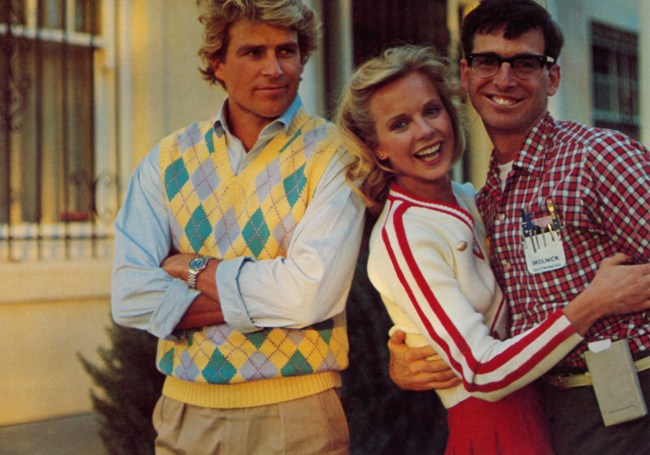

Robert Carradine, who passed away Monday at the age of 71 after a long battle with bipolar disorder, was the kind of actor who was so good in so many different kinds of roles that he meant something completely different to you depending on what sort of movies you loved, and what decade you first discovered movies in.
Carradine made his film debut at 18 opposite John Wayne in “The Cowboys,” one of the last gasps of classical Hollywood before the directors Billy Wilder called “the kids with beards” took over, appearing at the end of one tradition just before making his mark in several others. If you were an exploitation fan in the 1970s, you knew Carradine for his energetic work in superior drive-in fare like “Massacre in Central High,” a revenge flick as incisive in its politics and precise in its filmmaking as it was robust in its visceral thrills, or Joseph Ruben’s “Joyride,” a darkly comic crime spree flick with a malaise at its center straight from Antonioni.


Carradine also did fine work in Ruben’s genuinely funny “The Pom Pom Girls,” and in some of the best Roger Corman movies of the era, like “Cannonball!” and “Jackson County Jail.” But if you’re an auteurist, you probably came to Carradine through his cigar-chomping role as Sam Fuller’s onscreen alter ego in “The Big Red One,” a part he played with supreme gusto, or his cowboy in Walter Hill’s “The Long Riders,” which gave him the chance to play opposite his real-life brothers David and Keith.
Or maybe you discovered him as haunted Vietnam vet Bill Munson in Hal Ashby’s “Coming Home,” a movie that should have garnered him an Academy Award nomination. Then there’s his one wordless scene in Martin Scorsese’s “Mean Streets” as a young hit man, an iconic moment in a movie that’s full of them. Later on, Carradine was known to an entire generation of Disney Channel viewers as Lizzie McGuire‘s dad, and to horror fans for his work in several John Carpenter films.

He loved acting and did it constantly without snobbery about budget, genre, or role size; in the later decades of his career he reunited with his old pal Corman to play a lead in “Sharktopus vs. Pteracuda” not long after a blink-and-you’ll-miss-it cameo as a slave tracker in Quentin Tarantino’s “Django Unchained.” (Tarantino was a longtime Carradine superfan who had considered casting the actor in multiple films over the years — he wanted Carradine for Clarence Worley in “True Romance,” but director Tony Scott went with Christian Slater.) And as with most working actors, there were the frequent guest star jobs on episodic television and in TV movies.
For those of us who came of age as young moviegoers in the 1980s, however, Robert Carradine will always be, first and foremost, Lewis Skolnick from “Revenge of the Nerds.” Released in 1984 at the tail end of the teen sex farce boom launched by the massive box office success of “National Lampoon’s Animal House” and “Porky’s,” “Revenge of the Nerds” stood alongside “Animal House,” “Fast Times at Ridgemont High,” and “Risky Business” as one of the few entries in the genre that was actually good, a perfectly pitched comedy filled with lively performances, crisp editing, and inventive visual ideas.
Lewis Skolnick, a computer enthusiast who leads his fellow nerds to fulfill the promise of the movie’s title and triumph over their college’s bullies, is one of the all-time great comedy heroes, a character who generates almost as many laughs per minute as Steve Martin’s Navin Johnson or Groucho Marx’s Rufus T. Firefly thanks to Carradine’s fully realized comic conception. He’s somehow both emblematic of everything “nerds” were thought to be at the time and singular; the surface details — pocket protector, too-high pants, too-big glasses — are clichés, but Lewis’ inner life is specific, clearly and concisely conveyed through gesture and intonation, and often surprisingly touching thanks to the humanity Carradine brings to the character.

Carradine plays Lewis as an outcast who’s completely aware of the way others perceive and reject him, yet chooses to be relentlessly, willfully, almost foolishly optimistic. That combination and contradiction is the key to the character’s appeal, and the moments in the film where Carradine lets Lewis’ vulnerability show through the cracks in the armor of hopefulness he’s constructed for himself elevate the entire movie. Even the broadest, most tasteless moments land in a way that they don’t in a movie like “Porky’s,” because they’re anchored in the reality of Carradine’s performance (and those of the excellent ensemble supporting him, like Anthony Edwards, Michelle Meyrink, Bernie Casey and Ted McGinley). The movie, as Mel Brooks would say, “rises below vulgarity.”
Carradine was capable of playing the spectrum of human experience and emotion — he was as terrifying as a maniacal killer in John Carpenter’s “Body Bags” as he was hilarious and engaging in “Revenge of the Nerds.” But “Nerds” is the movie that most captures what made Carradine great: his ability to infuse his soul into characters who were superficially nothing like him, yet through his approach became exactly like him. Carradine wasn’t a nerd — he was a cool, motorcycle-riding dude who, in his youth, dated soon-to-be movie stars Jamie Lee Curtis and Melanie Griffith. But he was, in spite of the demons that ultimately got the better of him, an infectiously enthusiastic person, and that enthusiasm permeates every frame of his performance as Lewis.
Those of us who interacted with him, or even just listened to his podcast where he interviewed and celebrated fellow actors, couldn’t help but recognize his generosity, and he brings that innate kindness to his performance in “Revenge of the Nerds” in a way that makes it seem as though he’s playing himself in spite of the superficial differences. It’s why Lewis Skolnick, with his honking laugh and blindingly abrasive fashion sense, is ultimately so much more than just a caricature, and why “Revenge of the Nerds” resonates long after so many other sex comedies of its era have been forgotten. In those movies the people become jokes — in a Robert Carradine comedy, the jokes become people.