

Last week Matthew McConaughey was the latest in Hollywood to give voice to the inevitability of artificial intelligence in filmmaking, telling Oscar nominee Timothée Chalamet AI was “damn sure going to infiltrate” the best acting awards categories, and within five years, there might even be the need for a “Best AI Actor” category to counteract this.
It’s the latest example of how we are being told everyone in Hollywood is using Gen AI to make movies, but evidence on the big and small screens is scant. Mostly it’s been used (undetected and unpublicized) as a behind-the-scenes tool as some in Hollywood try to incorporate it in their normal processes of filmmaking, and the extremely rare times actual Gen AI image creation had driven a commercial project, such as the Darren Aronofsky-produced docuseries “On This Day… 1776” for YouTube, it has been roundly rejected and deemed unwatchable slop.


In the void between the technology’s promise and its current capabilities, we are left with the AI hype machine, fueled by trillions of dollars of investment and social media discourse about how every new “shocking” Gen AI clip marks “the end of Hollywood.” There is this predetermined narrative of disruption, when all we have are wild predictions, 10-second social media clips, and any celebrity willing to pontificate on AI going viral.
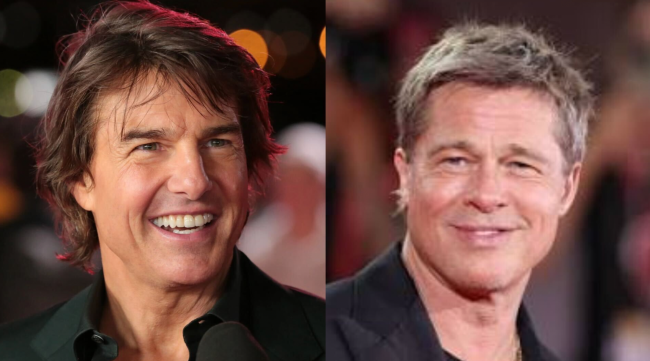
The problem is this discourse, both from the pro and anti-AI sides, is too often based on nonsense, and even those inside Hollywood’s efforts to incorporate AI are laughing at us. The pinnacle of this came last week. First with Seedance 2.0 releasing a photorealistic clip of a Gen AI Tom Cruise and Brad Pitt fighting — causing the “Deadpool & Wolverine” writer Rhett Reese to tweet “it’s likely over for us” — followed by an Oscar-winning actor telling a potential future Oscar winner that they’ll be competing against Tilly Norwood’s cousin in a few years.
This idea that AI “is already here,” as McConaughey phrased it, is especially problematic when applied to acting. Look, I don’t know where AI and filmmaking are headed — and anyone who talks like they do, trust me, is full of shit — but all evidence we’ve been shown and my own reporting points to AI not being able to replace human actors in cinema. Even those working at the cutting edge of AI in Hollywood, who predict AI will profoundly change filmmaking, see human actors as being essential. And those who don’t are working on alternative forms of interactive storytelling.
One thing you’ll notice about all of these viral clips featuring Gen AI performers is that they often feature physical exertion. There’s a reason for this.
I am a horrible actor, and the one thing I can reasonably replicate with my face is physical strain. Here’s an exercise. Go to a closed door, and have a friend film your face: Pull the door handle with all your might, then push against it equally hard. What you will notice is this is one of the few situations a non-actor can go “method” and deliver a Cruise-level performance with our faces. That’s because there are universal facial muscle patterns and expressions that come from concentrated physical effort, which are easy for software to believably mimic for a brief moment.
You know what you won’t see AI believably recreate, even with unlimited IP and copyright theft? That look on Cruise’s face, his eyes focused inward, as we watch Ethan Hunt’s mind intensely racing to find a way out of an impossible situation. And I don’t care what breakthrough new prompt you write, it’ll never recreate a Brad Pitt glance of resignation, that look of accepting a situation with a stoic calmness, but buried underneath that slight glimpse of empathy (sometimes sadness) that makes his characters so cool and inviting.
You don’t have to be spiritual to recognize that the individuality of our souls is expressed through our faces. Think of your loved ones, or co-workers you see every day: How do you know they are stressed, excited, intrigued, or preoccupied just by looking at them? Chances are, it’s not even conscious; your brain just reads their face and knows. My wife does a thing with her lip, my son’s eyes are dead giveaways, and when I pitch a story to my editor — one of the more even-keeled bosses you can have — I instantly know if she is excited by an idea just by watching her reaction.
Actors are experts at recreating this. Each has their own process of how to get there, mixing their own humanity with that of the character, but the commonality is the ability to project the inner life of a character. And in cinema, that is the very core and magic of the art form itself.
Director Alexander Mackendrick referred to it as the “preverbal” power of the medium. The ability of the camera, in the hands of a competent filmmaker, to photograph thought. With a simple glance or curl of the lip, our brains learn more about a character than five pages of a dialogue ever could tell us. And when composition, lighting, what’s in the frame, editing, sound, and music are in service to this, it is the height of cinema.
An incredible example of this comes in the last scene of “Sentimental Value,” which ends in silence. The actor/daughter (Renate Reinsve) and director/father (Stellan Skarsgård) don’t have the words for what they are experiencing, but it’s clear in watching their faces that a profound transformation is taking place, as the complex emotional issues that have held their fraught relationship captive are released. When discussing this scene, writer/director Joachim Trier said he “casts for close-ups.”
“We can talk about mood and light and space, but ultimately, the human face is what I get the biggest kick out of,” said Trier. “I really care that the actors can do that thing that we can only do in the movies, which is be aggressively intimate with them, and look at them in a way that we can’t in real life. That’s why I go to the movies. You’re allowed to stare at each other in a perversely intense way that no sane human being would do with another human being, and really get to know someone’s face and to read them and empathize with them.”

Put aside the incredible performances by Reinsve and Skarsgård, who, according to McConaughey, would be competing against AI actors if this were the 2030 Oscars: Do you believe we will ever be able to intimately stare at an AI-generated character in this way? Is there any level of technological advancement that will supply enough realistic detail to bridge the uncanny valley?
If you pay close attention, Seedance is already telling us they can’t. There’s a reason these clips are 15 seconds, but more importantly, pay close attention to all the tricks employed in these viral clips to mask what AI can’t do — helmets, jump cuts, stacking action, fancy camera moves that motivate moving off faces, or simply having the character look away from the camera. These highly curated clips give you just enough to be impressed by the realism, and the likeness of famous faces, but ultimately mask what is missing.
AI creators know what all of us should: The combination of the human eye and brain is the world’s biggest bull shit detector. When we talk about “bad VFX,” people think of some smart ass film writer like me freeze-framing a shot to highlight poor craftsmanship, but the reality is our brain just senses when something is off. If the backdrop doesn’t match the lighting in the foreground, our brain calls bull shit, and it’s not because we’ve got Roger Deakins’ eye and technical understanding. And when our eyes focus on a human face on screen, our eye+brain power is tenfold, because we are trained to read for emotion.
The “Avatar” films represent Hollywood’s current pinnacle of technical advancement, the culmination of the four biggest technological breakthroughs of my lifetime working in tandem: CGI, digital sound, virtual cameras, and performance capture. It’s instructive that in building this transporative and imaginary virtual world, the one thing all of Wētā’s technology breakthroughs couldn’t replace, but instead serves as its principal building block, is a human performance capture.
You know how AI was used in “Avatar”? To separate the sound of water and the human dialogue in tracks recorded while shooting in tanks. And James Cameron, 71, who banned Gen AI from his films, has said the future of the franchise will rely on them building AI-tools to speed up the processes of making an “Avatar” film, as he is not willing to spend another four years making a single film. Talk to those hoping AI can transform the time it takes to make big action films, including the “Avatar” team, and they say, universally, that eliminating the human performer only makes things more difficult, time-consuming, and unwatchable.
McConaughey’s comments made me think of one of my favorite anecdotes about director John Ford while he was shooting in Monument Valley, the iconic landscape of his great westerns. One day, when the weather turned ugly, a crew member asked, “Mr. Ford, what can we shoot out here?”
Ford replied: “What can we shoot? The most interesting and exciting thing in the whole world, the human face.”
Those at the forefront of AI tell me one day soon it’ll be possible to make a Monument Valley-set western without shooting on location. To which I respond, “Show me.” Yes, I am skeptical it could ever be as good, but considering what a film like “The Lion King” was able to do with virtual cameras and sets, we all need to leave ourselves open to what is possible once these tools successfully incorporate AI — a bumpy and unpredictable road, for sure.
What no serious person can imagine is ever replacing the need for a living, breathing actor like John Wayne, and it’s important to stop those who claim otherwise and ask for evidence to back such a claim. Because, right now, the biggest AI threat to cinema is the trillion-dollar-fueled discourse based on nothing, and those of us in the media willing to carry these claims without evidence or follow-up questions are just as much to blame.