


As technology has advanced, so too has noise control. Here’s the basic information about why noise appears in your photos and how to deal with it.
It may seem like a thing of the past if you have a new camera. Nevertheless, if you push your exposures to extremes, then you must still deal with noise.
Raw files from our cameras are far more tolerant of coping with incorrect exposures than they once were. The sensors can now differentiate between tones at the extremes of exposure more than they once could. Consequently, our cameras can simultaneously detect details in both the highlights and the shadows of a scene far better than cameras released 10 years ago.
What is Noise
Have you ever watched the movie “Back to the Future”? There is a scene where the hero, Marty McFly, plugs a guitar into an enormous amplifier. As he turns up the amplifier, the loud humming from the giant speaker increases. You can hear something similar if you turn the volume all the way up on most amplified speaker systems when there is no music playing.
The amplifier’s electronics produce that noise. The circuits produce energy, which the amplifier outputs as sound. A poor-quality amp will produce lots of that noise. Obviously, a newer, better-quality device will control it much better. Give it a try with your home or car sound systems. Turn the volume up without playing music, and you’ll probably hear a hiss or buzz. There is a caveat here. That experiment might not work on newer, high-quality speakers. The Bose soundbar I use for my computer makes no noise at all. But give it a try.
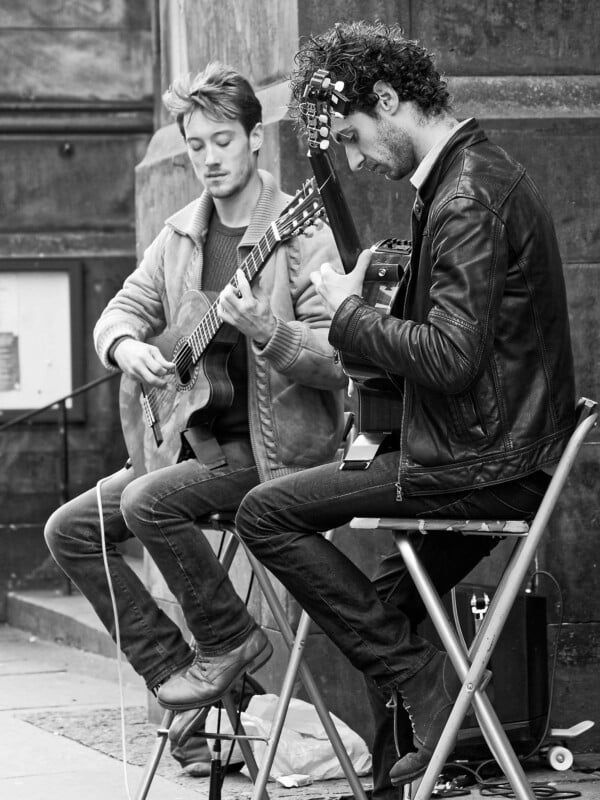
Next, imagine feeding a very low level of music into the amplifier from a phone or other device. If you reduce the phone’s output volume, the humming will drown out the music. Then, as you increase the phone’s volume again, the music begins to override the hissing until you no longer notice it. The “signal” from the music is greater than the noise.
That difference between the signal and the noise is called the signal-to-noise ratio.
That is a very simplified analogy of what is happening in your camera. The camera behaves similarly; its electronics generate noise. But the noise manifests not as sound but as grain in the photo. When you let in enough light, the light’s signal drowns out the noise.
The Sound of Silence
The bright areas in the photo correspond to the loud sections of a piece of music. Imagine the chorus of “Smells Like Teen Spirit” by Nirvana. Kurt Cobain screams out, “With the lights out, it’s less dangerous. Here we are now, entertain us”, or if you prefer, the final section of Carl Orff’s “O Fortuna” from Carmina Burana, with the wheel of fortune completes its turn to a powerful and inescapable cataclysm. That loudness is the equivalent of the highlights and whites in the photo.
Dark areas of the photograph correspond to the quieter parts of the music, such as the late Mr. Cobain singing the verse or the softer parts of “O Fortuna.” Just as listening to the quiet part of that music no longer drowns the amplifier’s noise, in the camera, there is less signal from the sensor, so it no longer hides the background noise. Consequently, there is a greater proportion of grainy speckles that appear, especially in the dark areas.
Furthermore, if you increase the brightness of blacks and shadows when processing a photo, you amplify the noise, making it even more noticeable.
Pump up the Volume
As you increase the ISO, you are effectively turning up the camera’s internal amplifier. At the same time, you are reducing the light coming into the camera, usually by increasing the shutter speed. Consequently, the noise becomes more noticeable.
Using my music analogy, this is like reducing the volume on your phone while turning up the volume on your external speaker. The overall volume of the sound increases, and both the music and the noise get louder. Therefore, as you increase the ISO on your camera, more noise appears in the image.
Everything in its Right Place
Your camera will have a setting that displays a histogram; a histogram is another name for a bar graph. It shows you how many pixels are in a photo at different brightness levels. The higher the peak, the more pixels are illuminated to that level.
On the left side of the graph is pure black, indicating the number of pixels where no signal is produced. Unsurprisingly, its numerical value is zero. Then, as you move gradually to the right, you can see how many pixels are illuminated in the shadows, the midtones (in the middle of the histogram), the highlights, and, finally, the whites on the far right. White has a numerical value of 255. So, in total, there are 256 shades of gray (eat your heart out, EL James) and 256 bars on that graph.
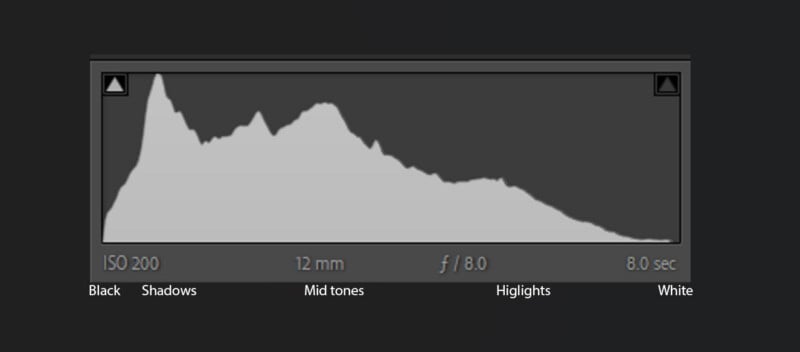
Usually, the bars are tightly packed and adjacent to each other. For that reason, you cannot see each bar individually, but you can see the overall shape that all the bars make.
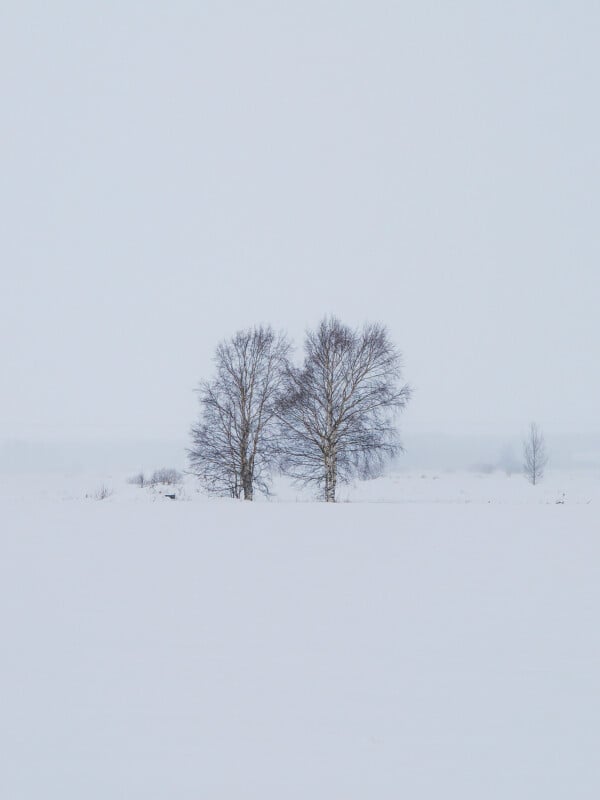
Many photographers consider it good practice to increase the exposure in the camera. So long as they are not making too many pixels pure white, more signal will arrive in the shadows. As a result, there would be less noise and more detail. There are limits to this. I often shoot facing the sunrise, and increasing the exposure would make more of the bright sky pure white, which would be blown out. So, exposing to the right is not an option in every circumstance.
One way around this is to take a high dynamic range (HDR) photo. That involves taking three (or more) identical frames at different exposures. One will be underexposed, one will be correctly exposed, and one will be overexposed. They are then combined in-camera (if it has that function) or using software to produce a single image with detail in both the darkest and brightest areas of the photo. The result of this process can either look astoundingly good or, if done badly, dreadful.
The Heat is On
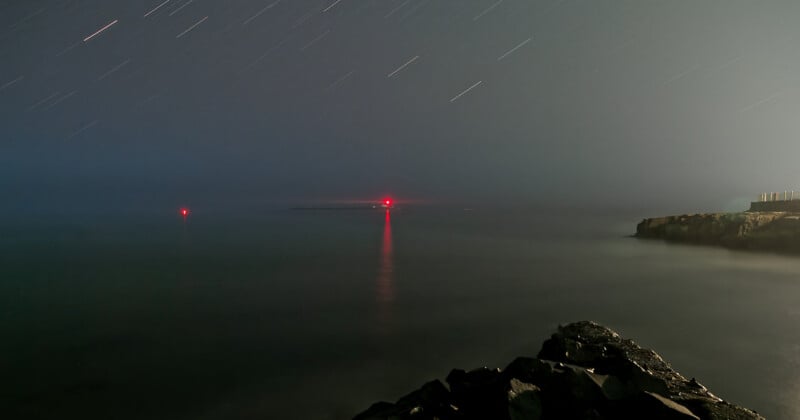
My parents’ old valve television used to hiss more the longer it was on. That was because the circuitry was heating up. Your camera will do the same. If you shoot very long exposures — my camera’s shutter is sometimes open for thirty minutes — you will notice increased noise for the same reason. Cameras with poor heat dissipation will be more affected by this issue.
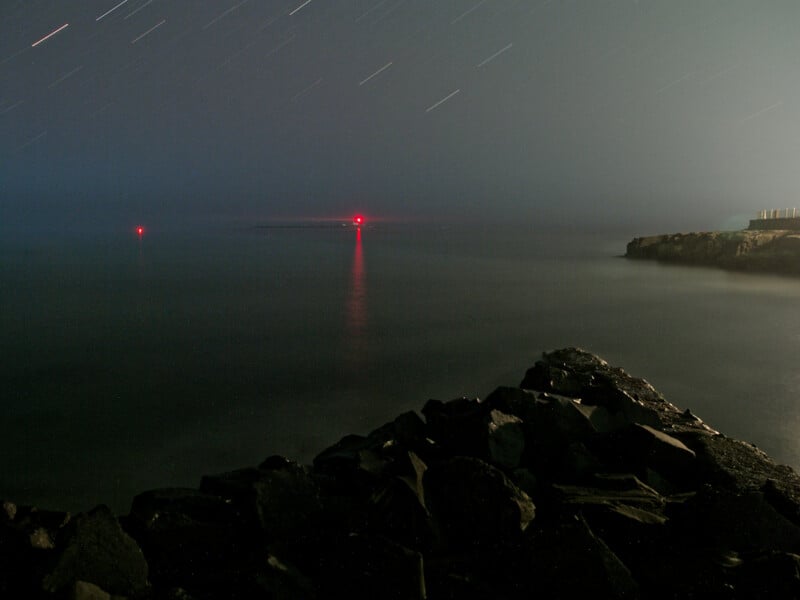
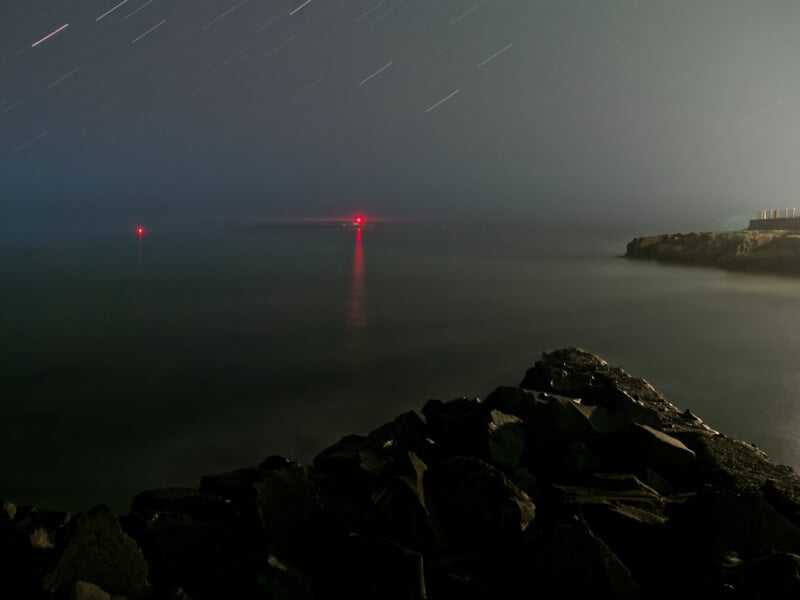
Noise Pollution
You are likely to see two types of noise: luminance and chroma.
Luminance Noise
Luminance Noise manifests as grey speckles in the image, similar to film grain. It occurs when the sensor doesn’t receive enough photons, making brightness information unreliable.
A high ISO setting, as described above, is a common cause of luminance noise. Also, small sensors, such as those in most compact cameras, bridge cameras, and phones, have tiny pixels. Each pixel collects fewer photons. Statistically, there’s the likelihood that some of the smaller pixels won’t collect any photons at all. That is also an argument against increasing pixel counts on sensors, which would make pixels smaller.
Although usually unwanted, luminance noise is considered less unpleasant than chroma noise.

Chroma Noise (Color Noise)
Ugly chroma noise appears as blotchy or speckled patches of color. Caused by the same reasons given above, this time it affects the color channels. Each pixel records color using filters. When light is low, colors become inaccurate and noisy. It can also result from sensor demosaicing errors. Your camera must reconstruct color for each pixel, and weak signal data leads to guesswork, errors, and, consequently, color artefacts.
Finally, some models have poor in-camera noise reduction, and color noise can be harder for cameras to remove cleanly.

I Can See Clearly Now
The instantaneous range of the human eye is the range your eyes can see once they have adjusted to different lighting levels. For example, if you step indoors from a brightly lit day into a dimly lit room, it takes time to adjust before you can see shadow detail. When you step back outside, your eyes take a while to adjust again. After a few moments, you can see details in the bright clouds. However, you might not then be able to see the texture of the black road surface in the shade under a parked car.
In total, most of us can see the equivalent of between 12 and 14 stops at any one time. Most modern camera sensors have a similar dynamic range of 12-14 stops in a single shot. That is also about the same as good quality film stock. Like our eyes, we need to adjust the exposure to compensate for differing lighting conditions. If we shoot indoors and head outside, we must adjust the exposure to see the full range of details the sensor can detect.
Combining that range with the camera’s built-in noise-reduction software means that cameras produce far less noise and capture more detail in highlights and shadows today than they did ten years ago.
Moreover, noise-reduction software on our computers is far more capable than it used to be. Historically, software used Gaussian smoothing to reduce noise; it worked, but wasn’t great for image quality. In 2007, BM3D (Block‑Matching and 3D Filtering) came along. Although a landmark improvement, it still left images looking soft and muddy.
These days, AI-based algorithms power modern noise-reduction software. They all do a fantastic job of cleaning up noisy images without losing detail. However, if you are being finicky, there are still some differences between them, with DxO’s Deep Prime XD widely being touted as the most highly rated, partly because of its superior demosaicing algorithms. Nevertheless, if that level of precision is not important to you, you should get good results from any mainstream AI-based program.
With those advancements in hardware and software, one can shoot at ISOs that were once only dreamt of by photographers.
What Are You Waiting For?
I have not mentioned the exact ISOs or shutter speeds I use. The reason is that, today, there are around 70 ILCs on the market from the six largest retailers, and a similar number of raw development tools with noise-reduction capabilities. Therefore, there are around 4,200 contemporary camera and software combinations. That’s excluding the hundreds of older camera models from the equation. Consequently, the noise my camera produces is unlikely to match yours.
So, grab your camera and go out to experiment with it. Push exposures to their limits. Try different ISOs and exposure lengths. Then see what noise levels you are happy with and how well your software handles them.