

Only the great ones can be regarded as masters of an entire genre. With Alfred Hitchcock, there’s no denying that he is not only the Master of Suspense, but he is also as synonymous with film directing as any director who’s ever lived. Hitchcock is so celebrated and beloved that his silhouette is more recognizable than most movie stars today. Despite never winning an Academy Award or receiving mass critical acclaim from contemporary critics in America, the British filmmaker, known for his thrillers about the wrongfully accused and studies of obsession and perverse romance, was quickly etched into the cinematic canon. With such a vast and varied filmography, starting from the 1920s all the way through the 1970s, Hitchcock has made plenty of movies—most of them being great—but 10 of them stand out from the pack as true masterpieces.
10
‘Rope’ (1948)

Rope asks an enticing question that subverts the murder mystery genre. Hitchcock’s cleverly constructed thriller is not about “who did it?” but rather, “will they get away with it?” There’s no mystery that Philip (Farley Granger) and Brandon (John Dall) committed the perfect murder of a former classmate at a dinner party, but the film, a series of ten-minute unbroken takes, will leave you holding your breath. The corpse is hiding in plain sight inside this apartment, a macabre work of art meant to impress Philip and Brandon’s old classmate, Rupert (Jimmy Stewart).
In his first film shot in Technicolor, Hitchcock makes Rope feel lifelike with its limited setting and real-time narrative structure. The 1948 film proved that Hitchcock didn’t need an ornate set piece to craft the most thrilling dynamics and tension between characters. Having grown in critical esteem since its release, Rope is frequently analyzed through a coded homosexual subtext, with Philip and Brandon committing murder as an act of perverse romance. Either way, Hitchcock’s most theater-like film is an exercise in sheer unbridled tension that examines the director’s long fascination with the psychology of murder. Simple but textually profound—that’s the Hitchcock magic.
9
‘Strangers on a Train’ (1951)

Hitchcock was always crafting the most ingenious ways to kill people and get away with it, to the point that it was almost concerning. In Strangers on a Train, the director conceived of a brilliant scheme that serves as the blueprint for an incredible thriller: two strangers “swap” murder targets so that they can’t be linked with their respective crimes. The 1951 film, about a smooth-talking sociopath, Bruno Antony (Robert Walker), and star tennis player Guy Haines (Farley Granger), exchanging cold-blooded kills to benefit their livelihoods, is quintessential Hitchcock greatness, an entertaining thrill ride that explores the most unsettling pockets of the human psyche.
Strangers on a Train holds no reservations about Bruno’s emotional stability. He is a cold, calculating man without a purpose, and all of his deep-seated psychopathic tendencies stem from his hostile relationship with his father, whom he plans to have murdered by Guy. On the flip side, Guy is a well-meaning, wholehearted tennis superstar with the world to conquer, but unshakable insecurity eats away at him. Everything would be perfect if his promiscuous wife were out of the picture, leaving room to marry a senator’s daughter. Moral quandaries lie at the heart of Strangers on a Train, as well as sly commentary on masculinity, sexual identity, and the gray line between guilt and redemption. Capped off by an intoxicating climax set at a carnival, Hitchcock’s precision manifests itself in this thorny film told with the vigor of a popcorn thriller.
8
‘Shadow of a Doubt’ (1943)

One of Hitchcock’s most intimate and closely observed films, Shadow of a Doubt is an evolution of the typical Hitchcockian thriller. In his 1943 noir/psychological drama, Hitchcock deconstructs the idyllic domestic front between a loving family in Santa Rosa, California. When dear uncle Charles Oakley (Joseph Cotten) makes a surprise visit, his niece, Charlie Newton (Teresa Wright), begins to suspect that her beloved uncle is hiding something nefarious about his life, background, and reason for making a sudden stop at the Newton home.
Shadow of a Doubt demonstrated Hitchcock’s chops as a noir master, creating an eerie mood that turns the ordinary American family into a Gothic nightmare. The tapestry of the Bay Area of California is ripe with equal amounts of nostalgia and terror, as Hitchcock immaculately makes natural and artificial settings look otherworldly. The film is light on twists and explicit shock factors, but the meticulous character development and evolution make this one of Hitchcock’s most understated directorial efforts. In one of the finest performances in any Hitchcock movie, Joseph Cotten is exceptional as the enigmatic criminal on the run who disrupts the glossy Americana of the period.
7
‘Rebecca’ (1940)

Although Rebecca won Best Picture at the 13th Academy Awards, Alfred Hitchcock, who lost Best Director to John Ford for The Grapes of Wrath, was still left without a statuette—a void he’d carry throughout his career. Despite the film’s highest level of acclaim, Hitchcock disowned the adaptation of the Daphne du Maurier novel due to his creative clash with mega-producer David O. Selznick, who imposed his vision on the uber-controlling and demanding director.
To this day, Rebecca, starring Laurence Olivier and Joan Fontaine as a socialite couple haunted by the spirit of Maxim de Winter’s (Olivier) first wife, remains overlooked in the Hitchcock canon. Sure, the director’s distinct voice may be slightly repressed in favor of its source material and Selznick’s aspirations to make a follow-up to Gone With the Wind, but the 1940 dark romantic drama is as scintillating as any of his murder mysteries and thrillers. In the British filmmaker’s American debut, Rebecca capitalizes on the lavish costume and set design of Golden Age Hollywood, which receives a lurid Gothic twist that reflects the eeriness of a tangible ghost lurking inside the de Manderlay estate. Even in his best movies, Hitchcock’s exacting blocking and framing of scenes prohibit expressive acting, but Olivier and Fontaine give some of the most heartfelt performances in the director’s oeuvre.
6
‘The Birds’ (1963)

In the director’s last canonical masterpiece, The Birds stays true to the Hitchcock formula while also updating his style to create a powerful late-period film. Few films exhibited Hitchcock’s unyielding autonomous voice quite like this 1963 classic, which has a divisive reception due to the notorious behind-the-scenes tension between the director and star Tippi Hedren, whose performance is often polarizing as well. Either way, you can’t watch this film and not be a little terrified of the titular avian animal when you walk outside.
The Birds pits another iconic Hitchcock blonde in Melanie Daniels (Hedren) against an onslaught of possessed birds that begin attacking people in San Francisco during her pursuit of a potential romantic partner, Mitch Brenner (Rod Taylor). Hitchcock’s antagonist figures, including killers across the street, manipulative con artists, and unhinged motel owners, belonged to our traditional framework of villains. In The Birds, his most cynical film, Hitchcock unleashes havoc on the world via friendly winged creatures. Hitchcock took delight in tormenting his lead characters by dropping them into spirals of obsession and paranoia, but Melanie’s abuse (which may have unfortunately translated to real life) feels like a pointed diatribe against the upper-class and naive socialites. With a limited musical score and production design, everything feels slightly uncanny in The Birds.
5
‘North by Northwest’ (1959)
Between James Bond and Mission: Impossible, at least half of our major blockbuster franchises today are all indebted to North by Northwest, Hitchcock’s most rip-roaring and crowd-pleasing effort as a director. This maximalist and high-octane evolution of his familiar “wrongfully accused” narrative, cemented by The 39 Steps and The Wrong Man, is a nation-trotting epic filled with action, romance, and sly commentary about the inscrutable nature of Madison Avenue advertising executives long before Mad Men.
Cary Grant, one of Hitch’s favorite leading men, reached his apex as Roger Thornhill, an influential Madison Avenue player who goes on the run after being mistaken for a government agent by foreign spies, where he falls in love with a woman, Eve Kendall (Eva Marie Saint), whose loyalties are questionable. From the opening shot of Hitchcock’s cameo boarding a bus to the breathtaking climax on Mount Rushmore, North by Northwest features an endless amount of iconography etched into cinema history, particularly the legendary crop duster raid that forces Roger to run for his life. Hitchcock’s visual panache is unparalleled in the 1959 film, which is less psychologically probing than his other classics, but his ability to keep the tension running high and the scope of the American countryside awe-inspiring makes it feel important.
4
‘Notorious’ (1946)

While one of his most acclaimed movies by cinephiles, Notorious doesn’t receive the mainstream recognition it deserves as one of the essential Hitchcock movies. A riveting WWII-set spy caper and sensitive romance about allegiances and repressed love, the 1946 film, led by the wonderful two-hander of Cary Grant and Ingrid Bergman, sneaks up on viewers. One minute, they’re watching a rudimentary spy thriller, and then another minute, they’re left speechless by its portrait of trust, guilt, and the duality of people working for a system while holding on to personal temptations.
Notorious is the finest demonstration of a MacGuffin, a term coined by Hitchcock to describe a superfluous plot device that exists to put the story and characters in motion. No one knows what Devlin (Grant) and Alicia (Bergman) are obtaining, and you don’t really care, but what matters is the rich dynamic between the American spy, Devlin, and the daughter of a convicted German spy, Alicia. Enhanced by some of Hitchcock’s most gorgeous photography and spellbinding camera movements and close-ups, the conflicted relationship between the two is the director at his most emotionally vulnerable, as they each want each other, but their thankless positions in life separate them. As he methodically and patiently explores their romance, Hitchcock has a blast when maneuvering all the pieces of the caper, using the film medium to manipulate the audience and underline that filmmaking and spy games are practically the same.
3
‘Psycho’ (1960)

There were movies before Psycho, and there were movies after Psycho. Alfred Hitchcock’s most recognizable film was an unexpected left turn for the director, who had never touched on the exploitation/horror genre. With his elevated touch and complete rejection of narrative conventions, Hitchcock defined the slasher subgenre and made other filmmakers envious and audiences speechless.
You can sense Hitchcock’s mastery behind the camera, who controls the tone and pace like a puppet master.
Everyone knows that Janet Leigh faces her merciless demise in the legendary shower scene, but viewers in 1960 could not conceive the idea of the main character being killed off halfway through the movie. Psycho is a brilliant stroke of genre and tonal shift at its mid-point, moving from a Hitchcockian black-and-white noir about an embezzler on the run to a terrifying slasher-thriller about Norman Bates (Anthony Perkins), a loving son who supposedly wouldn’t hurt a fly. Hitchcock, whose restrained formalism makes way for utterly shocking acts of violence and horror, uses the trappings of a B-movie to explore the darkest pockets of the human soul. You can sense Hitchcock’s mastery behind the camera, who controls the tone and pace like a puppet master, and the characters in the film are oblivious to the true machinations of what’s unfolding at the Bates Motel.
2
‘Rear Window’ (1954)

We talk about Alfred Hitchcock in such high esteem as a cinematic legend, but the weight of his legacy should not make us lose sight of the fact that his movies are endlessly entertaining and rewarding on repeat viewing. Rear Window, a perfect document that utilizes the beauty, magnitude, and enriching value of the cinematic medium, is Hitchcock’s most downright fun movie to watch. Not only is his 1954 masterpiece about an incapacitated and cooped-up photographer, L.B. “Jeff” Jefferies (Jimmy Stewart), using his boredom to solve a murder across the street an exciting thriller, but it also serves as a biting commentary on repressed masculine urges, as well as a comforting domestic drama.
Stuck in a wheelchair inside his apartment during the dog days of summer, what else could Jeff do besides stare out his window and go full Peeping Tom on his neighbors? Rear Window cleverly underlines the stranglehold obsession has on our minds and our longing for answers through Jeff’s disinterest in his girlfriend, Lisa, who is played by one of the most striking leading ladies in history, Grace Kelly. Everything pauses until Jeff unearths proof behind a suspected murder across the courtyard, and he pulls Lisa and his caretaker, Stella (Thelma Ritter), into his orbit. As a viewer, you’re disturbed by how deeply their intrusive investigation grows, but you can’t help but be entranced when looking through Jeff’s long-lens camera and play detective alongside them.
1
‘Vertigo’ (1958)

Image via Paramount Pictures
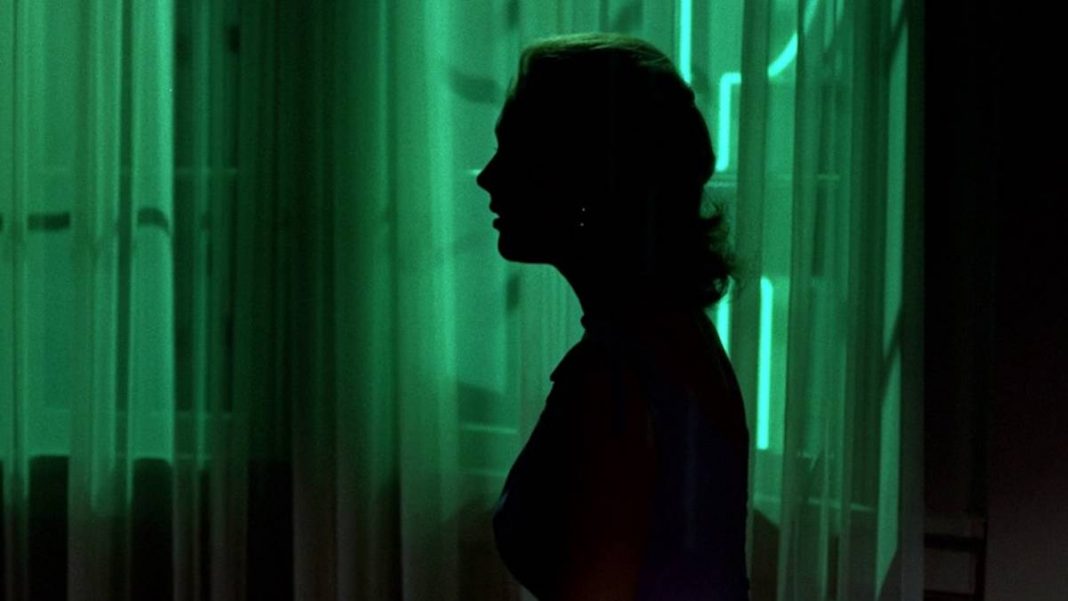
It doesn’t get much better than this. As spectacular as Alfred Hitchcock’s filmography is, Vertigo deserves an echelon of its own. One of the finest achievements in the history of the medium, the Master of Suspense’s 1958 perfect artistic object is the culmination of the director’s own obsessions and proclivities in a story about perverse intrigues. Starring Jimmy Stewart in his signature late-period performance and Kim Novak as the most hypnotizing Hitchcock blonde, watching Vertigo has the power of the sun, although you never want to look away.
Describing the plot details and story progression of Vertigo will make you feel hazy like John “Scottie” Ferguson (Stewart), an acrophobic private detective who gets wrapped up in a sinister scheme involving a shape-shifting femme fatale, Madeleine Ester/Judy (Novak). The film is often cryptic in its plot development, but the live-wire tension and provocation of the human soul are focused. Vertigo is both a heightened and sobering portrayal of what it’s like to operate under constant fear and disillusionment about the world. Most of all, the film sees a punitive Hitchcock reflecting on his own demanding ways of manipulating actors and imagining the world under his rigid guidelines. As a director known for fetishized depictions of women and obsessive control, Vertigo is a personal triumph and awe-inspiring vision that created its own film language and sensibility.

- Release Date
-
May 28, 1958
- Runtime
-
128 minutes
-

James Stewart
Det. John ‘Scottie’ Ferguson
-
Kim Novak
Madeleine Elster / Judy Barton